


Emergent collective behavior evolves more rapidly than individual behavior among acorn ant species
- PMID: 39576350
- PMCID: PMC11621464
- DOI: 10.1073/pnas.2420078121
Emergent collective behavior evolves more rapidly than individual behavior among acorn ant species
Abstract
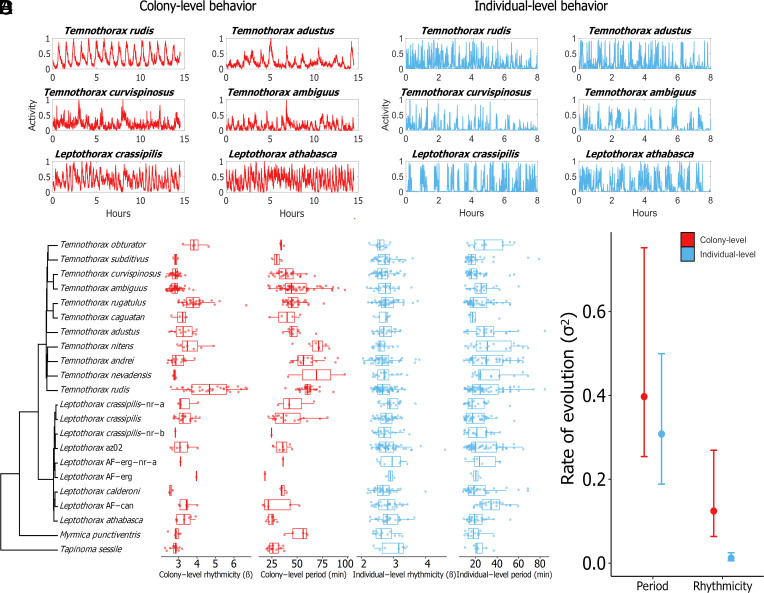
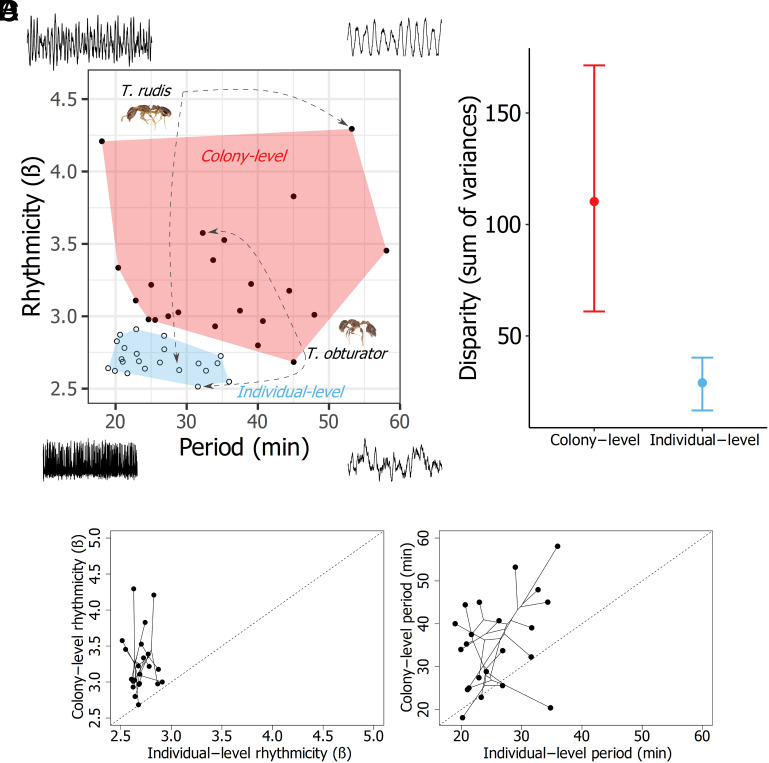
Emergence is a fundamental concept in biology and other disciplines, but whether emergent phenotypes evolve similarly to nonemergent phenotypes is unclear. The hypothesized process of emergent evolution posits that evolutionary change in at least some collective behaviors will differ from evolutionary change in the corresponding intrinsic behaviors of isolated individuals. As a result, collective behavior might evolve more rapidly and diversify more between populations compared to individual behavior. To test whether collective behavior evolves emergently, we conducted a large comparative study using 22 ant species and gathered over 1,500 behavioral rhythm time series from hundreds of colonies and isolated individuals, totaling over 1.5 y of behavioral data. We show that analogous traits measured at individual and collective levels exhibit distinct evolutionary patterns. The estimated rates of phenotypic evolution for the rhythmicity of activity in ant colonies were faster than the evolutionary rates of the same behavior measured in isolated individual ants, and total variation across species in collective behavior was higher than variation in individual behavior. We hypothesize that more rapid evolution and higher variation is a widespread feature of emergent phenotypes relative to lower-level phenotypes across complex biological systems.
Keywords: behavioral evolution; complex systems; synchronization; temnothorax; ultradian rhythms.
Conflict of interest statement
Competing interests statement:The authors declare no competing interest.
Figures
References
-
- Hanson F. E., Case J. F., Buck E., Buck J., Synchrony and Flash Entrainment in a New Guinea Firefly. Science 174, 161–164 (1971). - PubMed
-
- Ioannou C. C., Guttal V., Couzin I. D., Predatory fish select for coordinated collective motion in virtual prey. Science 337, 1212–1215 (2012). - PubMed
-
- Couzin I. D., Synchronization: The key to effective communication in animal collectives. Trends in Cogn. Sci. 22, 844–846 (2018). - PubMed
MeSH terms
Grants and funding
LinkOut - more resources
Full Text Sources
Research Materials
