Unmasking Suicidal Ideation for Asian American, Native Hawaiian, and Pacific Islander Youths Via Data Disaggregation
- PMID: 39576641
- PMCID: PMC11584931
- DOI: 10.1001/jamanetworkopen.2024.46832
Unmasking Suicidal Ideation for Asian American, Native Hawaiian, and Pacific Islander Youths Via Data Disaggregation
Abstract
Importance: Suicide is one of the leading causes of death for Asian American, Native Hawaiian, and Pacific Islander adolescents, but because these individuals are analyzed in aggregate, potentially important differences in suicide risk are obscured.
Objective: To disaggregate Asian and Native Hawaiian or Pacific Islander adolescents into racial and ethnic subgroups and compare risks of suicidal ideation between and within the subgroups.
Design, setting, and participants: This cross-sectional study used pooled data from 4-year public high school students (9th and 11th grade) participating in the 2017-2018 and 2018-2019 California Healthy Kids Survey. Data were analyzed between January 5, 2023, and March 31, 2024.
Exposures: Self-reported race and ethnicity, including American Indian or Alaska Native, Asian, Black, Hispanic or Latinx, Native Hawaiian or Pacific Islander, and White, and 9 Asian and Native Hawaiian or Pacific Islander subgroups, including Asian Indian, Chinese, Filipino, Japanese, Korean, Native Hawaiian or Pacific Islander, other Asian, Southeast Asian (ie, Cambodian, Hmong, Laotian), and Vietnamese.
Main outcome and measures: Past-year suicidal ideation was the primary outcome. Analyses compared an aggregated Asian and Native Hawaiian or Pacific Islander group with subgroups disaggregated by ethnicity and by monoethnic or monoracial, multiethnic, and multiracial identifications. Logistic regression models were used to test between- and within-group differences.
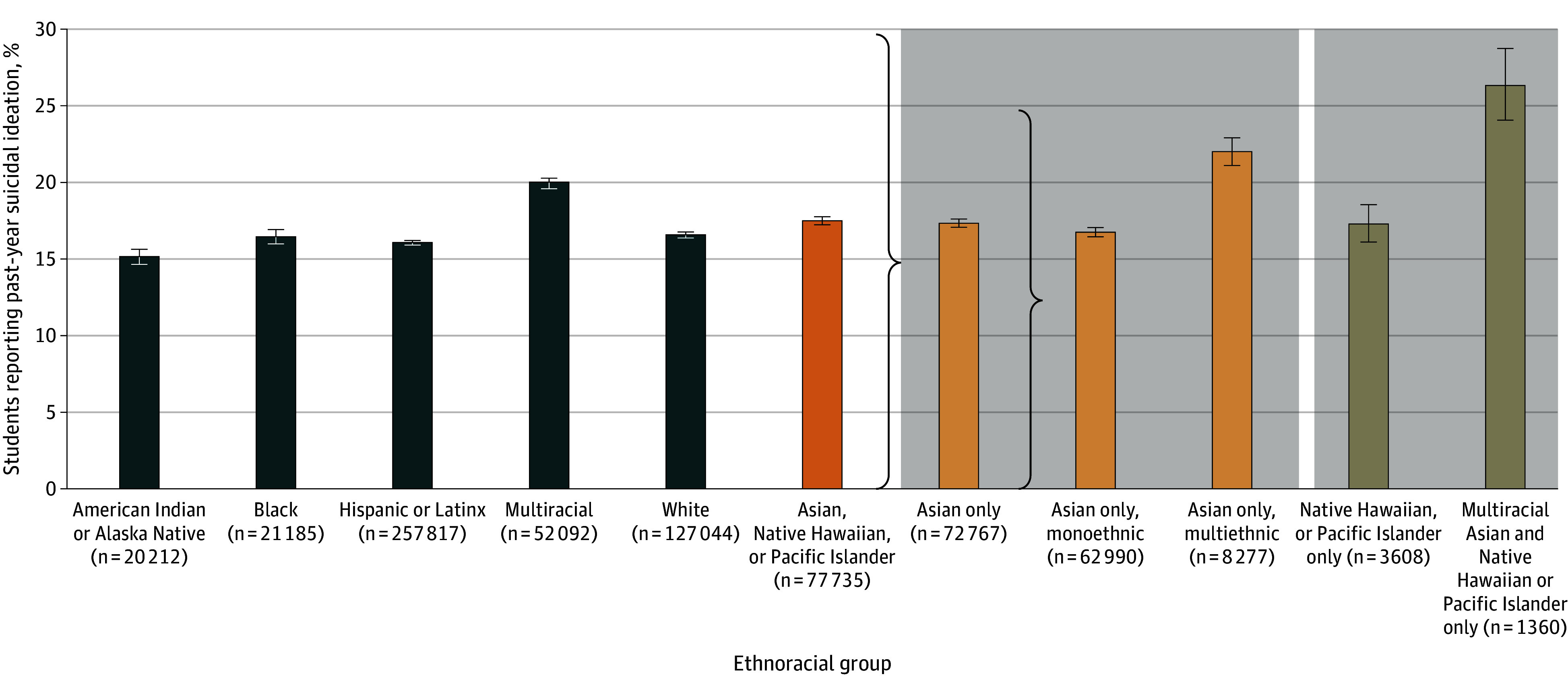
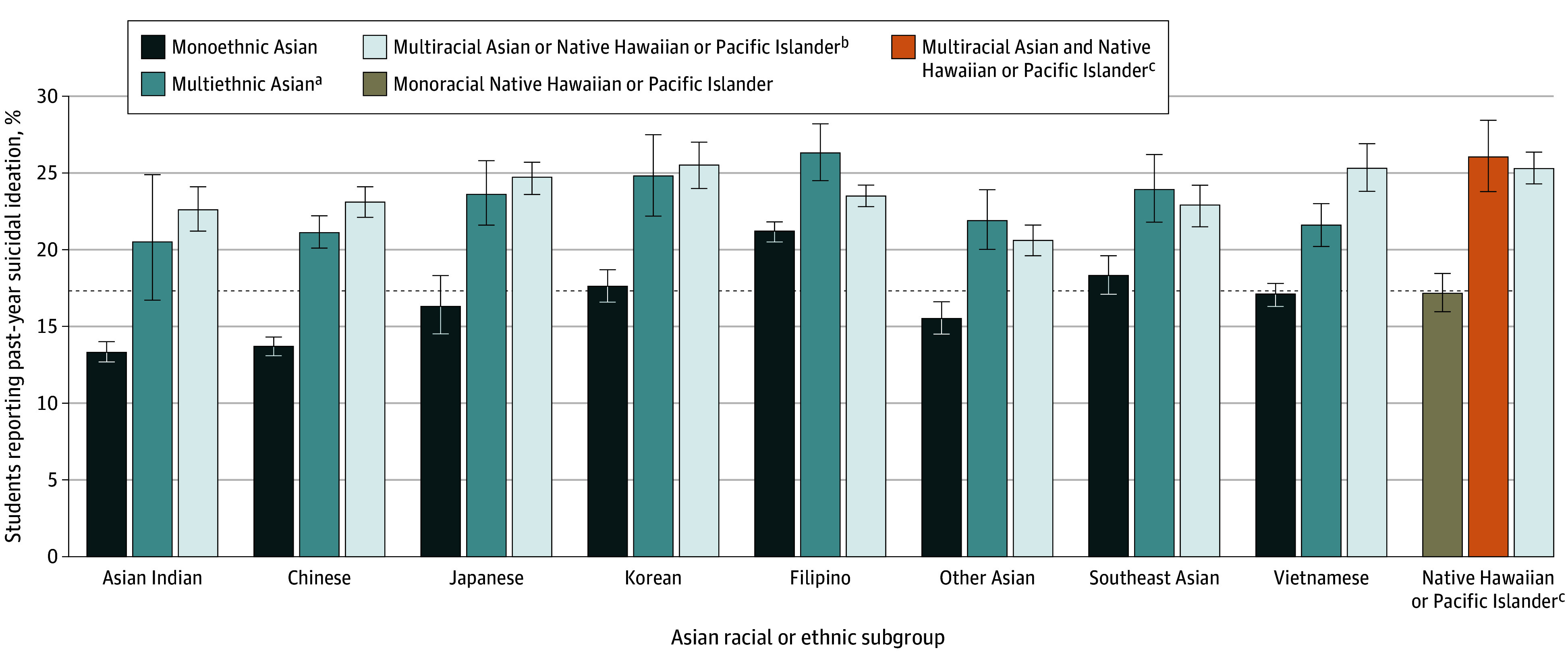
Results: Among 547 816 California adolescents in 9th or 11th grade surveyed (50.3% girls), 77 735 (14.2%) identified as Asian or Native Hawaiian or Pacific Islander. The prevalence of suicidal ideation was 17.5% (95% CI, 17.1%-17.9%) among adolescents in the combined Asian and Native Hawaiian or Pacific Islander group. After disaggregation into subgroups, prevalence of suicidal ideation ranged from 13.3% (95% CI, 12.3%-14.4%) for monoethnic Asian Indian adolescents to 21.2% (95% CI, 20.4%-21.9%) for monoethnic Filipino adolescents. Multiethnic and multiracial identity was associated with elevated risk of suicidal ideation for all groups, from 2.3 percentage points (from 21.2% [95% CI, 20.4%-21.9%] among monoethnic to 23.5% [95% CI, 22.8%-24.2%] among multiracial Filipino adolescents) to 9.4 percentage points (from 13.7%, [95% CI, 13.0%-14.4%] among monoethnic to 23.1% [95% CI, 22.1%-24.1%] among multiracial Chinese adolescents). Compared with a mutually exclusive approach, an additive model allowing for self-report of multiple identities had the best fit and showed a higher prevalence of suicidal ideation among multiethnic and multiracial Asian and Native Hawaiian or Pacific Islander adolescents compared with monoethnic Chinese adolescents.
Conclusions and relevance: The results from this cross-sectional study provide evidence for disaggregation of heterogeneous ethnoracialized groups as a data equity strategy that may illuminate hidden disparities in adolescent suicidal ideation risk. Further research is imperative to understand suicide risk among Asian, Native Hawaiian, and Pacific Islander adolescents who identify with multiple ethnic or racial groups.
Conflict of interest statement
Figures
Comment in
References
-
- Heron M. Deaths: leading causes for 2019. Natl Vital Stat Rep. 2021;70(9):1-114. - PubMed
-
- Chang RC, Penaia C, Thomas K. Count Native Hawaiian and Pacific Islanders in COVID-19 data—it’s an OMB mandate. Health Aff Forefront. Published online August 27, 2020. doi: 10.1377/forefront.20200825.671245 - DOI
-
- Office of Management and Budget . Revisions to the standards for the classification of federal data on race and ethnicity. Fed Regist. 1997;62(210):58782-58790.
Publication types
MeSH terms
Grants and funding
LinkOut - more resources
Full Text Sources
Medical
Miscellaneous