


Arteriovenous malformation associated with trophoblastic retention post-cesarean section: A case report and review
- PMID: 39579632
- PMCID: PMC11618002
- DOI: 10.1016/j.ijscr.2024.110620
Arteriovenous malformation associated with trophoblastic retention post-cesarean section: A case report and review
Abstract
Introduction and importance: Uterine arteriovenous malformations are a rare but potentially life-threatening condition. They may be congenital or acquired and should be suspected in cases of severe or persistent uterine hemorrhage.
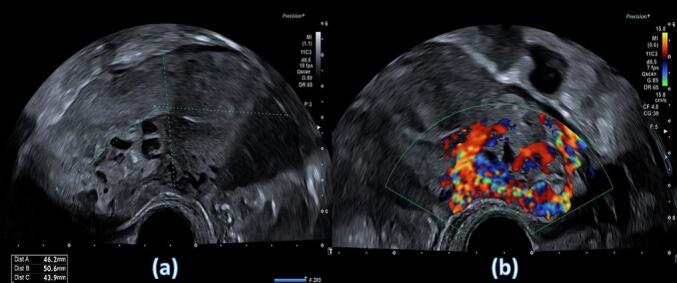
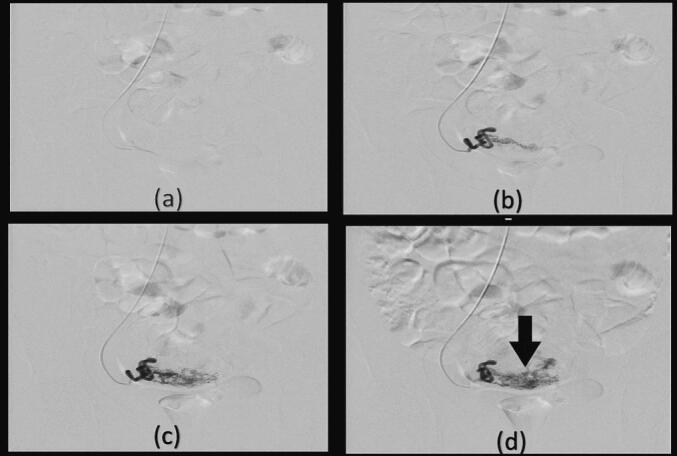
Case presentation: We present the clinical case of a 32-year-old woman who suffered from bleeding after a spontaneous miscarriage. Uterine arteriovenous malformation with trophoblastic retention was suspected on ultrasound and Doppler examination. Magnetic resonance imaging confirmed the diagnosis, leading to embolization of both uterine arteries, followed by operative hysteroscopy to remove the retained tissue, with a favorable outcome.
Clinical discussion: Uterine arteriovenous malformation is rare, with fewer than 100 cases reported in the literature (1). It is a potentially fatal condition due to the heavy bleeding that patients may experience. Color Doppler ultrasound (US) is a non-invasive method for initially diagnosing this rare condition, which can be confirmed by diagnostic angiography. A conservative approach or embolization is the preferred treatment to avoid hysterectomy in patients of childbearing age.
Conclusions: This case report emphasizes the use of ultrasound and MRI to diagnose a uterine AVM in a patient of childbearing age who presented with post-partum retention of products. It also showcases our experience with embolization in this patient, which allowed her to preserve her fertility.
Keywords: Arteriovenous malformation; Cesarean section; Doppler ultrasound; Embolization; Trophoblastic retention.
Copyright © 2024 The Authors. Published by Elsevier Ltd.. All rights reserved.
Conflict of interest statement
Declaration of competing interest The authors declare no conflict of interest.
Figures
References
-
- Hickey M., Fraser I.S. Clinical implications of disturbances of uterine vascular morphology and function. Best Pract. Res. Clin. Obstet. Gynaecol. 2000;14(6):937–951. - PubMed
-
- Sanguin S., Lanta-Delmas S., Le Blanche A., Grardel-Chambenoit E., Merviel P., Gondry J., et al. Diagnostic et traitement des malformations artério-veineuses utérines (MAVU) en 2011. Gynecol. Obstet. Fertil. 2011;39(12):722–727. - PubMed
-
- Timmerman D., Wauters J., Van Calenbergh S., Van Schoubroeck D., Maleux G., Van Den Bosch T., et al. Color Doppler imaging is a valuable tool for the diagnosis and management of uterine vascular malformations. Ultrasound Obstet. Gynecol. 2003;21(6):570–577. - PubMed
Publication types
LinkOut - more resources
Full Text Sources
