Review
. 2024 Nov 4;4(6):292-306.
doi: 10.1021/acsenvironau.4c00037. eCollection 2024 Nov 20.

Biogeochemistry of Actinides: Recent Progress and Perspective

Affiliations
Review

Biogeochemistry of Actinides: Recent Progress and Perspective

Gauthier J-P Deblonde. ACS Environ Au. .

Abstract

Actinides are elements that are often feared because of their radioactive nature and potentially devastating consequences to humans and the environment if not managed properly. As such, their chemical interactions with the biosphere and geochemical environment, i.e., their "biogeochemistry," must be studied and understood in detail. In this Review, a summary of the past discoveries and recent advances in the field of actinide biogeochemistry is provided with a particular emphasis on actinides other than thorium and uranium (i.e., actinium, neptunium, plutonium, americium, curium, berkelium, and californium) as they originate from anthropogenic activities and can be mobile in the environment. The nuclear properties of actinide isotopes found in the environment and used in research are reviewed with historical context. Then, the coordination chemistry properties of actinide ions are contrasted with those of common metal ions naturally present in the environment. The typical chelators that can impact the biogeochemistry of actinides are then reviewed. Then, the role of metalloproteins in the biogeochemistry of actinides is put into perspective since recent advances in the field may have ramifications in radiochemistry and for the long-term management of nuclear waste. Metalloproteins are ubiquitous ligands in nature but, as discussed in this Review, they have largely been overlooked for actinide chemistry, especially when compared to traditional environmental chelators. Without discounting the importance of abundant and natural actinide ions (i.e., Th4+ and UO2 2+), the main focus of this review is on trivalent actinides because of their prevalence in the fields of nuclear fuel cycles, radioactive waste management, heavy element research, and, more recently, nuclear medicine. Additionally, trivalent actinides share chemical similarities with the rare earth elements, and recent breakthroughs in the field of lanthanide-binding chelators may spill into the field of actinide biogeochemistry, as discussed hereafter.


Conflict of interest statement

The author declares no competing financial interest.

Figures
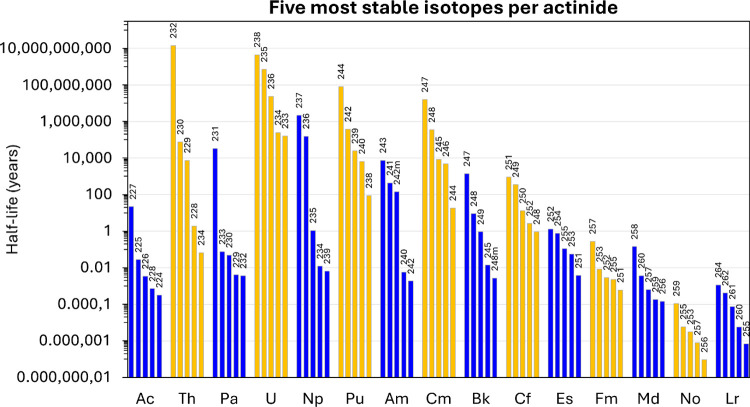
Figure 1
Figure 1
Half-lives of the five most stable isotopes that have been identified for each element of the actinide series (Ac to Lr). The mass number is indicated above each bar. Note that the y-axis is in years, is displayed as a logarithmic scale, and it spans 18 orders of magnitude.
Figure 2
Figure 2
Half-life of actinide isotopes that are generally preferred in research laboratories for chemistry, biochemistry, or physics experiments. Color code: isotopes with half-lives > 100 years are displayed in green, those with half-lives of 1 to 100 years are displayed in yellow, those with half-lives < 1 year are displayed in red. Note that the y-axis is displayed as a logarithmic scale and spans 18 orders of magnitude.
Figure 3
Figure 3
Comparison of the ionic radii of the trivalent ions of the lanthanide (triangles) and actinide (circles) series. Top: Ionic radius values for a coordination number of 6, as described in reference (33) for Pa to Cf and reference (34) for actinium. Bottom: Ionic radius values for a coordination number of 9, as described in reference (31).
Figure 4
Figure 4
Comparison of the ionic radius (a) and charge density (b) for select actinides, lanthanides, and biorelevant metals. For iron, the ionic radius shown is that of the 6-coordinated ion in order to take into account its preferred coordination mode. For the other elements, the ionic radius of the 8-coordinated ion was considered. The ionic radius values were taken from the review of Shannon, except for Am3+ and Cm3+.
Figure 5
Figure 5
Summary of the general partition of actinide ions between the proteins and other components of blood plasma. Percentages were taken from the review by Taylor.
Figure 6
Figure 6
Comparison of the general affinity of the proteins studied for actinide(III) complexation. Note that in the biochemistry field, the thermodynamic affinity is usually reported in terms of the dissociation constant, Kd. On the Kd scale, the lower the value, the stronger the complex. Also note that the x-axis is a logarithmic scale and spans 10 orders of magnitude. In this figure, the different protein systems are organized from the strongest (LanM) to the weakest (α-amylase) from top to bottom. Although the synthetic peptides “lanthanide binding tags” (LBTs) are not proteins, they have been included in this figure for comparison. See Table 3 for details about chemical conditions under which the Kd values have been determined. LanM = lanmodulin. Scn = siderocalin. Tf = transferrin. LBT = lanthanide binding tag.
Figure 7
Figure 7
Example of the potential impact of lanmodulin (LanM) on the speciation and sorption of trivalent actinides. (a) Fraction of the curium–lanmodulin complex (248Cm3LanM) formed as a function of the ratio carbonate/LanM at different pH values. The speciation of curium was determined via fluorescence spectroscopy as previously in ref (125). [LanM] = 1.0 μM. [Cm] = 2.0 μM. [CO3]total = ambient concentration up to 300 mM. The x-axis is shown with a logarithmic scale and gives the ratio between the total concentration of HCO3/CO32– and the concentration of LanM. Dotted lines are for eye guidance only. (b) Soluble fraction of americium (243Am3+) and neptunyl (239NpO2+) in the presence of calcite (CaCO3) and with or without LanM. Note the strong increase in the soluble fraction of Am3+ (from 3 to 79–93%) upon addition of LanM. pH = 8.5. See ref (125) for experimental details.

References

    1. Geibert W.; Charette M.; Kim G.; Moore W. S.; Street J.; Young M.; Paytan A. The release of dissolved actinium to the ocean: A global comparison of different end-members. Marine Chemistry 2008, 109, 409–420. 10.1016/j.marchem.2007.07.005. - DOI
    1. Taylor S. R. Abundance of chemical elements in the continental crust: a new table. Geochim. Cosmochim. Acta 1964, 28, 1273–1285. 10.1016/0016-7037(64)90129-2. - DOI
    1. Alibo D. S.; Nozaki Y. Rare earth elements in seawater: particle association, shale-normalization, and Ce oxidation. Geochim. Cosmochim. Acta 1999, 63, 363–372. 10.1016/S0016-7037(98)00279-8. - DOI
    1. The Chemistry of the Actinide and Transactinide Elements, 3rd ed.; Springer Nature, 2006. https://link.springer.com/book/10.1007/1-4020-3598-5 (accessed June 16, 2021).
    1. MacDonald M. R.; Fieser M. E.; Bates J. E.; Ziller J. W.; Furche F.; Evans W. J. Identification of the + 2 Oxidation State for Uranium in a Crystalline Molecular Complex, [K(2.2.2-Cryptand)][(C5H4SiMe3)3U]. J. Am. Chem. Soc. 2013, 135, 13310–13313. 10.1021/ja406791t. - DOI - PubMed

LinkOut - more resources