


Retention of blue-green cryptophyte organelles by Mesodinium rubrum and their effects on photophysiology and growth
- PMID: 39584600
- PMCID: PMC11822877
- DOI: 10.1111/jeu.13066
Retention of blue-green cryptophyte organelles by Mesodinium rubrum and their effects on photophysiology and growth
Abstract
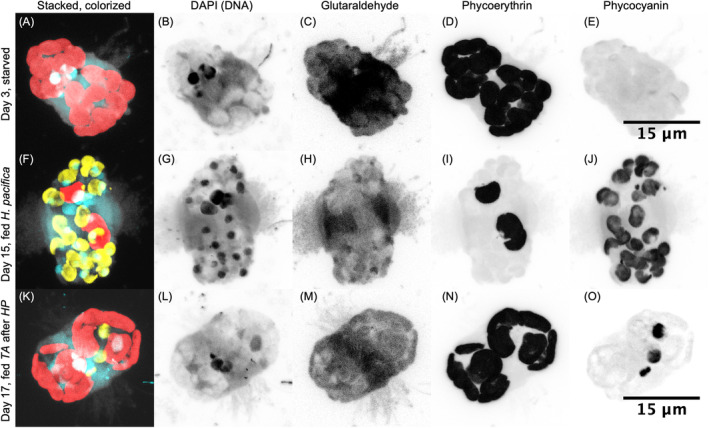
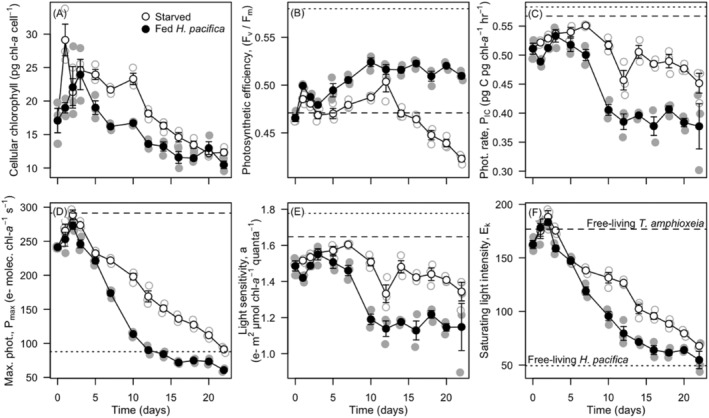
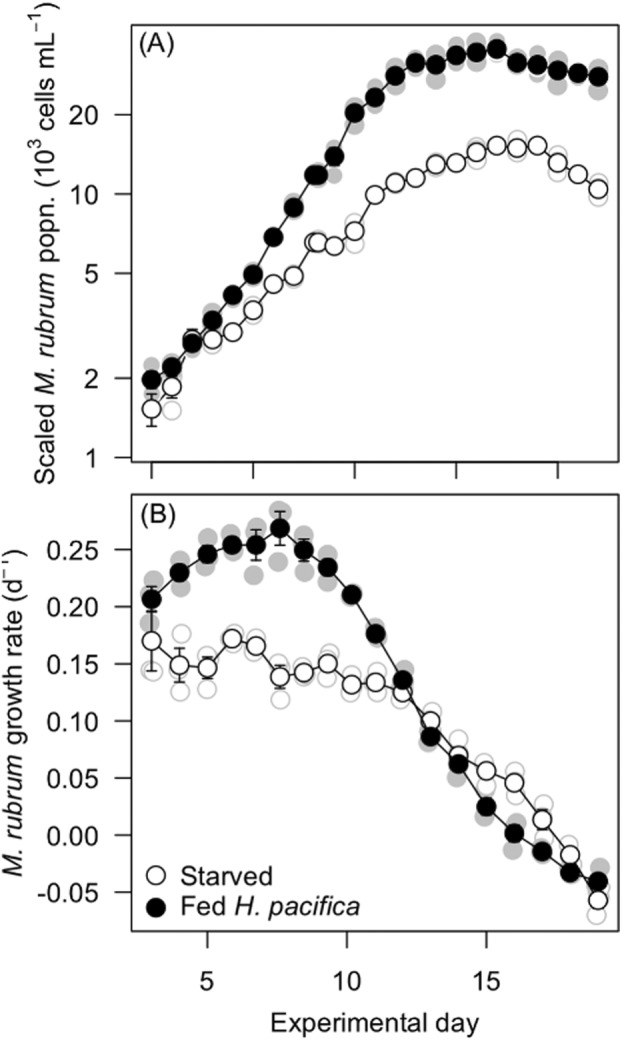
As chloroplast-stealing or "kleptoplastidic" lineages become more reliant on stolen machinery, they also tend to become more specialized on the prey from which they acquire this machinery. For example, the ciliate Mesodinium rubrum obtains > 95% of its carbon from photosynthesis, and specializes on plastids from the Teleaulax clade of cryptophytes. However, M. rubrum is sometimes observed in nature containing plastids from other cryptophyte species. Here, we report on substantial ingestion of the blue-green cryptophyte Hemiselmis pacifica by M. rubrum, leading to organelle retention and transient increases in M. rubrum's growth rate. However, microscopy data suggest that H. pacifica organelles do not experience the same rearrangement and integration as Teleaulax amphioxeia's. We measured M. rubrum's functional response, quantified the magnitude and duration of growth benefits, and estimated kleptoplastid photosynthetic rates. Our results suggest that a lack of discrimination between H. pacifica and the preferred prey T. amphioxeia (perhaps due to similarities in cryptophyte size and swimming behavior) may result in H. pacifica ingestion Thus, while blue-green cryptophytes may represent a negligible prey source in natural environments, they may help M. rubrum survive when Teleaulax are unavailable. Furthermore, these results represent a useful tool for manipulating M. rubrum's cell biology and photophysiology.
Keywords: Hemiselmis pacifica; acquired photosynthesis; ciliate; cryptophyte; functional response; kleptoplasty.
© 2024 The Author(s). Journal of Eukaryotic Microbiology published by Wiley Periodicals LLC on behalf of International Society of Protistologists.
Figures



References
-
- Campbell, L. , Olson, R.J. , Sosik, H.M. , Abraham, A. , Henrichs, D.W. , Hyatt, C.J. et al. (2010) First harmful Dinophysis (Dinophyceae, Dinophysiales) bloom in the U.S. is revealed by automated imaging flow cytometry. Journal of Phycology, 46, 66–75.
-
- Cartaxana, P. , Morelli, L. , Quintaneiro, C. , Calado, G. , Calado, R. & Cruz, S. (2018) Kleptoplast photoacclimation state modulates the photobehaviour of the solar‐powered sea slug Elysia viridis . The Journal of Experimental Biology, 221, jeb180463. - PubMed
-
- Gismervik, I. (2005) Numerical and functional responses of choreo‐and oligotrich planktonic ciliates. Aquatic Microbial Ecology, 40, 163–173.
-
- Gorbunov, M. & Falkowski, P.G. (2004) Fluorescence induction and relaxation (FIRe) technique and instrumentation for monitoring photosynthetic processes and primary production in aquatic ecosystems. In Photosynthesis: Fundamental aspects to global perspectives (pp. 1029–1031). Allen Press Montreal.
MeSH terms
Grants and funding
LinkOut - more resources
Full Text Sources
Research Materials
