Centralized Colorectal Cancer Screening Outreach in Federally Qualified Health Centers: A Randomized Clinical Trial
- PMID: 39585696
- PMCID: PMC11589799
- DOI: 10.1001/jamanetworkopen.2024.46693
Centralized Colorectal Cancer Screening Outreach in Federally Qualified Health Centers: A Randomized Clinical Trial
Abstract
Importance: Colorectal cancer (CRC) screening is effective but remains underused in federally qualified health centers (FQHCs).
Objective: To assess the effectiveness of a centralized CRC screening outreach intervention involving mailed fecal immunochemical testing (FIT) outreach and patient navigation to colonoscopy after abnormal results of FIT.
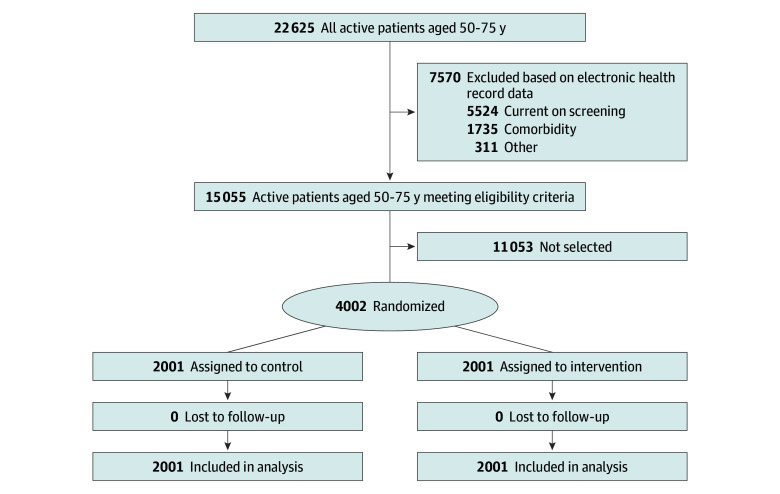
Design, setting, and participants: A pragmatic randomized clinical trial was conducted, using intention-to-treat analysis. Participants were enrolled from July 6, 2020, to September 17, 2021, and analyses were performed from July 6, 2023, to January 31, 2024. The study was conducted at independent FQHCs comprising 12 clinical delivery sites in North Carolina. The outreach intervention was centralized at an academic cancer center. Active individuals aged 50 to 75 years at average risk for CRC and not current with screening per US Preventive Services Task Force recommendations were included.
Intervention: In addition to usual care, intervention participants received mailed screening outreach materials including an introductory letter, FIT kit packet with instructions and return postage, and 2 reminder letters if needed. Intervention participants with positive results of mailed FIT were offered navigation to facilitate follow-up colonoscopy completion. Control participants received usual care alone.
Main outcomes and measures: The primary outcome was completion of a US Preventive Services Task Force-recommended CRC screening test within 6 months determined by electronic health record review. Secondary outcomes were colonoscopy completion within 6 months after positive FIT results and detection of advanced colorectal neoplasia, defined as advanced adenoma or CRC.
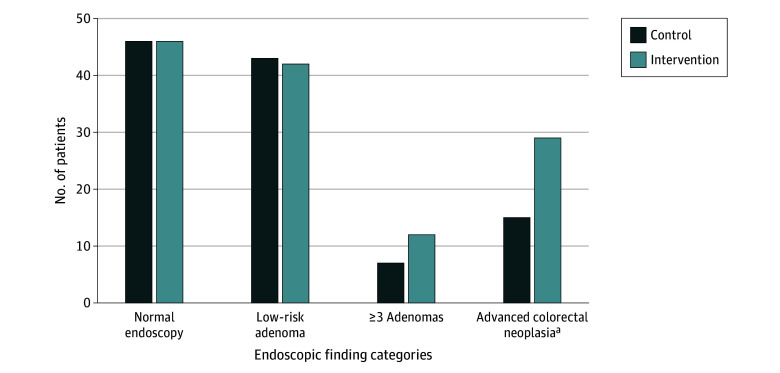
Results: A total of 4002 participants were included (mean [SD] age, 59.6 [6.8] years; 2256 [56.4%] female; 364 (9.1%) Hispanic; 1082 [27.0%] non-Hispanic Black; 2288 [57.2%] non-Hispanic White; 1198 [29.9%] commercially insured; 617 [15.4%] Medicaid; 1227 [30.7%] Medicare; and 960 [24.0%] uninsured), with 2001 randomized to each group. Compared with controls, intervention participants were more likely to complete screening within 6 months of randomization (30.0% vs 9.7%; difference, 20.29 percentage points; 95% CI, 17.85-22.73 percentage points). The intervention was effective in all insurance types. In the intervention arm, 33 of 48 participants with positive FIT results (68.8%) completed follow-up colonoscopy within 6 months compared with 8 of 18 participants (44.4%) in the control arm (difference, 24.3 percentage points; 95% CI, -2.13 to 50.74 percentage points). Advanced colorectal neoplasia was detected in 29 intervention participants (1.4%) and 15 control participants (0.7%) (difference, 0.68 percentage points; 95% CI, 0.05-1.35 percentage points).
Conclusions and relevance: In this randomized clinical trial of centralized screening outreach intervention in diverse patients served by independent FQHCs, CRC screening completion and advanced colorectal neoplasia detection were substantially increased. Future studies should examine the cost and scalability of this intervention in this context.
Trial registration: ClinicalTrials.gov Identifier: NCT04406714.
Conflict of interest statement
Figures
Comment in
References
Publication types
MeSH terms
Associated data
Grants and funding
LinkOut - more resources
Full Text Sources
Medical