


The association between novel urinary kidney damage biomarkers and coronary atherosclerosis in an apparently healthy population
- PMID: 39587192
- PMCID: PMC11589585
- DOI: 10.1038/s41598-024-80321-5
The association between novel urinary kidney damage biomarkers and coronary atherosclerosis in an apparently healthy population
Abstract
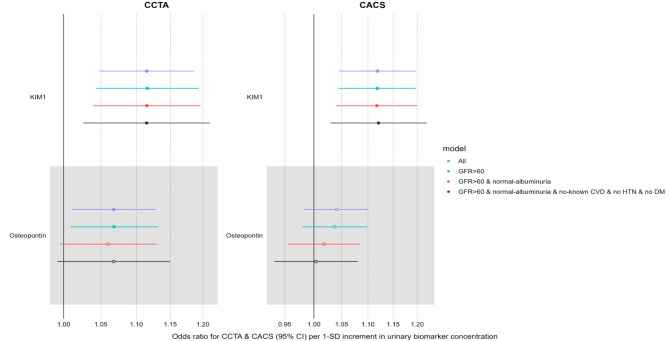
Several novel urinary kidney damage biomarkers predict the progression of kidney disease. However, the relations of these biomarkers to atherosclerosis, a major consequence of kidney disease, are less studied. Urinary levels of several biomarkers, including kidney injury molecule-1 (KIM-1), osteopontin, epidermal growth factor, and Dickkopf-3, were assessed in participants enrolled in the Swedish CArdioPulmonary BioImage Study. The study included 9,628 individuals with a mean age of 57.5 years, of which 52.4% were women. The presence of coronary artery stenosis and the coronary artery calcium score (CACS) were determined using coronary computed tomography angiography. To analyze the associations between coronary atherosclerosis and urinary biomarker levels, an ordered logistic regression model adusting for confounding factors was employed. KIM-1 was the only biomarker associated with both coronary stenosis and CACS after adjusting for established cardiovascular risk factors (odds ratio [95% confidence intervals], 1.23[1.05-1.44] and 1.25[1.07-1.47]). These results were consistent in sensitivity analyses of individuals without hypertension, diabetes, or known cardiovascular disease and with normal kidney function. Urinary KIM-1, a specific marker of proximal tubular damage, was robustly linked to coronary atherosclerosis even in apparently healthy individuals, which suggests that the detrimental interplay between the kidney and cardiovascular system begins before clinically overt kidney disease. Additional studies are warranted to evaluate the urinary KIM-1 to predict kidney and cardiovascular disease.
Keywords: Coronary atherosclerosis; Dickkopf-3; Epidermal growth factor; Kidney injury molecule-1; Osteopontin.
© 2024. The Author(s).
Conflict of interest statement
Declarations. Competing interests: J.Ä. has received lecture fees from Novartis and AstraZeneca, and served on advisory boards for Astella, AstraZeneca and Boehringer Ingelheim, all unrelated to the present paper. All other authors report no conflicts of interest in connection with this study.
Figures
References
-
- Webster, A. C., Nagler, E. V., Morton, R. L. & Masson, P. Chronic kidney disease. Lancet389, 1238–1252. 10.1016/S0140-6736(16)32064-5 (2017). - PubMed
MeSH terms
Substances
LinkOut - more resources
Full Text Sources
Medical
Research Materials
