


Erythrocyte indices and response to hypoxia-inducible factor prolyl hydroxylase inhibitors in chronic kidney disease patients with renal anemia: a retrospective study
- PMID: 39587465
- PMCID: PMC11590316
- DOI: 10.1186/s12882-024-03877-4
Erythrocyte indices and response to hypoxia-inducible factor prolyl hydroxylase inhibitors in chronic kidney disease patients with renal anemia: a retrospective study
Abstract
Background: Although erythropoiesis-stimulating agents (ESAs) have been the standard treatment for renal anemia, ESA hyporesponsiveness remains a concern. Hypoxia-inducible factor prolyl hydroxylase inhibitors (HIF-PHIs) are a new class of agents indicated for renal anemia. Several lines of evidence indicate that HIF-PHIs affect erythrocyte indices; nonetheless, their clinical significance remains unclear.
Methods: We retrospectively analyzed data from 233 non-dialysis-dependent chronic kidney disease patients who initiated either ESA (darbepoetin) or HIF-PHI for the treatment of anemia. We analyzed the changes in hemoglobin levels three months after the initiation of anti-anemic treatments, examining their association with changes in erythrocyte indices.
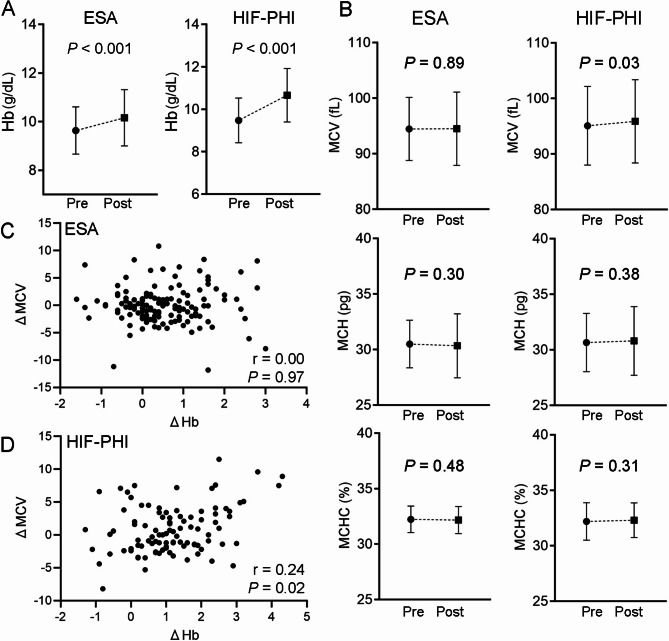
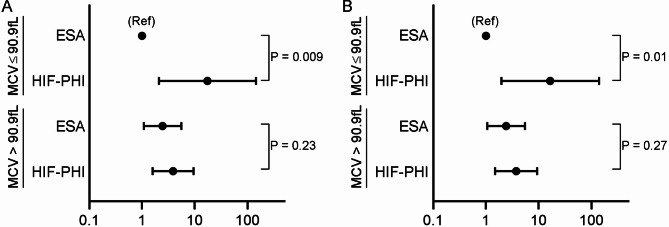
Results: Both ESA and HIF-PHIs significantly increased hemoglobin levels after three months of treatment. In the HIF-PHI group, the increase in hemoglobin levels was positively correlated with the increase in mean corpuscular volume (MCV) levels, a finding that was not observed in the ESA group. In a subgroup analysis based on the mean reference range value for MCV (90.9 fL), a significant difference in the proportion of patients with improved anemia was observed between ESA and HIF-PHIs in patients with lower MCV values. Logistic regression and interaction analyses confirmed that there was a significant interaction between baseline MCV values and the effectiveness of anti-anemic drugs, independently of other covariates.
Conclusions: An increase in hemoglobin levels is associated with an increase in MCV in patients treated with HIF-PHIs. The anti-anemic effects of ESA and HIF-PHIs may be influenced by baseline MCV values. However, long-term consequences need further evaluation.
Keywords: Anemia; CKD; ESA; Erythropoiesis; HIF-PHI.
© 2024. The Author(s).
Conflict of interest statement
Declarations. Ethics approval and consent to participate: This study was approved by the Ethics Committee of Teikyo University School of Medicine with a waiver of the requirement for obtaining written informed consent due to its retrospective nature (No. 22-059-2). The study was conducted in accordance with the principles of the Declaration of Helsinki. Consent for publication: Not applicable. Competing interests: S.S. received personal fees and/or research funding from Bayer, Kyowa-Kirin, and Torii.
Figures
References
-
- McFarlane SI, Chen SC, Whaley-Connell AT, Sowers JR, Vassalotti JA, Salifu MO, Li S, Wang C, Bakris G, McCullough PA, et al. Prevalence and associations of anemia of CKD: kidney early evaluation program (KEEP) and National Health and Nutrition Examination Survey (NHANES) 1999–2004. Am J Kidney Dis. 2008;51(4 Suppl 2):S46–55. - PubMed
-
- Sofue T, Nakagawa N, Kanda E, Nagasu H, Matsushita K, Nangaku M, Maruyama S, Wada T, Terada Y, Yamagata K, et al. Prevalence of anemia in patients with chronic kidney disease in Japan: a nationwide, cross-sectional cohort study using data from the Japan chronic kidney Disease Database (J-CKD-DB). PLoS ONE. 2020;15(7):e0236132. - PMC - PubMed
-
- Guedes M, Guetter CR, Erbano LHO, Palone AG, Zee J, Robinson BM, Pisoni R, de Moraes TP, Pecoits-Filho R, Baena CP. Physical health-related quality of life at higher achieved hemoglobin levels among chronic kidney disease patients: a systematic review and meta-analysis. BMC Nephrol. 2020;21(1):259. - PMC - PubMed
MeSH terms
Substances
LinkOut - more resources
Full Text Sources
Medical
