. 2024 Nov 25;18(1):152.
doi: 10.1186/s13034-024-00842-9.

Network analysis of influential risk factors in adolescent suicide attempters

Affiliations

Network analysis of influential risk factors in adolescent suicide attempters

Jennifer Fernandez-Fernandez et al. Child Adolesc Psychiatry Ment Health. .

Abstract

Objective: This study aims to investigate the interrelationship of risk factors for suicidal behaviour and their influence on attempt severity in a sample of adolescents who have recently attempted suicide. For it a network analyse was performed.

Method: Data from a sample of adolescents from 12 to 17 years of age with documented suicide attempts were collected and analysed in the context of a larger study conducted in Spain called SURVIVE. Several factors were examined including age, sex, depression, trauma, impulsivity, and substance abuse. Graph analysis was performed to identify relationships and centrality measures among these factors.

Results: A total of 267 participants were enrolled: 233 females and 34 males with a mean age of 15.00 years (SD = 1.52). The results indicate that age and sex do not have a notable relationship with attempt severity in adolescents. Emotional and behavioural difficulties, measured by the Strengths and Difficulties Questionnaire (SDQ), have the greatest influence on other variables. Depression and childhood trauma show varying degrees of association with suicidal behaviour, as does motor impulsivity. Substance use does not appear to be strongly related to suicide attempt severity. The number of suicide attempts is strongly correlated with emotional and behavioural difficulties, depression, and childhood trauma. Lethality of suicide attempts and intensity of suicidal ideation do not show significant associations with the other variables.

Conclusion: This study identifies significant risk factors for adolescent suicide. Emotional and behavioural symptoms, depression, and childhood trauma are strongly linked to suicidal behaviour. However, age, sex, and substance abuse show minimal correlation. Assessing emotional difficulties and depressive symptoms using specific questionnaires could be crucial in evaluating suicidal behaviour in adolescents.

Keywords: Adolescent; Depression; Network analysis; Risk factors; Suicide; Trauma.


Conflict of interest statement

Declarations. Conflict of interest: Pilar A. Saiz has been a consultant to and/or has received honoraria or grants from Adamed, Alter Medica, Angelini Pharma, CIBERSAM, Ethypharm Digital Therapy, European Commission, Government of the Principality of Asturias, Instituto de Salud Carlos III, Johnson & Johnson, Lundbeck, Otsuka, Pfizer, Plan Nacional Sobre Drogas, Rovi, Servier and Viatris España. Luis Jiménez Treviño has been a consultant to and/or has received honoraria or grants from Adamed, Alter Medica, Angelini Pharma, Cassen-Recordati, CIBERSAM, Eli Lilly, European Commission, Government of the Principality of Asturias, Instituto de Salud Carlos III, Johnson & Johnson, Lundbeck, Otsuka, Pfizer, and Servier outside the submitted work. Jennifer Fernandez-Fernandez has been a consultant to and/or has received honoraria or grants from Otsuka. Iria Grande has received grants and served as a consultant, advisor, or CME speaker for the following identities: Adamed, Angelini, Casen Recordati, Esteve, Ferrer, Gedeon Richter, Janssen-Cilag, Lundbeck, Lundbeck-Otsuka, Luye, SEI Healthcare, and Viatris outside the submitted work. She also receives royalties from Oxford University Press, Elsevier, and Editorial Médica Panamericana. Ethical approval: The current proposal complies with the national (code of ethics of the national board of medicine) and international (Declaration of Helsinki, Fortaleza, Brasil, Octubre 2013) guidelines, and with the national regulations: Ley 14/2007, 3rd of July of Investigación Biomédica, and Ley Orgánica 3/2018, 5th of December, regarding Protección de Datos Personales y Garantía de Derechos Digitales. Data protection will be assured following EU regulations (General Data Protection Regulation 2016/679 and the Council of 27 April 2016). Individuals who attempted suicide will be screed by a psychiatrist at the emergency ward. After discharge, the participant will be asked verbally, whether he/she consents to be called by a study team member to inform he/she about the study. If the patient consents, a study team member will contact the patient within the first 24 h to explain the study aims, and to arrange an appointment. Participants who agreed will be given the Patient Information Sheet and Informed Consent. Participation will be voluntarily, and participants will be allowed to abandon the study at any time. The same procedure will be conducted to recruit the youth sample. The adolescent’s consent will also be obtained through the provision of age-appropriate information. Adolescents will be included in the study only if consent from both (the adolescent and his/her legal representative) is obtained. The project was evaluated at the Ethical Committees of each one of the participating sites.

Figures
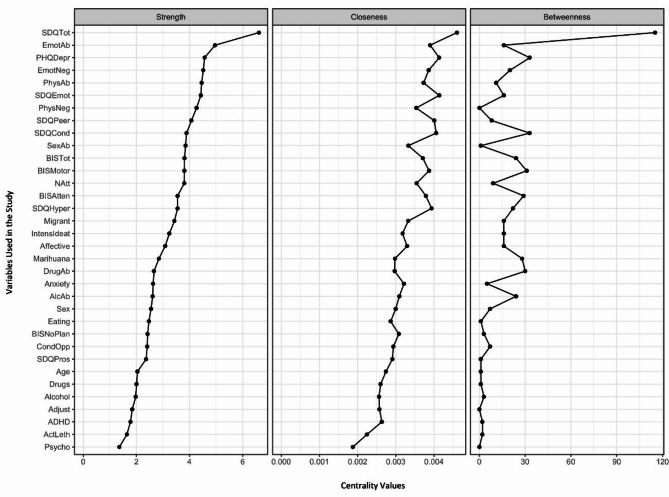
Fig. 1
Fig. 1
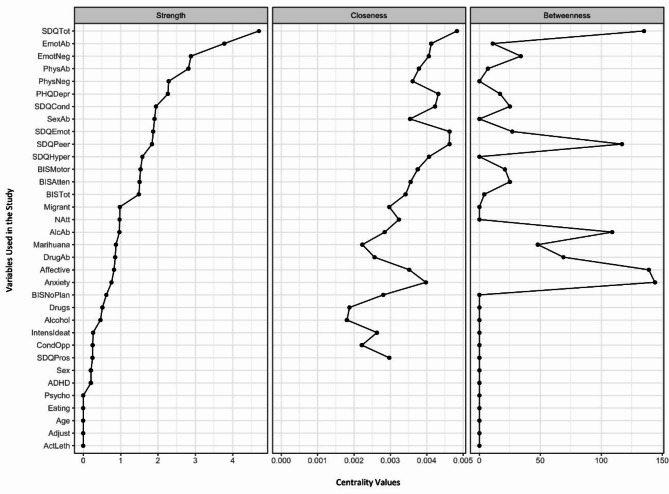
Strength, closeness, and betweenness centrality measures for all the variables, considering all the correlations. Note: Values of the Strength, Closeness, and Betweenness centrality measures for all the variables used in our study. Variables are ordered in a descending order based on their Strength value. The following variable abbreviations are used: BIS Barratt Impulsiveness Scale, BISAtten Attentional sub-score, BISMotor Motor sub-score, BISNoPlan Non-planning sub-score, BISTot Total score, CTA Characteristics of the Attempt, Alcohol consumption of alcohol prior to suicide attempt, Marihuana consumption of cannabis prior to suicide attempt, Drugs consumption of other drugs prior to suicide attempt, CTQ Childhood Trauma Questionnaire, EmoAb Emotional Abuse, EmoNeg Emotional Neglect, PhysNeg Physical Neglect, SexAb Sexual Abuse, PhyAb Physical Abuse, SDQ Strengths and Difficulties Questionnaire, SDQEmot Emotional symptoms, SDQCond Conduct problems, SDQHyper Hyperactivity/inattention, SDQPeer Peer problems, SDQPros Prosocial behaviour, SDQTot Total score, MINI-KID Mini International Neuropsychiatric Interview for Children and Adolescents, Affective Affective disorders, Anxiety Anxiety disorders, ADHD Attention deficit/hyperactivity disorder, AlcAb Alcohol-related disorder, DrugAb Drug-related disorder, CondOpp Conduct disorder and Oppositional defiant disorder, Psycho Psychotic disorder, Eating Anorexia and bulimia nervosa, Adjust Adjustment disorder, PHQDep Patient Health Questionnaire, Natt total number of suicide attempts, IntensIdeat intensity of suicidal thoughts, ActLeth Lethality of actual attempt, Migrant not born in Spain
Fig. 2
Fig. 2
Strength, closeness, and betweenness centrality measures for all the variables, considering all the correlations with an absolute value of 0.2 or greater. Note: Values of the Strength, Closeness, and Betweenness centrality measures for all the variables used in our study, considering only those with a minimum correlation with absolute values greater than or equal to 0.2. Variables are ordered in a descending order based on their Strength value. The following variable abbreviations are used: BIS Barratt Impulsiveness Scale, BISAtten Attentional sub-score, BISMotor Motor sub-score, BISNoPlan Non-planning sub-score, BISTot Total score, CTA Characteristics of the Attempt, Alcohol consumption of alcohol prior to suicide attempt, Marihuana consumption of cannabis prior to suicide attempt, Drugs consumption of other drugs prior to suicide attempt, CTQ Childhood Trauma Questionnaire, EmoAb Emotional Abuse, EmoNeg Emotional Neglect, PhysNeg Physical Neglect, SexAb Sexual Abuse, PhyAb Physical Abuse, SDQ Strengths and Difficulties Questionnaire, SDQEmot Emotional symptoms, SDQCond Conduct problems, SDQHyper Hyperactivity/inattention, SDQPeer Peer problems, SDQPros Prosocial behaviour, SDQTot Total score, MINI-KID Mini International Neuropsychiatric Interview for Children and Adolescents, Affective Affective disorders, Anxiety Anxiety disorders, ADHD Attention deficit/hyperactivity disorder, AlcAb Alcohol-related disorder, DrugAb Drug-related disorder, CondOpp Conduct disorder and Oppositional defiant disorder, Psycho Psychotic disorder, Eating Anorexia and bulimia nervosa, Adjust Adjustment disorder, PHQDep Patient Health Questionnaire, Natt total number of suicide attempts, IntensIdeat intensity of suicidal ideas, ActLeth Lethality of actual attempt, Migrant: not born in Spain
Fig. 3
Fig. 3
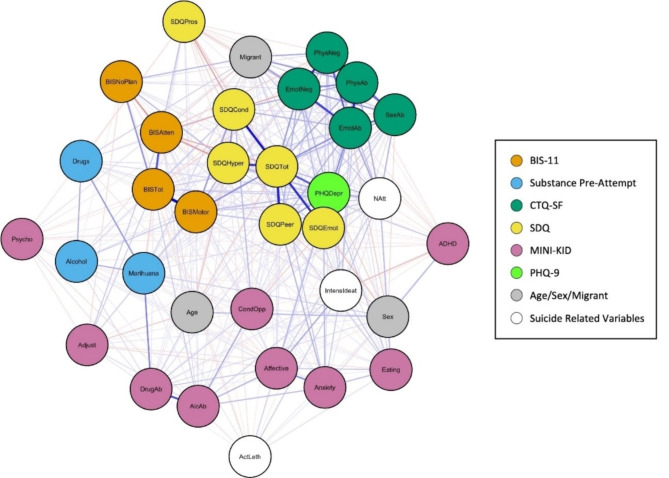
Fruchterman-Reingold graph representation of the spearman correlations. Note: Fruchterman-Reingold graph representation of the Spearman correlations between variables. Node colours represent the type of variable, edge width indicates the correlation value, blue edges represent positive correlations and orange edges showing negative correlations. The following variable abbreviations are used: BIS Barratt Impulsiveness Scale, BISAtten Attentional sub-score, BISMotor Motor sub-score, BISNoPlan Non-planning sub-score, BISTot Total score, Alcohol consumption of alcohol prior to suicide attempt, Marihuana consumption of cannabis prior to suicide attempt, Drugs consumption of other drugs prior to suicide attempt, CTQ Childhood Trauma Questionnaire, EmoAb Emotional Abuse, EmoNeg Emotional Neglect, PhysNeg Physical Neglect, SexAb Sexual Abuse, PhyAb Physical Abuse, SDQ Strengths and Difficulties Questionnaire, SDQEmot Emotional symptoms, SDQCond Conduct problems, SDQHyper Hyperactivity/inattention, SDQPeer Peer problems, SDQPros Prosocial behaviour, SDQTot Total score, MINI-KID Mini International Neuropsychiatric Interview for Children and Adolescents, Affective Affective disorders, Anxiety Anxiety disorders, ADHD Attention deficit/hyperactivity disorder, AlcAb Alcohol-related disorder, DrugAb Drug-related disorder, CondOpp Conduct disorder and Oppositional defiant disorder, Psycho Psychotic disorder, Eating Anorexia and bulimia nervosa, Adjust Adjustment disorder, PHQDep Patient Health Questionnaire, Natt total number of suicide attempts, IntensIdeat intensity of suicidal thoughts, ActLeth Lethality of actual attempt, Migrant: not born in Spain
Fig. 4
Fig. 4
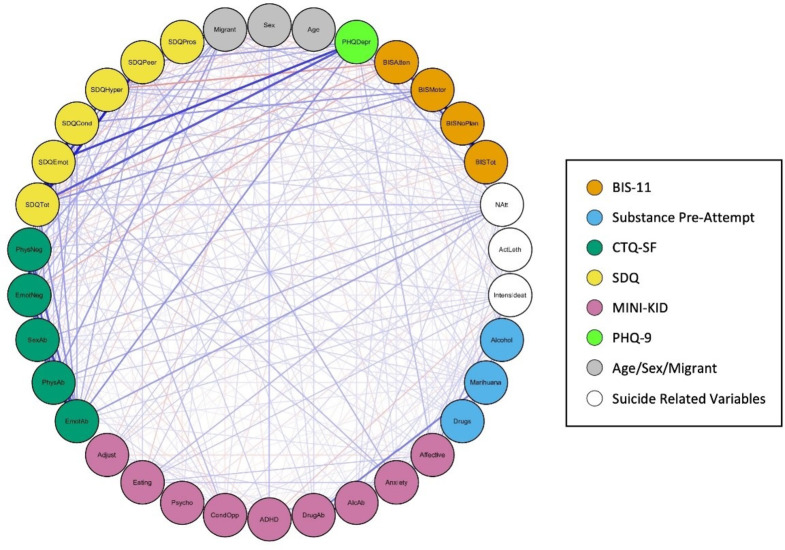
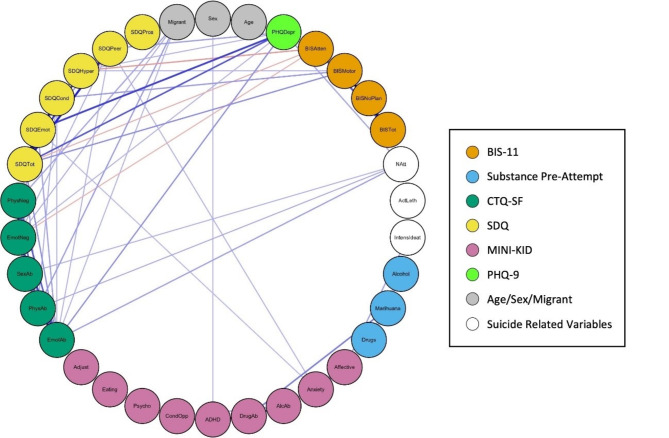
Graph (network) representation of the spearman correlations, placing all the nodes in a circle. Note: Graph (network) representation placing all the nodes in a circle. Node colours represent the type of variable, edge width indicates the correlation value, blue edges represent positive correlations and orange edges showing negative correlations. The following variable abbreviations are used: BIS Barratt Impulsiveness Scale, BISAtten Attentional sub-score, BISMotor Motor sub-score, BISNoPlan Non-planning sub-score, BISTot Total score, CTA Characteristics of the Attempt, Alcohol consumption of alcohol prior to suicide attempt, Marihuana consumption of cannabis prior to suicide attempt, Drugs consumption of other drugs prior to suicide attempt, CTQ Childhood Trauma Questionnaire, EmoAb Emotional Abuse, EmoNeg Emotional Neglect, PhysNeg Physical Neglect, SexAb Sexual Abuse, PhyAb Physical Abuse, SDQ Strengths and Difficulties Questionnaire, SDQEmot Emotional symptoms, SDQCond Conduct problems, SDQHyper Hyperactivity/inattention, SDQPeer Peer problems, SDQPros Prosocial behaviour, SDQTot Total score, MINI-KID Mini International Neuropsychiatric Interview for Children and Adolescents, Affective Affective disorders, Anxiety Anxiety disorders, ADHD Attention deficit/hyperactivity disorder, AlcAb Alcohol-related disorder, DrugAb Drug-related disorder, CondOpp Conduct disorder and Oppositional defiant disorder, Psycho Psychotic disorder, Eating Anorexia and bulimia nervosa, Adjust Adjustment disorder, PHQDep Patient Health Questionnaire, Natt total number of suicide attempts, IntensIdeat intensity of suicidal thoughts, ActLeth Lethality of actual attempt, Migrant: not born in Spain
Fig. 5
Fig. 5
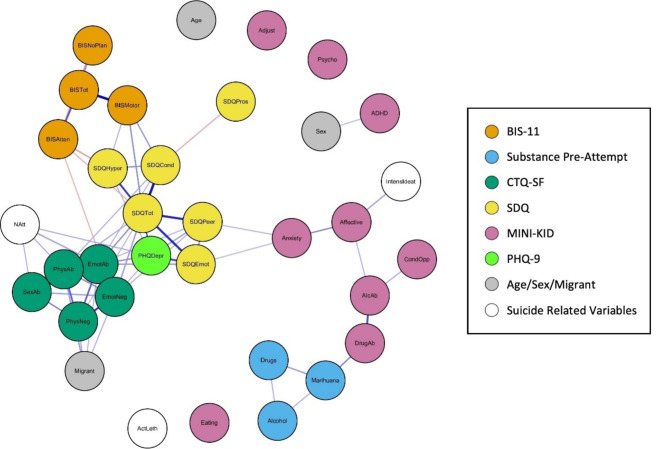
Fruchterman-Reingold graph representation of the spearman correlations with an absolute value of 0.2 or greater. Note. Fruchterman-Reingold graph representation of the Spearman correlations between variables, considering only those with absolute values greater than or equal to 0.2. Node colours represent the type of variable, edge width indicates the correlation value, blue edges represent positive correlations and orange edges showing negative correlations. The following variable abbreviations are used: BIS Barratt Impulsiveness Scale, BISAtten Attentional sub-score, BISMotor Motor sub-score, BISNoPlan Non-planning sub-score, BISTot Total score, CTA Characteristics of the Attempt, Alcohol consumption of alcohol prior to suicide attempt, Marihuana consumption of cannabis prior to suicide attempt, Drugs consumption of other drugs prior to suicide attempt, CTQ Childhood Trauma Questionnaire, EmoAb Emotional Abuse, EmoNeg Emotional Neglect, PhysNeg Physical Neglect, SexAb Sexual Abuse, PhyAb Physical Abuse, SDQ Strengths and Difficulties Questionnaire, SDQEmot Emotional symptoms, SDQCond Conduct problems, SDQHyper Hyperactivity/inattention, SDQPeer Peer problems, SDQPros Prosocial behaviour, SDQTot Total score, MINI-KID Mini International Neuropsychiatric Interview for Children and Adolescents, Affective Affective disorders, Anxiety Anxiety disorders, ADHD Attention deficit/hyperactivity disorder, AlcAb Alcohol-related disorder, DrugAb Drug-related disorder, CondOpp Conduct disorder and Oppositional defiant disorder, Psycho Psychotic disorder, Eating Anorexia and bulimia nervosa, Adjust Adjustment disorder, PHQDep Patient Health Questionnaire, Natt total number of suicide attempts, IntensIdeat intensity of suicidal thoughts, ActLeth Lethality of actual attempt, Migrant: not born in Spain
Fig. 6
Fig. 6
Graph (network) representation of the spearman correlations with an absolute value of 0.2 or greater, placing all the nodes in a circle. Note: Graph (network) representation placing all the nodes in a circle, considering only correlations with absolute values greater than or equal to 0.2. Node colours represent the type of variable, edge width indicates the correlation value, blue edges represent positive correlations and orange edges showing negative correlations. The following variable abbreviations are used: BIS Barratt Impulsiveness Scale, BISAtten Attentional sub-score, BISMotor Motor sub-score, BISNoPlan Non-planning sub-score, BISTot Total score, Alcohol consumption of alcohol prior to suicide attempt, Marihuana consumption of cannabis prior to suicide attempt, Drugs consumption of other drugs prior to suicide attempt, CTQ Childhood Trauma Questionnaire, EmoAb Emotional Abuse, EmoNeg Emotional Neglect, PhysNeg Physical Neglect, SexAb Sexual Abuse, PhyAb Physical Abuse, SDQ Strengths and Difficulties Questionnaire, SDQEmot Emotional symptoms, SDQCond Conduct problems, SDQHyper Hyperactivity/inattention, SDQPeer Peer problems, SDQPros Prosocial behaviour, SDQTot Total score, MINI-KID Mini International Neuropsychiatric Interview for Children and Adolescents, Affective Affective disorders, Anxiety Anxiety disorders, ADHD Attention deficit/hyperactivity disorder, AlcAb Alcohol-related disorder, DrugAb Drug-related disorder, CondOpp Conduct disorder and Oppositional defiant disorder, Psycho Psychotic disorder, Eating Anorexia and bulimia nervosa, Adjust Adjustment disorder, PHQDep Patient Health Questionnaire, Natt total number of suicide attempts, IntensIdeat intensity of suicidal thoughts, ActLeth Lethality of actual attempt

References

    1. World Health Organization. (2024) Suicide. https://www.who.int/news-room/fact-sheets/detail/suicide
    1. National Statictics Institute. (2023) Deaths by suicide. https://www.ine.es/dynt3/inebase/en/index.htm?padre=5453&capsel=5454
    1. Carli V, Hoven CW, Wasserman C, Chiesa F, Guffanti G, Sarchiapone M, et al. A newly identified group of adolescents at invisible risk for psychopathology and suicidal behavior: findings from the SEYLE study. World Psychiatry. 2014;13(1):78–86. - PMC - PubMed
    1. Suicide. (2024) https://www.who.int/health-topics/suicide#tab=tab_2
    1. Klonsky ED, May AM, Saffer BY, Suicide. Suicide attempts, and suicidal ideation. Annu Rev Clin Psychol. 2016;12:307–30. - PubMed

LinkOut - more resources