


Impact of white matter hyperintensity volume on cognition among US Mexican American adults
- PMID: 39587764
- PMCID: PMC11735330
- DOI: 10.1017/S1355617724000316
Impact of white matter hyperintensity volume on cognition among US Mexican American adults
Abstract
Objective: Higher white matter hyperintensity (WMH) volume is a marker of cardiovascular disease (CVD) risk. CVD risk factors increase risk for Alzheimer's disease and related dementias (ADRD). Mexican Americans (MA) and individuals of other Hispanic/Latino heritages have higher risk for CVD and ADRD. However, knowledge of associations between WMH volume and cognition in these groups remains limited.
Method: We conducted a cross-sectional study of associations between WMH volume and neuropsychological performance (attention/executive functioning, memory) in MA (n = 851) and non-Hispanic White (NHW; n = 747) adults in the Health and Aging Brain Study: Health Disparities.
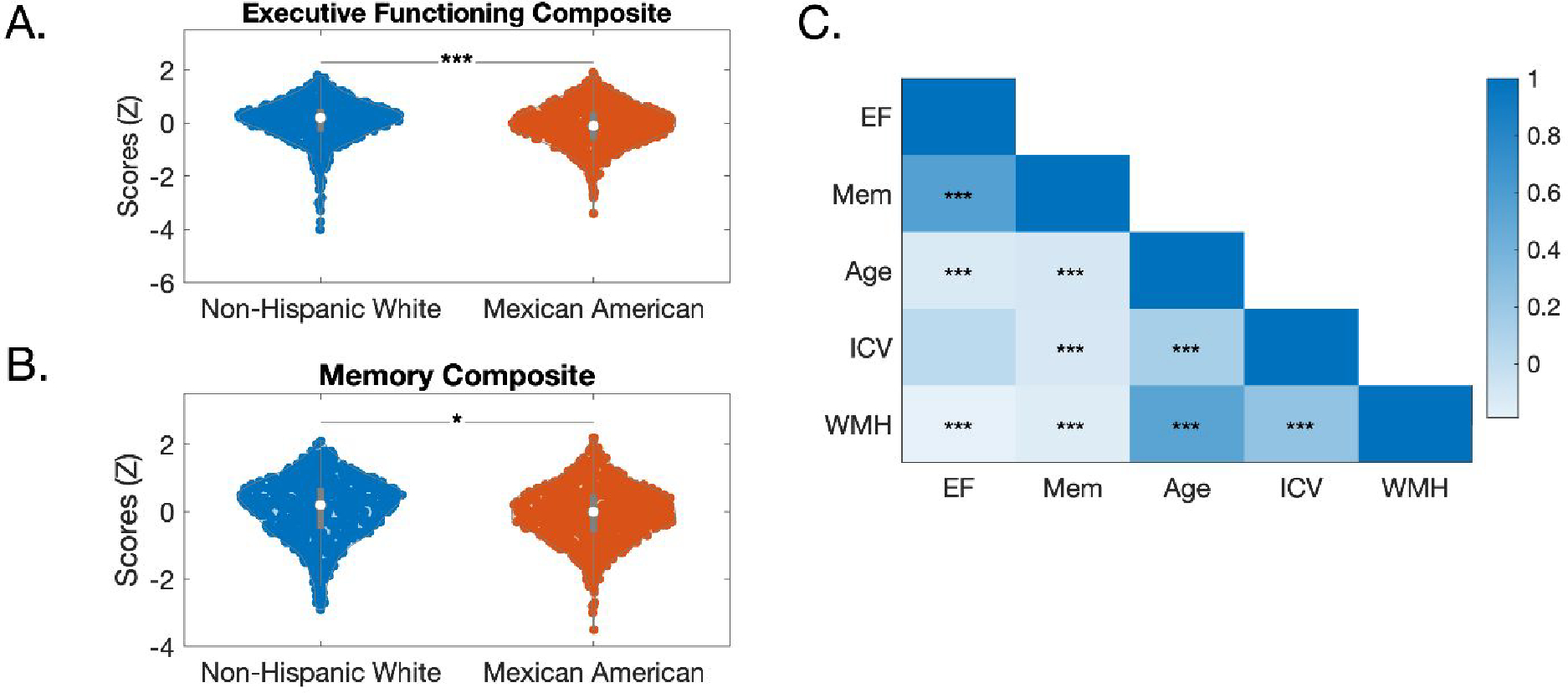
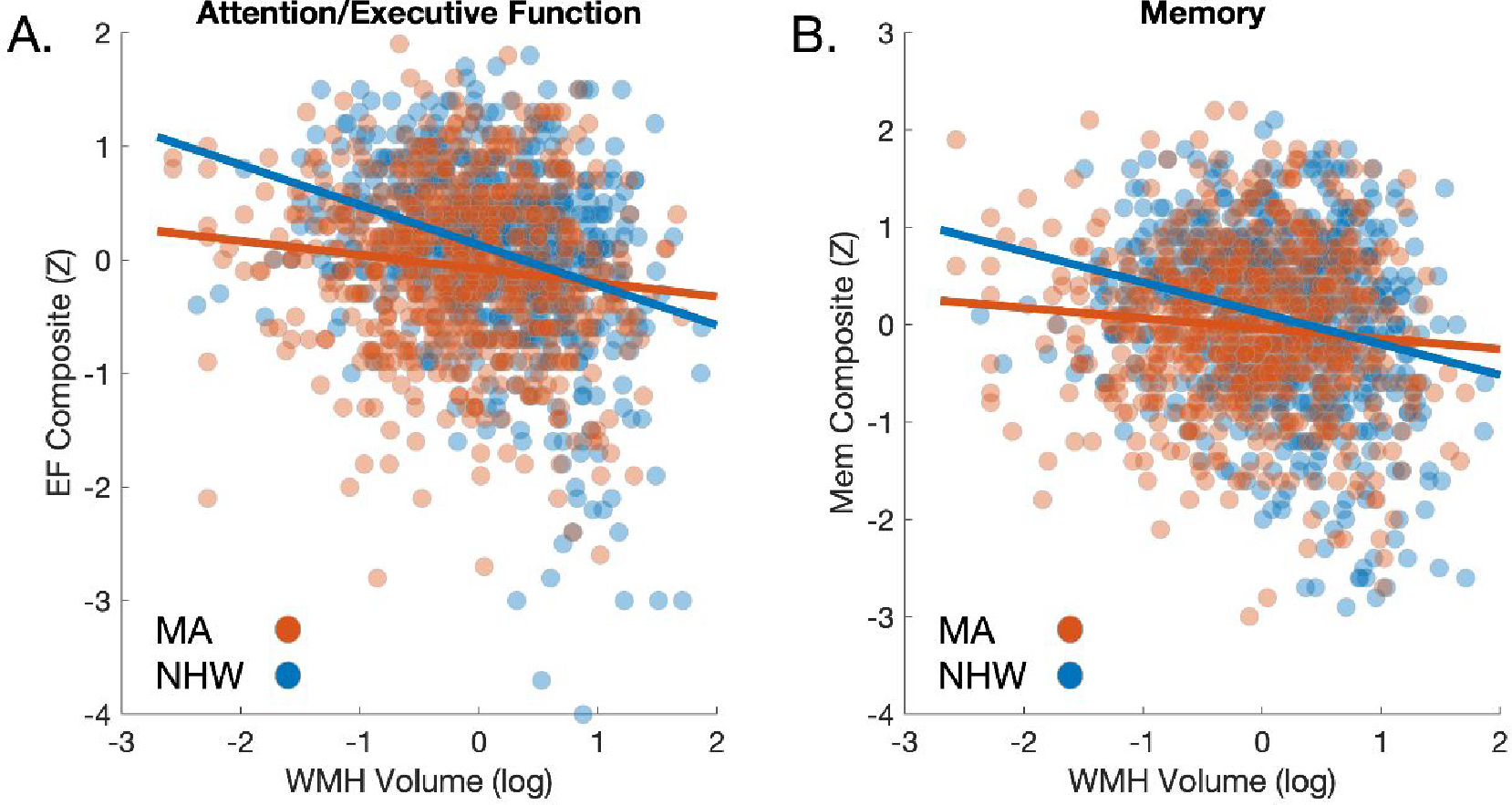
Results: The MA group (mean age = 63.72 ± 7.90 years; 66.3% female) had higher rates of consensus diagnoses of hypertension and diabetes, whereas the NHW group (mean age = 69.18 ± 8.65 years; 55.2% female) had higher rates of diagnosed CVD (ps < .01). WMH volumes were higher among individuals with CVD risk factors/conditions (ps < .01). There were differential associations between WMH and neuropsychological performance across ethnoracial groups (ps < .001), wherein associations were steeper in the NHW group than in the MA group. Lower educational level was associated with higher WMH volume in the NHW group (p < .001), but no association was seen in the MA group (p > .05).
Conclusions: Negative effects of pathological changes in the form of WMH on cognition may be less robust or consistent for MA adults than NHW adults. Furthermore, the impact of WMH on cognition in NHW adults may be mitigated by cognitive reserve related to educational attainment.
Keywords: Aging; Alzheimer’s disease; Hispanic or Latino; cardiovascular diseases; cognition; cognitive reserve.
Conflict of interest statement
Competing Interests and Sources of Financial Support (Including Grant Numbers)
The authors have no conflicts to report. MMD is supported by the NIH NIMH (K23MH131466), Alzheimer’s Association (AARGD-22-924896) and the American Academy of Neurology.
Figures
References
-
- Alzheimer’s Association. (2020). Alzheimer’s disease facts and figures. Alzheimer’s & Dementia, 16(3), 391+.
-
- Amaefule CO, Dyrba M, Wolfsgruber S, Polcher A, Schneider A, Fliessbach K, Spottke A, Meiberth D, Preis L, Peters O, Incesoy EI, Spruth EJ, Priller J, Altenstein S, Bartels C, Wiltfang J, Janowitz D, Burger K, Laske C, Munk M, … Teipel SJ (2021). Association between composite scores of domain-specific cognitive functions and regional patterns of atrophy and functional connectivity in the Alzheimer’s disease spectrum. NeuroImage: Clinical, 29, 102533. - PMC - PubMed
-
- Babulal GM, Quiroz YT, Albensi BC, Arenaza-Urquijo E, Astell AJ, Babiloni C, Bahar-Fuchs A, Bell J, Bowman GL, Brickman AM, Chételat G, Ciro C, Cohen AD, Dilworth-Anderson P, Dodge HH, Dreux S, Edland S, Esbensen A, Evered L, Ewers M, … International Society to Advance Alzheimer’s Research and Treatment, Alzheimer’s Association (2019). Perspectives on ethnic and racial disparities in Alzheimer’s disease and related dementias: Update and areas of immediate need. Alzheimer’s & Dementia, 15(2), 292–312. - PMC - PubMed
-
- Benjamin P, Zeestraten E, Lambert C, Chis Ster I, Williams OA, Lawrence AJ, Patel B, MacKinnon AD, Barrick TR, & Markus HS (2016). Progression of MRI markers in cerebral small vessel disease: Sample size considerations for clinical trials. Journal of Cerebral Blood Flow and Metabolism, 36(1), 228–240. - PMC - PubMed
MeSH terms
Grants and funding
LinkOut - more resources
Full Text Sources
Medical
