. 2024 Oct 24;10(11):688.
doi: 10.3390/gels10110688.

Conductive-Polymer-Based Double-Network Hydrogels for Wearable Supercapacitors

Affiliations

Conductive-Polymer-Based Double-Network Hydrogels for Wearable Supercapacitors

Bu Quan et al. Gels. .

Abstract

In the field of contemporary epidermal bioelectronics, there is a demand for energy supplies that are safe, lightweight, flexible and robust. In this work, double-network polymer hydrogels were synthesized by polymerization of 3,4-ethylenedioxythiophene (EDOT) into a poly(vinyl alcohol)/poly(ethylene glycol diacrylate) (PVA/PEGDA) double-network hydrogel matrix. The PEDOT-PVA/PEGDA double-network hydrogel shows both excellent mechanical and electrochemical performance, having a strain up to 498%, electrical conductivity as high as 5 S m-1 and specific capacitance of 84.1 ± 3.6 mF cm⁻2. After assembling two PEDOT-PVA/PEGDA double-network hydrogel electrodes with the free-standing boron cross-linked PVA/KCl hydrogel electrolyte, the formed supercapacitor device exhibits a specific capacitance of 54.5 mF cm⁻2 at 10 mV s-1, with an energy density of 4.7 μWh cm-2. The device exhibits excellent electrochemical stability with 97.6% capacitance retention after 3000 charging-discharging cycles. In addition, the hydrogel also exhibits great sensitivity to strains and excellent antifouling properties. It was also found that the abovementioned hydrogel can achieve stable signals under both small and large deformations as a flexible sensor. The flexible and antifouling PEDOT-PVA/PEGDA double-network hydrogel-based supercapacitor is a promising power storage device with potential applications in wearable electronics.

Keywords: conducting polymer; double-network hydrogels; energy supply; epidermal bioelectronics; flexible supercapacitors; solid-state electrolyte.


Conflict of interest statement

The authors declare no conflicts of interest.

Figures
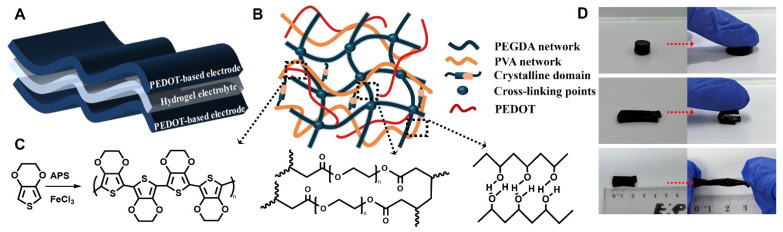
Figure 1
Figure 1
(A) The “sandwich” structure of the PEDOT-PVA/PEGDA DN hydrogel-based supercapacitor. (B) The double-network structure of the PEDOT-PVA/PEGDA DN hydrogels. (C) Chemical polymerization of EDOT and chemical structures of PEGDA and PVA. (D) Optical photographs showing PEDOT-PVA/PEGDA DN hydrogels under compression, bending, stretching, twisting and torsional stretching.
Figure 2
Figure 2
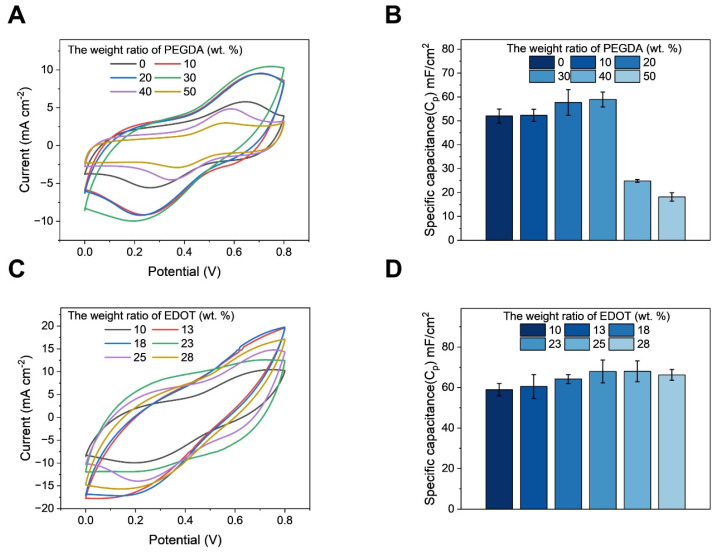
(A) CVs at different scan rates and (B) areal specific capacitances of PEDOT-PVA/PEGDA DN hydrogel electrodes with PEGDA content from 0 wt.% to 50 wt.% in 1 M KCl solution at a scan rate of 100 mV s−1. (C) CVs at different scan rates and (D) areal specific capacitances of PEDOT−PVA/PEGDA DN hydrogel electrodes with EDOT content from 10 wt.% to 28 wt.% in 1 M KCl solution at a scan rate of 100 mV s−1.
Figure 3
Figure 3
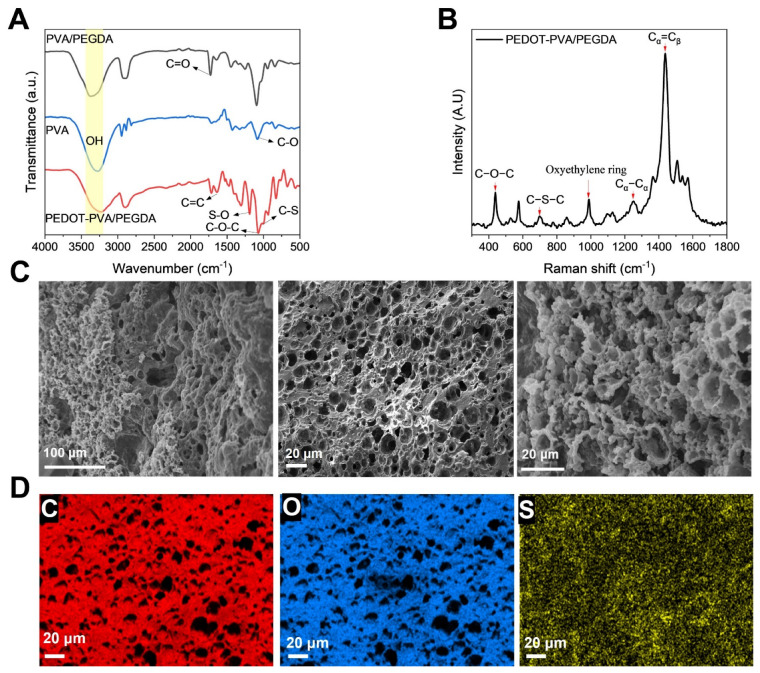
(A) FTIR spectra of the dried PVA, PVA/PEGDA and PEDOT-PVA/PEGDA DN hydrogels. (B) Raman spectra of dried PEDOT-PVA/PEGDA DN hydrogel. (C) SEM morphologies of the fracture surfaces of the freeze-dried PEDOT-PVA/PEGDA DN hydrogels. (D) EDX elemental mapping images of freeze-dried PEDOT-PVA/PEGDA DN hydrogel: C element, O element and S element.
Figure 4
Figure 4
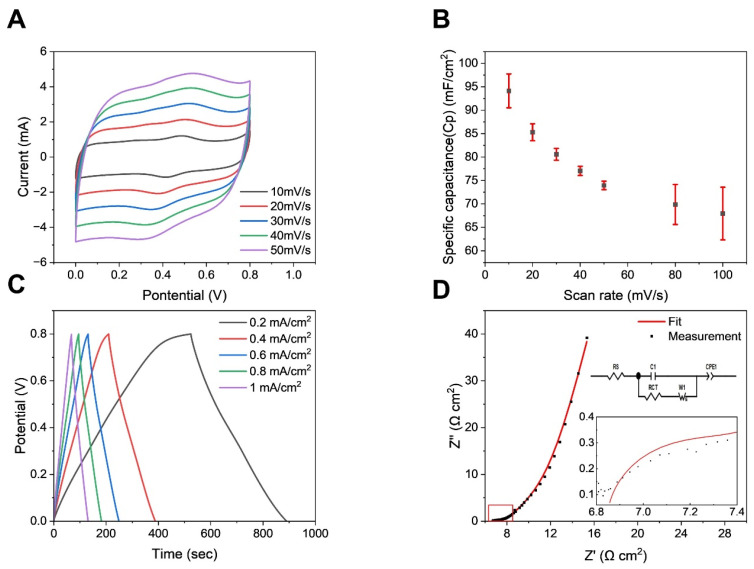
Characterization of PEDOT-PVA/PEGDA DN hydrogel as supercapacitor electrode material. (A) CV curves at various scan rates in the potential window of 0–0.8 V. (B) Specific capacitance of the PEDOT-PVA/PEGDA DN hydrogel electrode at different scan rates. The error bars represent a standard deviation from 3 measurements. (C) GCD curves at a current density from 0.2 mA·cm−2 to 1 mA cm−2 in a potential window of 0–0.8 V. (D) Nyquist plot of PEDOT-PVA/PEGDA DN hydrogel in the frequency range of 0.1–100 kHz.
Figure 5
Figure 5
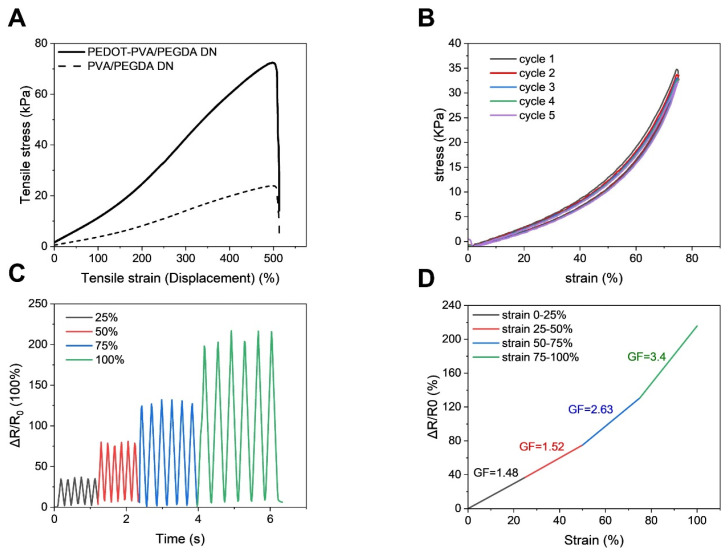
(A) Tensile stress–strain curves of PEDOT-PVA/PEGDA DN hydrogel and PVA/PEGDA DN hydrogel. (B) Cyclic tensile test of PEDOT-PVA/PEGDA DN hydrogel up to 75% strain. (C) The change in the relative resistance (∆R/R0) of PEDOT-PVA/PEGDA DN hydrogel at different strains (25%, 50%, 75%, 100%). (D) GF of PEDOT-PVA/PEGDA DN hydrogel at different tensile strain stages.
Figure 6
Figure 6
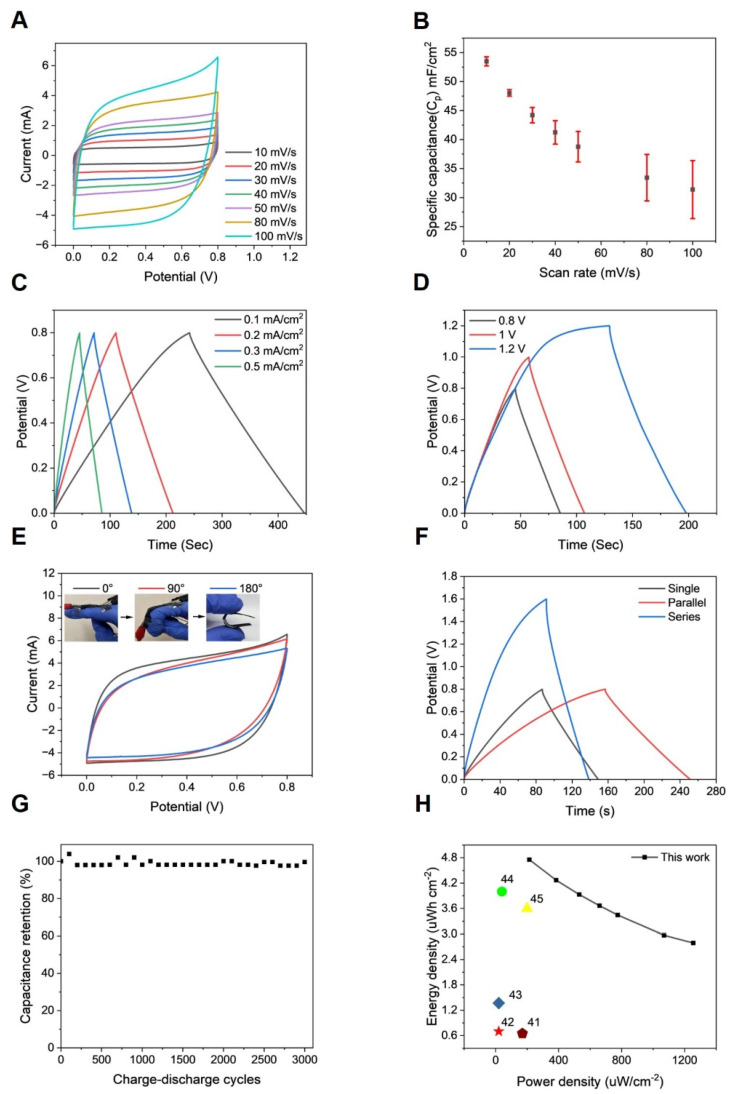
Characterizations of PEDOT-PVA/PEGDA DN hydrogel-based supercapacitor device. (A) CV plots at different scan rates in the voltage window of 0–0.8 V. (B) Specific capacitance plot of PEDOT-PVA/PEGDA DN hydrogel-based supercapacitors at different scan rates. The error bars represent a standard deviation from 3 measurements. (C) GCD curves at a current density from 0.1 mA·cm−2 to 0.5 mA cm−2 in voltage windows of 0–0.8 V. (D) GCD curves at a current density of 1 mA cm−2 in various voltage windows. (E) CV plots of the PEDOT-PVA/PEGDA DN hydrogel-based supercapacitor at different bending angles. (F) GCD curves of a single PEDOT-PVA/PEGDA DN hydrogel-based supercapacitor, two PEDOT-PVA/PEGDA DN hydrogel-based supercapacitors connected in parallel and two PEDOT-PVA/PEGDA DN hydrogel-based supercapacitors connected in series. (G) Capacitance retention (%) during GCD cyclic test at a current density of 3 mA cm−2. (H) Ragone plots of comparison with various PEDOT-based supercapacitors.

References

    1. Zhao D., Zhu Y., Cheng W., Xu G., Wang Q., Liu S., Li J., Chen C., Yu H., Hu L. A Dynamic Gel with Reversible and Tunable Topological Networks and Performances. Matter. 2020;2:390–403. doi: 10.1016/j.matt.2019.10.020. - DOI
    1. Carlberg J.C., Inganäs O. Poly(3,4-ethylenedioxythiophene) as Electrode Material in Electrochemical Capacitors. J. Electrochem. Soc. 1997;144:L61–L64. doi: 10.1149/1.1837553. - DOI
    1. Hu L., Xu K. Nonflammable Electrolyte Enhances Battery Safety. Proc. Natl. Acad. Sci. USA. 2014;111:3205–3206. doi: 10.1073/pnas.1401033111. - DOI - PMC - PubMed
    1. Choi N.S., Chen Z., Freunberger S.A., Ji X., Sun Y.K., Amine K., Yushin G., Nazar L.F., Cho J., Bruce P.G. Challenges Facing Lithium Batteries and Electrical Double-Layer Capacitors. Angew. Chem. Int. Ed. 2012;51:9994–10024. doi: 10.1002/anie.201201429. - DOI - PubMed
    1. Shao Y., El-Kady M.F., Sun J., Li Y., Zhang Q., Zhu M., Wang H., Dunn B., Kaner R.B. Design and Mechanisms of Asymmetric Supercapacitors. Chem. Rev. 2018;118:9233–9280. doi: 10.1021/acs.chemrev.8b00252. - DOI - PubMed

LinkOut - more resources