Human Circovirus in Patients with Hepatitis, Hong Kong

Shusheng Wu et al. Emerg Infect Dis. 2024 Dec.

Abstract

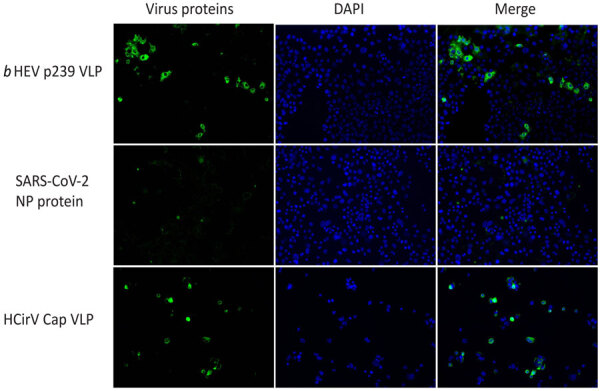
Circovirus human is a new viral species that includes the human circovirus (HCirV), which has been linked to hepatitis in immunocompromised persons. We investigated prevalence of HCirV infection in 278 patients with hepatitis and 184 asymptomatic persons using real-time PCR and sequencing assays. HCirV viremia and sequences were found in 8 (2.9%) hepatitis patients and no asymptomatic patients. Alternate causes of hepatitis (hepatitis E and cholangitis) were clearly identifiable in 2 HCirV-infected patients. HCirV could not be ruled out as a contributor to hepatitis in the remaining 6 patients, 4 of whom were immunocompromised. Persistent infections were documented in 3 patients, but only 1 had relapsing hepatitis. One HCirV patient displayed symptoms of an infectious mononucleosis-like syndrome. Isolates clustered with known HCirV strains from France and China. HCirV-derived virus-like particles bound to PLC/PRF/5 and Hep-G2 human hepatoma cells but not to lung epithelial cells, indicating hepatic tropism.

Keywords: China; Hong Kong; chronic hepatitis; circovirus; hepatitis viruses; infectious mononucleosis; viruses.


Figures
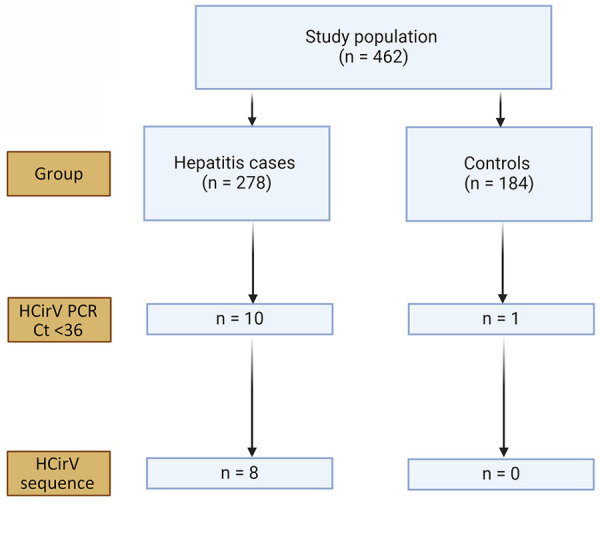
Figure 1
Figure 1
Results of screening in study of human circovirus in patients with hepatitis, Hong Kong. Ct, cycle threshold; HCirV, human circovirus.
Figure 2
Figure 2
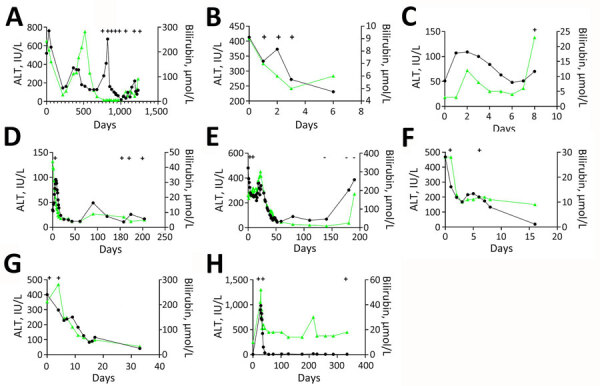
Liver function test kinetics in 8 patients with hepatitis and human circovirus infection, Hong Kong. A) Patient 1; B) patient 2; C) patient 3; D) patient 4; E) patient 5; F) patient 6; G) patient 7; H) patient 8. Black line indicates ALT, and green line indicates bilirubin. Plus signs indicate days when human circovirus DNA was detected in blood, whereas dashes indicate days when human circovirus DNA was not detected in blood. ALT, alanine aminotransferase.
Figure 3
Figure 3
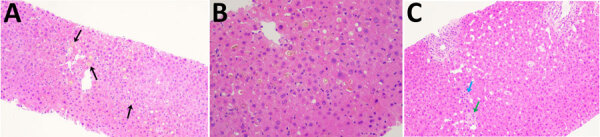
Hematoxylin and eosin stained liver sections of patients in study of human circovirus in patients with hepatitis, Hong Kong. A, B) Cholestasis with bile pigment in zone 3 canaliculi (arrows) in patient 5 at original magnification ×10 (A) and original magnification ×20 (B). C) Acidophil body (blue arrow) with neutrophils around ducts (green arrow) in patient 8; original magnification ×10.
Figure 4
Figure 4
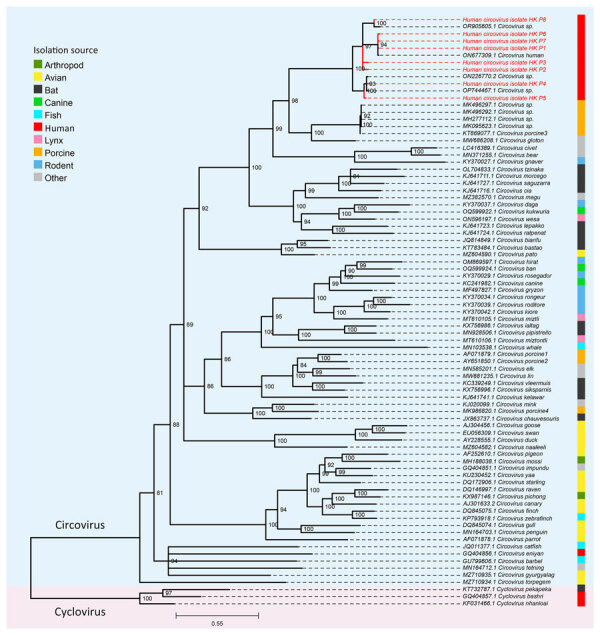
Phylogenetic tree of representative circoviruses and human circoviruses from study of human circovirus in patients with hepatitis, Hong Kong. Maximum-likelihood phylogenetic tree was inferred from a multiple sequence alignment of complete representative Circovirus genomes and a mixture of full-length and partial genome sequences from this study (red text) using IQ-TREE (16). Three representative species of Cyclovirus were used as an outgroup for rooting the tree. Branch supports were assessed using the Shimodaira-Hasegawa–like approximate likelihood ratio test with 10,000 bootstrap replicates. Branches with <80% support were collapsed. Scale bar indicates nucleotide substitutions per site.
Figure 5
Figure 5
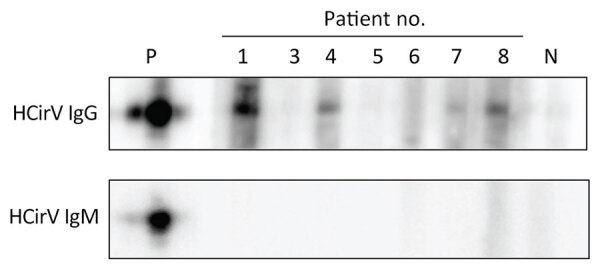
IgM and IgG immunoblots of 7 patients for whom sufficient serum was available from study of HCirV in patients with hepatitis, Hong Kong. P indicates positive control, mouse polyclonal serum raised against HCirV cap protein. N indicates HCirV PCR-negative human donor sample. HCirV, human circovirus.
Figure 6
Figure 6
Cell-binding assay showing binding of HCirV VLPs to PLC/PRF/5 cells in study of HCirV in patients with hepatitis. HEV VLPs (bHEV p239) is included as a positive control; SARS-CoV-2 NP protein is included as a negative control. Nuclei are counterstained with DAPI. Cap, capsid; HCirV, human circovirus; HEV, hepatitis E virus; NP, nucleoprotein; VLP, virus-like particle.

References

    1. Bernal W, Auzinger G, Dhawan A, Wendon J. Acute liver failure. Lancet. 2010;376:190–201. 10.1016/S0140-6736(10)60274-7 - DOI - PubMed
    1. Ho A, Orton R, Tayler R, Asamaphan P, Herder V, Davis C, et al.; DIAMONDS Consortium; ISARIC4C Investigators. Adeno-associated virus 2 infection in children with non-A-E hepatitis. Nature. 2023;617:555–63. 10.1038/s41586-023-05948-2 - DOI - PubMed
    1. Sridhar S, Yip CCY, Wu S, Cai J, Zhang AJ, Leung KH, et al. Rat hepatitis E virus as cause of persistent hepatitis after liver transplant. Emerg Infect Dis. 2018;24:2241–50. 10.3201/eid2412.180937 - DOI - PMC - PubMed
    1. Rivero-Juarez A, Frias M, Perez AB, Pineda JA, Reina G, Fuentes-Lopez A, et al.; HEPAVIR and GEHEP-014 Study Groups. Orthohepevirus C infection as an emerging cause of acute hepatitis in Spain: First report in Europe. J Hepatol. 2022;77:326–31. 10.1016/j.jhep.2022.01.028 - DOI - PubMed
    1. Sridhar S, Yip CCY, Lo KHY, Wu S, Situ J, Chew NFS, et al. Hepatitis E virus species C infection in humans, Hong Kong. Clin Infect Dis. 2022;75:288–96. 10.1093/cid/ciab919 - DOI - PubMed

MeSH terms

LinkOut - more resources