. 2024 Nov 26;15(1):10233.
doi: 10.1038/s41467-024-54331-w.

Eliminating chemo-mechanical degradation of lithium solid-state battery cathodes during >4.5 V cycling using amorphous Nb2O5 coatings

Affiliations

Eliminating chemo-mechanical degradation of lithium solid-state battery cathodes during >4.5 V cycling using amorphous Nb2O5 coatings

Manoj K Jangid et al. Nat Commun. .

Abstract

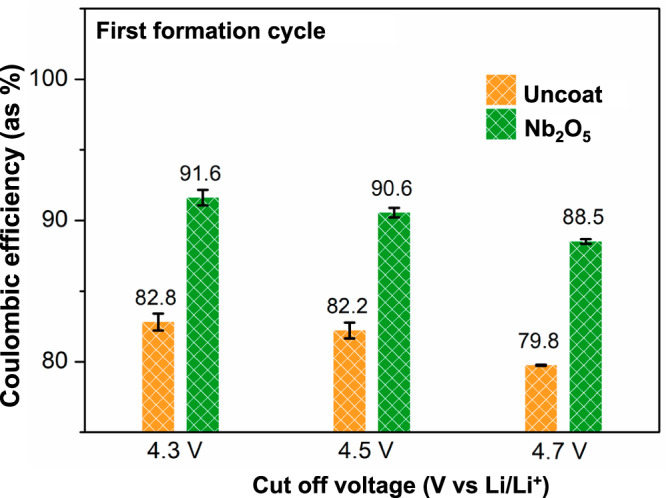
Lithium solid-state batteries offer improved safety and energy density. However, the limited stability of solid electrolytes (SEs), as well as irreversible structural and chemical changes in the cathode active material, can result in inferior electrochemical performance, particularly during high-voltage cycling (>4.3 V vs Li/Li+). Therefore, new materials and strategies are needed to stabilize the cathode/SE interface and preserve the cathode material structure during high-voltage cycling. Here, we introduce a thin (~5 nm) conformal coating of amorphous Nb2O5 on single-crystal LiNi0.5Mn0.3Co0.2O2 cathode particles using rotary-bed atomic layer deposition (ALD). Full cells with Li4Ti5O12 anodes and Nb2O5-coated cathodes demonstrate a higher initial Coulombic efficiency of 91.6% ± 0.5% compared to 82.2% ± 0.3% for the uncoated samples, along with improved rate capability (10x higher accessible capacity at 2C rate) and remarkable capacity retention during extended cycling (99.4% after 500 cycles at 4.7 V vs Li/Li+). These improvements are associated with reduced cell polarization and interfacial impedance for the coated samples. Post-cycling electron microscopy analysis reveals that the Nb2O5 coating remains intact and prevents the formation of spinel and rock-salt phases, which eliminates intra-particle cracking of the single-crystal cathode material. These findings demonstrate a potential pathway towards stable and high-performance solid-state batteries during high-voltage operation.


Conflict of interest statement

Competing interests: The authors declare no competing interests.

Figures
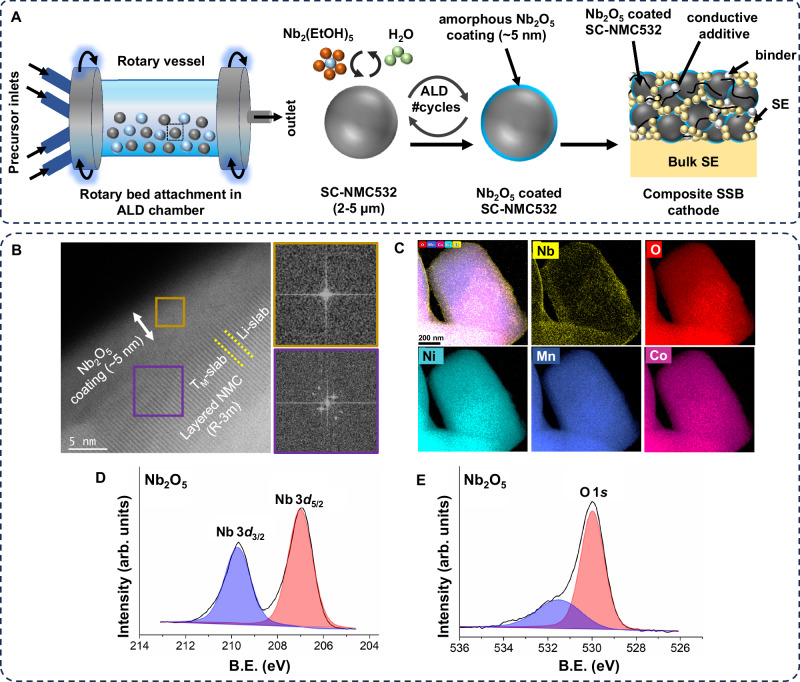
Fig. 1
Fig. 1. Schematic and characterization of Nb2O5 coatings on SC-NMC cathode particles by rotary-bed ALD.
A Schematic of ALD equipped with a rotary-bed attachment, ALD process for depositing a 5 nm thick amorphous Nb2O5 coating on SC-NMC particles, and composite cathode assembly. B High-resolution TEM micrograph showing amorphous Nb2O5 coating and layered (R-3m) structure of an SC-NMC particle. FFTs from marked regions are also presented. C HDAAF-STEM EDS maps showing conformal Nb2O5 coating and distribution of elements in an SC-NMC particle. XPS core scans corresponding to (D) Nb 3d peak (E) O 1s peak from Nb2O5-coated SC-NMC powder.
Fig. 2
Fig. 2. Initial Coulombic efficiency of LTO|SE|NMC cells with uncoated and Nb2O5-coated cathodes cycled to different cut-off voltages during the first formation cycle.
The temperature during testing was 60 °C and stack pressure was 7 MPa.
Fig. 3
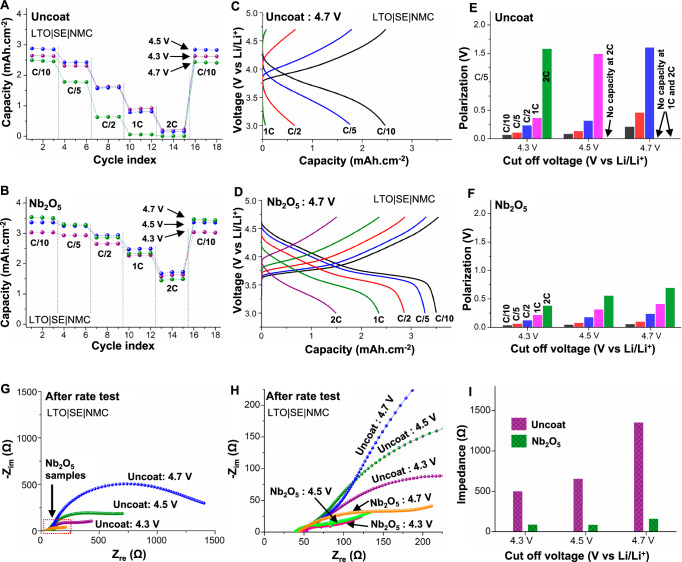
Fig. 3. Rate capability and impedance analysis for coated and uncoated cathodes.
Rate capability trends of LTO|SE|NMC cells with (A) uncoated and (B) Nb2O5-coated composite cathodes. Voltage profiles of (C) uncoated and (D) Nb2O5-coated cathodes at different C-rates (C/10, C/5, C/2, 1C, 2C; where 1C = 3 mA·cm−2) at a cut-off voltage of 4.7 V vs Li/Li+. Comparison of polarization estimated from dQ/dV analysis of voltage profiles at different C-rates for (E) uncoated and (F) Nb2O5-coated electrodes. G Nyquist impedance plots of uncoated and Nb2O5-coated cathodes after the rate capability tests. H Zoomed-in view showing Nyquist impedance plots of Nb2O5-coated cathodes. I Comparison of interfacial impedance for uncoated and Nb2O5-coated cathodes after the rate capability tests. The temperature during testing was 60 °C and stack pressure was 7 MPa.
Fig. 4
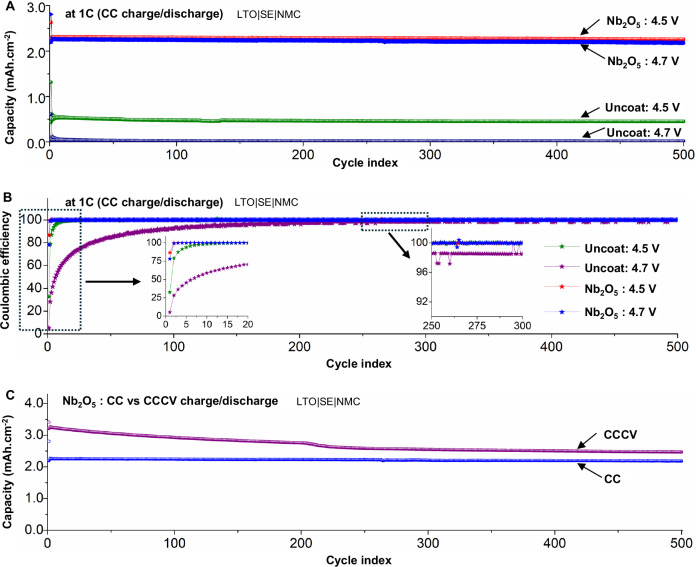
Fig. 4. Long-term cycling performance of cells with coated and uncoated cathodes.
A Long-term cycling stability and (B) associated Coulombic efficiencies of LTO|SE|NMC cells with uncoated and Nb2O5-coated SC-NMC cathodes at 1C rate (3 mA·cm−2) cycled to 4.5 V and 4.7 V (vs Li/Li+) voltage limits using a CC charge/discharge protocol. Insets in (B) show Coulombic efficiency during the first 20 cycles and for cycles 250 to 300. C Comparison of long-term cycling stability of Nb2O5-coated cathodes at 1C rate cycled to 4.7 V limit using CC (where a current equivalent to 1C is applied until the cell reaches the voltage limit) and CCCV (where a current equivalent to 1C is applied until the cell reaches the voltage limit followed by a voltage hold at the limit such that entire half cycle takes 1 h time) charge/discharge protocols. The temperature during testing was 60 °C and stack pressure was 7 MPa.
Fig. 5
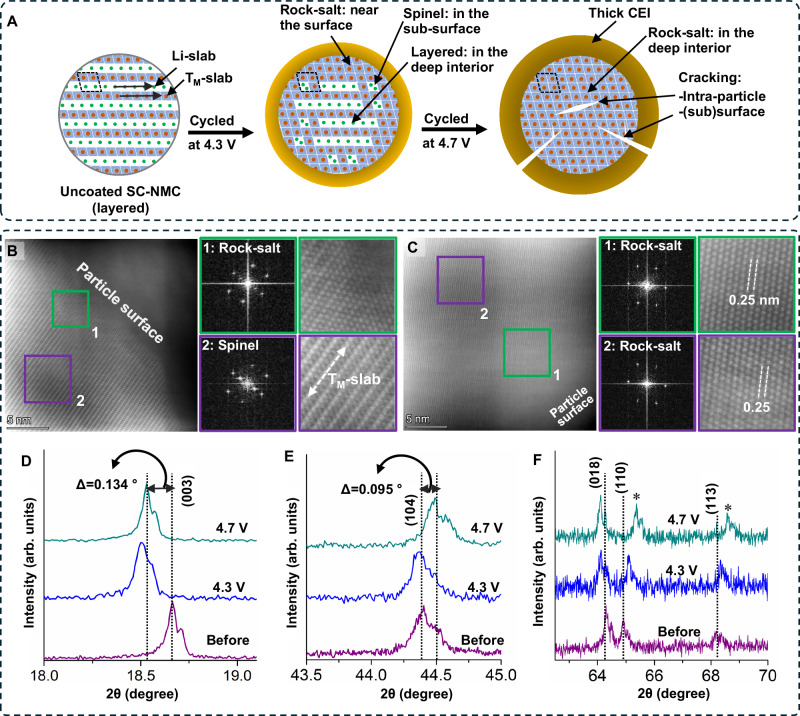
Fig. 5. Schematic and characterization of structural changes for uncoated SC-NMC particles after high-voltage cycling.
A Schematic showing structural changes occurring in uncoated SC-NMC532 particles when cycled to different voltage limits. Upon repeated cycling to high-voltage limits (>4.3 V vs Li/Li+), uncoated particles undergo irreversible structural changes (spinel and rock-salt phase formations), and (sub)surface and intra-particle cracking. HAADF-STEM images after 500 cycles at 1C rate (3 mA·cm−2) for (B) uncoated cycled at 4.3 V vs Li/Li+ and (C) uncoated cycled at 4.7 V vs Li/Li+ are presented. FFT patterns and zoomed-in views of marked regions are also presented as insets. (DF) Ex-situ XRD scans of uncoated samples before cycling and from samples after rate capability tests at 4.3 V and 4.7 V limits.
Fig. 6
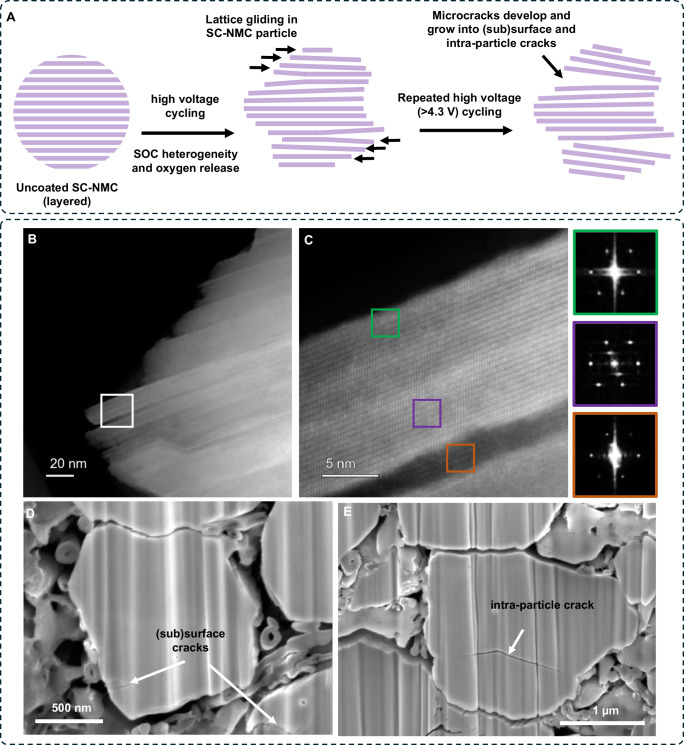
Fig. 6. Schematic and characterization of chemo-mechanical degradation in uncoated SC-NMC particles after high-voltage cycling.
A Schematic showing the onset of lattice gliding, subsequent microcrack formation, and its growth in (sub)surface and intra-particle cracking. B HAADF-STEM image of uncoated SC-NMC particle after 500 cycles at 1C rate (3 mA·cm−2) and a voltage limit of 4.7 V vs Li/Li+ shows a serrated surface resulting from lattice gliding and (sub)surface cracking. C Zoomed-in images of the cracks highlighted by the white box in (B) and FFTs from different marked regions. FIB-SEM cross-section images of uncoated SC-NMC electrode after 500 cycles at a 1C rate (3 mA·cm−2) and a voltage limit of 4.7 V vs Li/Li+ showing (D) (sub)surface and (E) intra-particle cracks.
Fig. 7
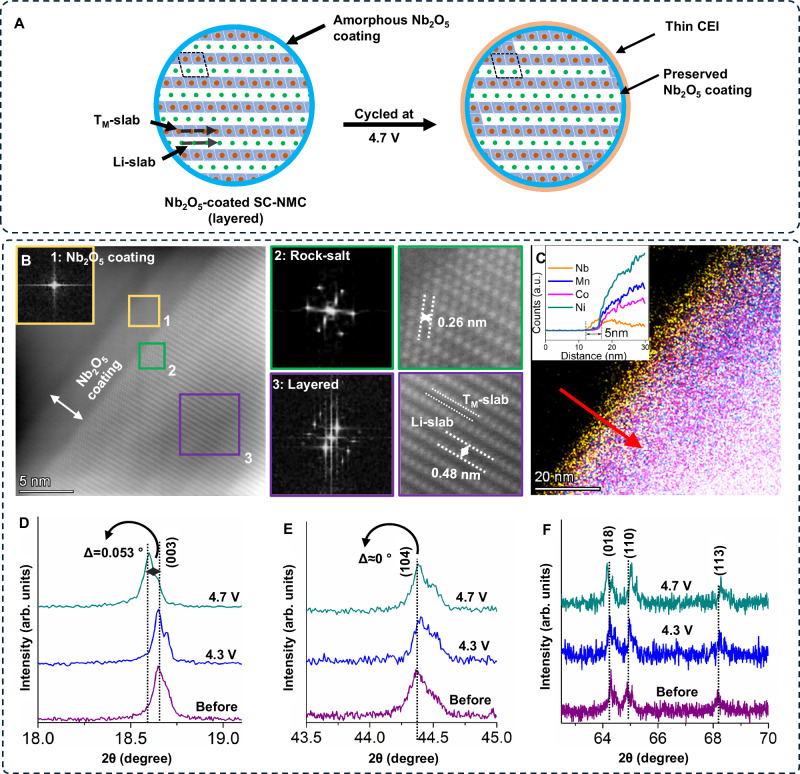
Fig. 7. Schematic and materials characterization of ALD-coated SC-NMC particles after high-voltage cycling.
A Schematic showing structural changes occurring in Nb2O5-coated SC-NMC532 particles when cycled at different upper voltage limits. For Nb2O5-coated NMC cathodes, both the NMC structure and Nb2O5-coating remain preserved even repeatedly cycled up to 4.7 V vs Li/Li+. B HAADF-STEM images after 500 cycles at a 1C rate (3 mA·cm−2) for Nb2O5-coated cathode cycled at 4.7 V limit. FFT patterns and zoom-in views of marked regions are also presented as insets. C STEM-EDS shows the preserved ~ 5 nm thick Nb2O5 coating and distribution of elements in an SC-NMC532 particle after 500 cycles at a 1C rate (3 mA·cm−2) and a voltage limit of 4.7 V vs Li/Li+. In the inset, the EDS line-scan shows the elemental distribution from particle surface to inside. (DF) Ex-situ XRD scans of Nb2O5-coated samples before cycling and from samples after rate capability tests at 4.3 V and 4.7 V limits.

References

    1. Janek, J. & Zeier, W. G. Challenges in speeding up solid-state battery development. Nat. Energy8, 230–240 (2023).
    1. Wang, M. J., Kazyak, E., Dasgupta, N. P. & Sakamoto, J. Transitioning solid-state batteries from lab to market: linking electro-chemo-mechanics with practical considerations. Joule5, 1371–1390 (2021).
    1. Zhao, Q., Stalin, S., Zhao, C. Z. & Archer, L. A. Designing solid-state electrolytes for safe, energy-dense batteries. Nat. Rev. Mater.5, 229–252 (2020).
    1. Kim, S. Y., Cha, H., Kostecki, R. & Chen, G. Composite cathode design for high-energy all-solid-state lithium batteries with long cycle life. ACS Energy Lett.8, 521–528 (2023).
    1. Doerrer, C. et al. High energy density single-crystal NMC/Li6PS5Cl cathodes for all-solid-state lithium-metal batteries. ACS Appl Mater. Interfaces13, 37809–37815 (2021). - PMC - PubMed

LinkOut - more resources