


Screening of the Nutritional Properties, Bioactive Components, and Antioxidant Properties in Legumes
- PMID: 39593944
- PMCID: PMC11593270
- DOI: 10.3390/foods13223528
Screening of the Nutritional Properties, Bioactive Components, and Antioxidant Properties in Legumes
Abstract
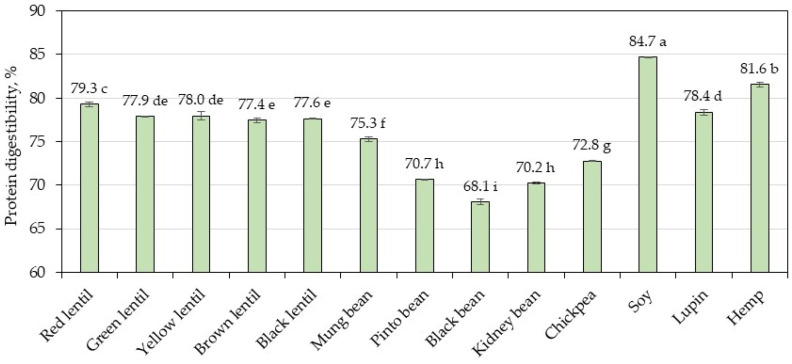
This study provides an assessment of nutrients (protein, amino acid profiles, fiber, starch), phenolic content TPC, flavonoid content TFC, and antioxidant capacity through different in vitro methods in 12 legume species (red, green, yellow, brown, and black lentils; mung, pinto, black, and kidney beans; chickpea, soy, and lupin) and hemp. Legumes with a protein content above 30% were black lentil, lupin, and soy. Chickpea, soy, black bean, kidney bean, and mung bean did not have any limiting amino acids. All samples had moderate overall protein quality, except green and brown lentils. Black bean was less digestible (68.1%), while soy, hemp, and red lentil had higher protein digestibility (79.3-84.7%). Pinto bean had the highest TPC (425.19 mg GAE/100 g), comparable with hemp, but the lowest TFC (0.24 mg QE/100 g). Yellow and red lentils showed the lowest TPC (69-85.89 mg GAE/100 g). Mung bean presented the highest concentration of flavonoids (45.47 mg QE/100 g), followed by black lentil (28.57 mg QE/100 g). There were distinct variations in the antioxidant capacity across different legume samples and assays. Pinto bean, hemp, and green lentil had the highest relative antioxidant capacity index, while yellow lentil, red lentil, and chickpea presented the lowest. Dark-colored legume samples showed a higher TPC and a lower antioxidant capacity (CUPRAC and PCL assays), while yellow legumes had less antioxidant capacity (DPPH assay). A high correlation coefficient was observed between TPC and DPPH (r = 0.8133), TPC and FRAP (r = 0.8528), TPC and CUPRAC (r = 0.9425), and TPC and ACL (r = 0.8261) methods. The results highlight large variations in the legume properties and support the exploitation of the nutritional properties of legumes as raw materials for the development of products designed to fulfil modern consumer demands.
Keywords: amino acids; antioxidant capacity; flavonoids; hemp; legumes; protein digestibility; total polyphenolic content.
Conflict of interest statement
The authors declare no conflicts of interest. The funders had no role in the design of the study; in the collection, analyses, or interpretation of data; in the writing of the manuscript; or in the decision to publish the results.
Figures


References
-
- United Nations Department of Economic and Social Affairs, Population Division . World Population Prospects 2022: Summary of Results. United Nations; New York, NY, USA: 2022. UN DESA/POP/2022/TR/NO. 3.
-
- Semba R.D., Ramsing R., Rahman N., Kraemer K., Bloem M.W. Legumes as a sustainable source of protein in human diets. Glob. Food Sec. 2021;28:100520. doi: 10.1016/j.gfs.2021.100520. - DOI
-
- Carbas B., Machado N., Pathania S., Brites C., Rosa E.A., Barros A.I. Potential of legumes: Nutritional value, bioactive properties, innovative food products, and application of eco-friendly tools for their assessment. Food Rev. Int. 2021;39:160–188. doi: 10.1080/87559129.2021.1901292. - DOI
-
- Martín-Cabrejas M.A. Legumes: An Overview. In: Martín-Cabrejas M.A., editor. Legumes: Nutritional Quality, Processing and Potential Health Benefits. Royal Society of Chemistry; London, UK: 2019. pp. 1–18.
Grants and funding
LinkOut - more resources
Full Text Sources
Miscellaneous
