


The Pharmacokinetics of Δ9-Tetrahydrocannabinol in Sheep
- PMID: 39595380
- PMCID: PMC11590932
- DOI: 10.3390/ani14223328
The Pharmacokinetics of Δ9-Tetrahydrocannabinol in Sheep
Abstract
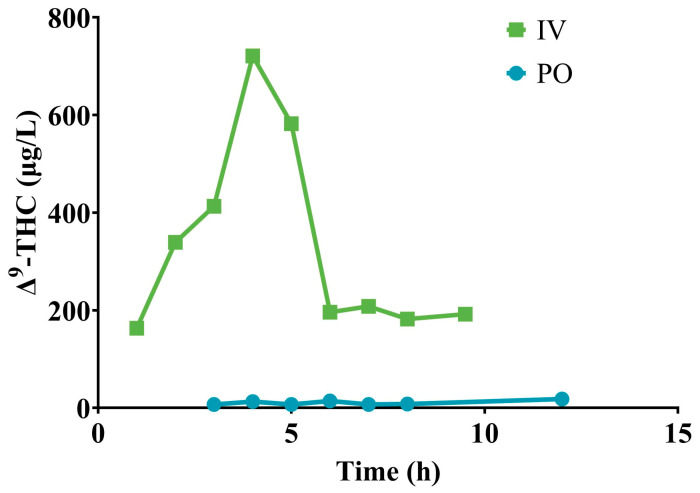
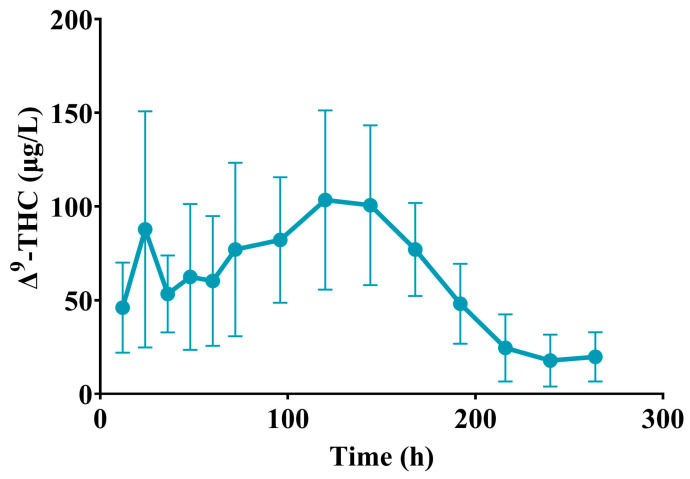
The pharmacokinetics of Δ9-tetrahydrocannabinol (Δ9-THC) has not been established in ruminants. Pharmacokinetic knowledge is important given feeding industrial hemp biomass has been shown to result in tissue residues post feeding in sheep. Due to a lack of testing and available data, a 'maximum' concentration of Δ9-THC has not been currently set for foods of animal origin. Consequently, this study was designed to gain a better understanding of how ruminants process Δ9-THC. Eight Merino ewes were administered with two per os (PO) doses of 88.5 mg Δ9-THC/kg bodyweight (BW) 12 h apart. Blood samples were collected periodically post dosing to determine the pharmacokinetics of Δ9-THC and subcutaneous fat biopsies were taken to investigate the deposition and elimination of Δ9-THC from sheep. An elimination half-life of 31.40 ± 13.87 h was identified, with residues persisting in the subcutaneous fat for 28 d in five of the eight sheep, before decreasing below the limit of detection in all sheep by 91 d. These results support the prolonged presence of Δ9-THC residues previously identified. Thus, imposing a practical withholding period for ruminants involved in the food chain may not be possible, with further research required to investigate how iHemp biomass may be safely fed to ruminants.
Keywords: THC; industrial hemp; pharmacokinetics; residues; ruminants.
Conflict of interest statement
The authors declare no conflicts of interest. The funders had no role in the design of the study; in the collection, analyses, or interpretation of data; in the writing of the manuscript; or in the decision to publish the results. There are no relevant financial or non-financial competing interests to report.
Figures
References
-
- Cremonesi P., Capra E., Turri F., Lazzari B., Chessa S., Battelli G., Colombini S., Rapetti L., Castiglioni B. Effect of diet enriched with hemp seeds on goat milk fatty acids, transcriptome, and miRNAs. Front. Anim. Sci. 2022;3:909271. doi: 10.3389/fanim.2022.909271. - DOI
-
- Gibb D.J., Shah M.A., Mir P.S., McAllister T.A. Effect of full-fat hemp seed on performance and tissue fatty acids of feedlot cattle. Can. J. Anim. Sci. 2005;85:223–230. doi: 10.4141/A04-078. - DOI
-
- Mierliță D. Effects of diets containing hemp seeds or hemp cake on fatty acid composition and oxidative stability of sheep milk. S. Afr. J. Anim. Sci. 2018;48:504–515. doi: 10.4314/sajas.v48i3.11. - DOI
-
- Abrahamsen F.W., Gurung N.K., Abebe W., Reddy G.P., Mullenix K., Adhikari S. Effects of feeding varying levels of hempseed meal on dry matter intake, rumen fermentation, in vitro digestibility, blood metabolites, and growth performance of growing meat goats. App. Anim. Sci. 2021;37:681–688. doi: 10.15232/aas.2021-02153. - DOI
Grants and funding
LinkOut - more resources
Full Text Sources
