


Voice Assessment in Patients with Amyotrophic Lateral Sclerosis: An Exploratory Study on Associations with Bulbar and Respiratory Function
- PMID: 39595845
- PMCID: PMC11591699
- DOI: 10.3390/brainsci14111082
Voice Assessment in Patients with Amyotrophic Lateral Sclerosis: An Exploratory Study on Associations with Bulbar and Respiratory Function
Abstract
Background: Speech production is a possible way to monitor bulbar and respiratory functions in patients with amyotrophic lateral sclerosis (ALS). Moreover, the emergence of smartphone-based data collection offers a promising approach to reduce frequent hospital visits and enhance patient outcomes. Here, we studied the relationship between bulbar and respiratory functions with voice characteristics of ALS patients, alongside a speech therapist's evaluation, at the convenience of using a simple smartphone.
Methods: For voice assessment, we considered a speech therapist's standardized tool-consensus auditory-perceptual evaluation of voice (CAPE-V); and an acoustic analysis toolbox. The bulbar sub-score of the revised ALS functional rating scale (ALSFRS-R) was used, and pulmonary function measurements included forced vital capacity (FVC%), maximum expiratory pressure (MEP%), and maximum inspiratory pressure (MIP%). Correlation coefficients and both linear and logistic regression models were applied.
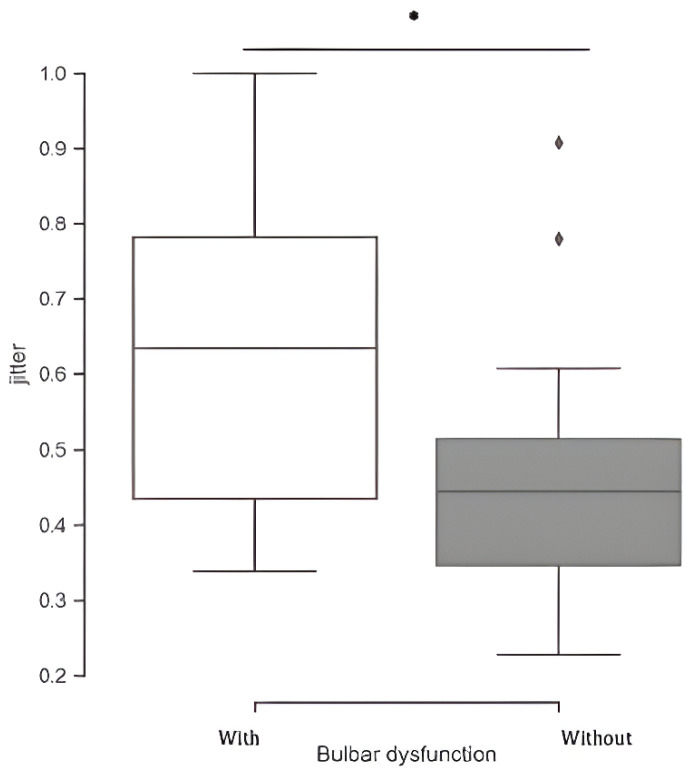
Results: A total of 27 ALS patients (12 males; 61 years mean age; 28 months median disease duration) were included. Patients with significant bulbar dysfunction revealed greater CAPE-V scores in overall severity, roughness, strain, pitch, and loudness. They also presented slower speaking rates, longer pauses, and higher jitter values in acoustic analysis (all p < 0.05). The CAPE-V's overall severity and sub-scores for pitch and loudness demonstrated significant correlations with MIP% and MEP% (all p < 0.05). In contrast, acoustic metrics (speaking rate, absolute energy, shimmer, and harmonic-to-noise ratio) significantly correlated with FVC% (all p < 0.05).
Conclusions: The results provide supporting evidence for the use of smartphone-based recordings in ALS patients for CAPE-V and acoustic analysis as reliable correlates of bulbar and respiratory function.
Keywords: ALS; acoustic analysis; digital health; personalized medicine.
Conflict of interest statement
The authors declare no conflicts of interest.
Figures


References
Grants and funding
LinkOut - more resources
Full Text Sources
Miscellaneous
