


Neuronal TCF7L2 in Lateral Habenula Is Involved in Stress-Induced Depression
- PMID: 39596468
- PMCID: PMC11594340
- DOI: 10.3390/ijms252212404
Neuronal TCF7L2 in Lateral Habenula Is Involved in Stress-Induced Depression
Abstract
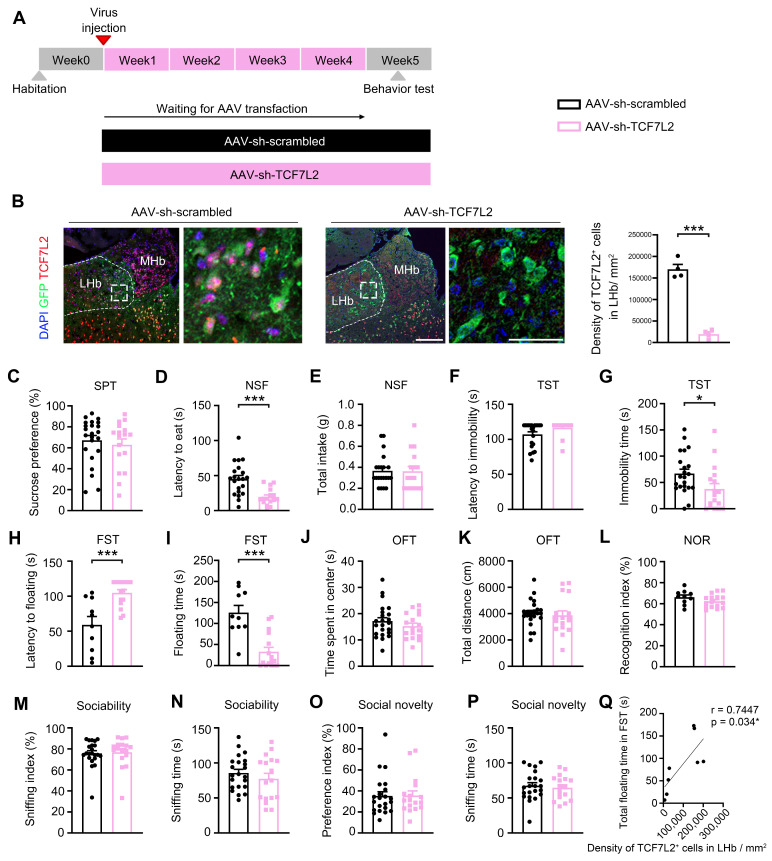
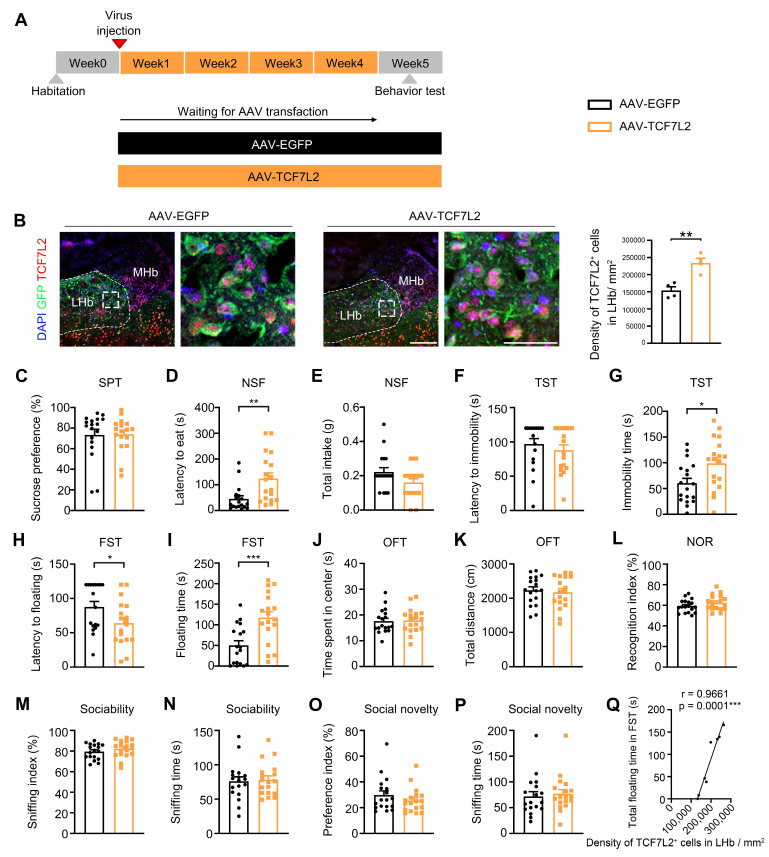
Depression is a complex psychiatric disorder that has substantial implications for public health. The lateral habenula (LHb), a vital brain structure involved in mood regulation, and the N-methyl-D-aspartate receptor (NMDAR) within this structure are known to be associated with depressive behaviors. Recent research has identified transcription factor 7-like 2 (TCF7L2) as a crucial transcription factor in the Wnt signaling pathway, influencing diverse neuropsychiatric processes. In this study, we explore the role of TCF7L2 in the LHb and its effect on depressive-like behaviors in mice. By using behavioral tests, AAV-mediated gene knockdown or overexpression, and pharmacological interventions, we investigated the effects of alterations in TCF7L2 expression in the LHb. Our results indicate that TCF7L2 expression is reduced in neurons within the LHb of male ICR mice exposed to chronic mild stress (CMS), and neuron-specific knockdown of TCF7L2 in LHb neurons leads to notable antidepressant activity, as evidenced by reduced immobility time in the tail suspension test (TST) and forced swimming test (FST). Conversely, the overexpression of TCF7L2 in LHb neurons induces depressive behaviors. Furthermore, the administration of the NMDAR agonist NMDA reversed the antidepressant activity of TCF7L2 knockdown, and the NMDAR antagonist memantine alleviated the depressive behaviors induced by TCF7L2 overexpression, indicating the involvement of NMDAR. These findings offer novel insights into the molecular mechanisms of depression, highlighting the potential of TCF7L2 as both a biomarker and a therapeutic target for depression. Exploring the relationship between TCF7L2 signaling and LHb function may lead to innovative therapeutic approaches for alleviating depressive symptoms.
Keywords: N-methyl-D-aspartate receptor; chronic mild stress; depression; lateral habenula; transcription factor 7-like 2.
Conflict of interest statement
The authors declare no conflict of interest.
Figures


References
-
- James S.L., Abate D., Abate K.H., Abay S.M., Abbafati C., Abbasi N., Abbastabar H., Abd-Allah F., Abdela J., Abdelalim A. Global, regional, and national incidence, prevalence, and years lived with disability for 354 diseases and injuries for 195 countries and territories, 1990–2017: A systematic analysis for the Global Burden of Disease Study 2017. Lancet. 2018;392:1789–1858. doi: 10.1016/S0140-6736(18)32279-7. - DOI - PMC - PubMed
MeSH terms
Substances
Grants and funding
- 82171536/National Natural Science Foundation of China
- H2023206511/Hebei Provincial Natural Science Foundation Project
- H2023206902, No.23JCZXJC00130, J230014/Beijing-Tianjin-Hebei Basic Research Cooperation Special Project
- 246Z7746G/the Hebei Province Central Leading Local Science and Technology Development Fund Project
- JYFY-23ZR004/the open project of Hebei Key Laboratory of Forensic Medicine
LinkOut - more resources
Full Text Sources
Medical
Miscellaneous
