. 2024 Oct 29;15(11):1392.
doi: 10.3390/genes15111392.

Role of LncRNA MSTRG.20890.1 in Hair Follicle Development of Cashmere Goats

Affiliations

Role of LncRNA MSTRG.20890.1 in Hair Follicle Development of Cashmere Goats

Min Wang et al. Genes (Basel). .

Abstract

Background: The cashmere goat is a biological resource that mainly produces cashmere. Cashmere has a soft hand feel and good luster, with high economic value. The quality and yield of cashmere are determined by the process of hair follicle development during the embryonic period.

Methods: In this study, the skin of the Inner Mongolia cashmere goat at different embryonic stages (45, 55, 65, and 75d) was collected, and the differentially expressed lncRNA MSTRG.20890.1 at 75d was obtained by screening. Dual luciferase reporter gene system, qRT-PCR, and EDU experiments were used to verify further the regulatory role and molecular mechanism of the lncRNA in dermal fibroblasts.

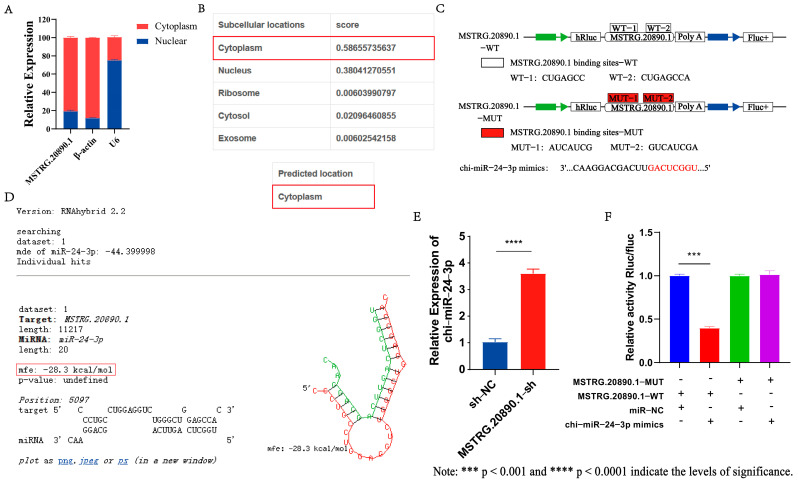
Results: Based on the transcriptome database of Inner Mongolia cashmere goat skin at different embryonic stages, which was previously constructed by our group, according to the characteristics of hair follicle development in the embryonic stage, we screened out the lncRNA MSTRG.20890.1 that was down-expressed on the 75-SHFINI day of the embryonic stage. We found that lncRNA MSTRG.20890.1 was mainly located in the cytoplasm of cells, and it could inhibit the proliferation and directional migration of dermal fibroblasts through the chi-miR-24-3p/ADAMTS3 signaling axis, thereby inhibiting the formation of dermal papilla structure at embryonic stage.

Conclusions: This study revealed that lncRNA MSTRG.20890.1 regulated secondary hair follicle morphogenesis and development in cashmere goats through the chi-miR-24-3p/ADAMTS3 signaling axis.

Keywords: cashmere goat; dermal fibroblast; hair follicle; lncRNA; morphogenesis.


Conflict of interest statement

We certify that there are no conflicts of interest with any financial organization regarding the material discussed in the manuscript.

Figures
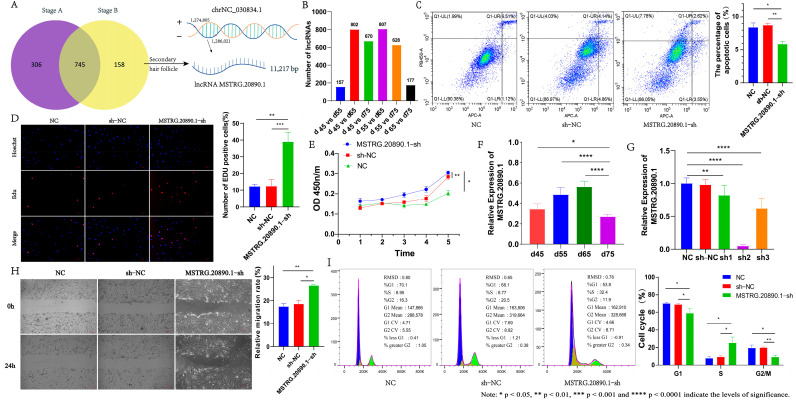
Figure 1
Figure 1
Functional analysis of lncRNA MSTRG.20890.1 in dermal fibroblasts. (A) Screening of lncRNA MSTRG.20890.1 related to secondary hair follicle morphogenesis. (B) Expression of lncRNA in different treatment groups. (C) The apoptosis of dermal fibroblasts was detected after lncRNA MSTRG.20890.1 interference. (D) EDU was used to detect the proliferation of lncRNA MSTRG.20890.1-sh cell line. (E) CCK8 was used to detect the proliferation of lncRNA MSTRG.20890.1-sh cell line. (F) Expression of lncRNA MSTRG.20890.1 in skin samples at different embryonic periods. (G) Screening of lncRNA MSTRG.20890.1 interference vector. (H) Migration ability of lncRNA MSTRG.20890.1-sh cell line. (I) Cell cycle determination of lncRNA MSTRG.20890.1-sh cell line.
Figure 2
Figure 2
LncRNA MSTRG.20890.1 acts as a sponge for chi-miR-24-3p in cashmere goat. (A) Detection of lncRNA MSTRG.20890.1 expression in the nucleus and cytoplasm of dermal fibroblasts. (B) lncLocator software predicts the distribution of lncRNA MSTRG.20890.1 in cells. (C) Schematic diagram of wild/mutant lncRNA MSTRG.20890.1 luciferase reporter vector construction. (D) RNAhybrid (v2.1.2) software predicts the sequence of lncRNA MSTRG.20890.1 binding site to chi-miR-24-3p. (E) Relative expression of chi-miR-24-3p after transfection of dermal fibroblasts with lncRNA MSTRG.20890.1-sh. (F) Dual-luciferase reporter gene system to detect target binding of lncRNA MSTRG.20890.1 to chi-miR-24-3p.
Figure 3
Figure 3
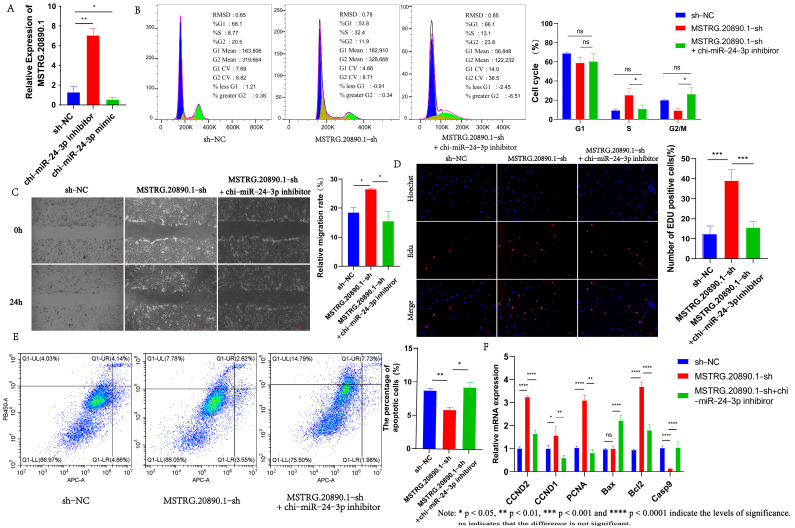
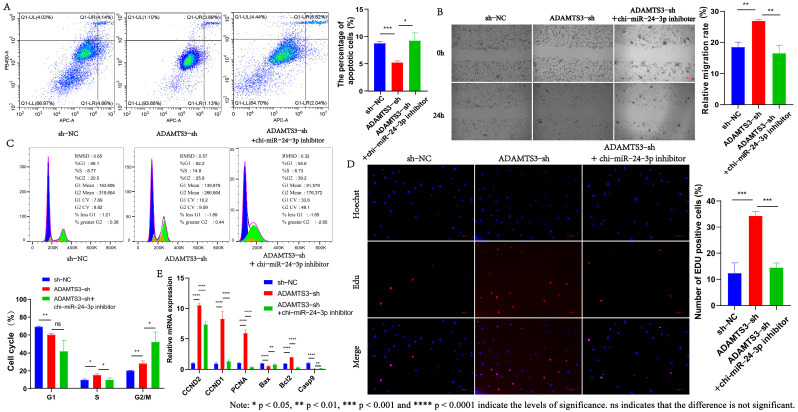
Chi-miR-24-3p can reverse the effect of lncRNA MSTRG.20890.1 on the cell phenotype of dermal fibroblasts. (A) The expression of lncRNA MSTRG.20890.1 was detected in chi-miR-24-3p interference/overexpression cell lines. (B) The cell cycle of lncRNA MSTRG.20890.1-sh cell line was detected after adding chi-miR-24-3p inhibitor. (C) The migration of lncRNA MSTRG.20890.1-sh cell line was detected after adding chi-miR-24-3p inhibitor. (D) lncRNA MSTRG.20890.1-sh cell line was added with chi-miR-24-3p inhibitor to detect cell proliferation. (E) The apoptosis of lncRNA MSTRG.20890.1-sh cell line was detected after adding chi-miR-24-3p inhibitor. (F) Expression of marker genes for cell proliferation/apoptosis.
Figure 4
Figure 4
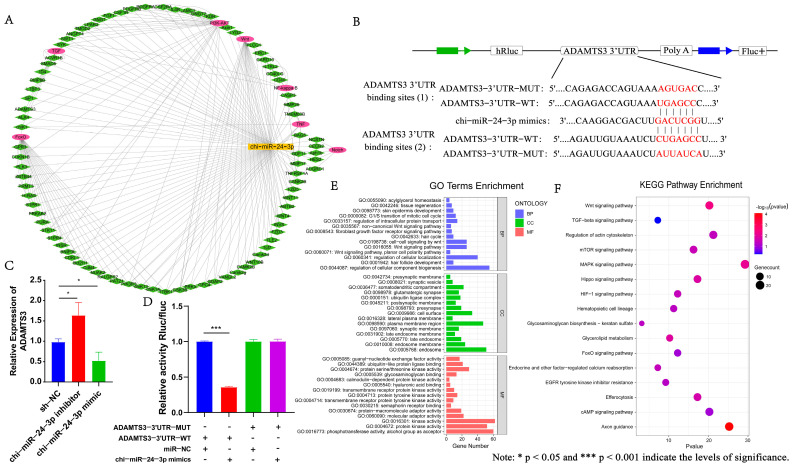
Prediction and analysis of chi-miR-24-3p target gene. (A) Construction of chi-miR-24-3p-mRNA regulatory network. (B) Schematic diagram of wild-type/mutant-type ADAMTS3-3′UTR luciferase reporter vector construction. (C) Detection of ADAMTS3 expression in chi-miR-24-3p interference/overexpression dermal fibroblast cell lines. (D) Targeted binding of chi-miR-24-3p toADAMTS3-3′UTR was detected. (E) GO enrichment analysis of chi-miR-24-3p target genes. (F) KEGG enrichment analysis of chi-miR-24-3p target genes.
Figure 5
Figure 5
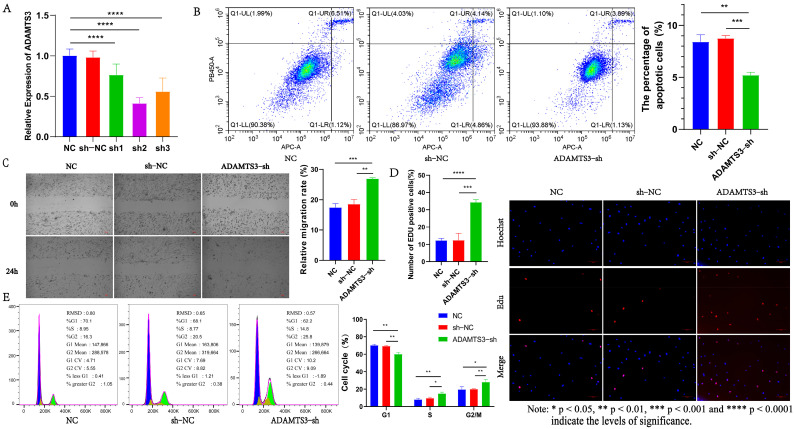
Functional analysis of ADAMTS3 in dermal fibroblasts. (A) Screening of ADAMTS3 interference vector. (B) The apoptosis of dermal fibroblasts was detected after ADAMTS3 interference. (C) Migration ability of ADAMTS3-sh cell line. (D) EDU was used to detect the proliferation of ADAMTS3-sh cell line. (E) Cell cycle determination of ADAMTS3-sh cell line.
Figure 6
Figure 6
Chi-miR-24-3p can reverse the effect of ADAMTS3 on the cell phenotype of dermal fibroblasts. (A) The apoptosis of ADAMTS3-sh cell line was detected after adding chi-miR-24-3p inhibitor. (B) The migration of ADAMTS3-sh cell line was detected after adding chi-miR-24-3p inhibitor. (C) The cell cycle of ADAMTS3-sh cell line was detected after adding chi-miR-24-3p inhibitor. (D) The proliferation of ADAMTS3-sh cell line was detected after adding chi-miR-24-3p inhibitor. (E) Expression of marker genes for cell proliferation/apoptosis.
Figure 7
Figure 7
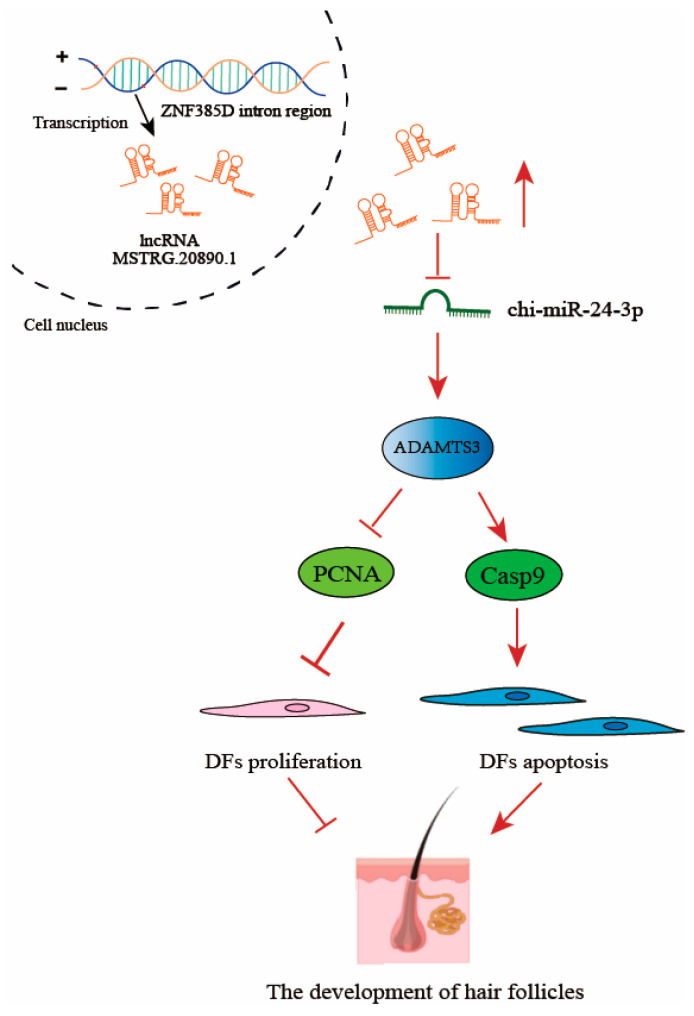
Diagram of the lncRNA MSTRG.20890.1/chi-miR-24-3p/ADAMTS3 regulatory mechanism.

References

    1. Zhang P. Production and research status of cashmere goat industry in the world. Anim. Husb. Feed. Sci. 1994;1:20–24. doi: 10.16003/j.cnki.issn1672-5190.1994.01.006. - DOI
    1. Zhang Y., Yin J., Li J., Li C. Study on Hair Follicle Structure and Morphogenesis of the Inner Mongolian Arbas Cashmere Goat. Sci. Agric. Sin. 2007;05:1017–1023.
    1. Xu W., He L., Li Y., Tan Y., Zhang F., Xu H. Silencing of lncRNA ZFAS1 Inhibits Malignancies by Blocking Wnt/β-Catenin Signaling in Gastric Cancer Cells. Biosci. Biotechnol. Biochem. 2018;82:456–465. doi: 10.1080/09168451.2018.1431518. - DOI - PubMed
    1. Ma R., Du H., Cao Y., Zhao Z., Shang F., Wang R., Zhang Y. Research progress on the regulatory mechanisms of follicle morphogenesis and development in mammals. J. China Agric. Univ. 2024;29:40–55. doi: 10.11841/j.issn.1007-4333.2024.05.04. - DOI
    1. Zhang Y., Yin J., Li C., Li J. Study on Development of Skin and Hair Folli cle fro m Fetal I inner Mongoli an Arbas Cashmere Goats. Acta Vet. Et Zootech. Sin. 2006;8:761–768.

MeSH terms

LinkOut - more resources