. 2024 Oct 31;16(11):1406.
doi: 10.3390/pharmaceutics16111406.

Treatment of Inflammatory Bowel Disease by Using Curcumin-Containing Self-Microemulsifying Delivery System: Macroscopic and Microscopic Analysis

Affiliations

Treatment of Inflammatory Bowel Disease by Using Curcumin-Containing Self-Microemulsifying Delivery System: Macroscopic and Microscopic Analysis

Nabeela Ameer et al. Pharmaceutics. .

Erratum in

Abstract

Background: The lack of local availability for drugs in the colon can be addressed by preparing a self-microemulsifying drug delivery system (SMEDDS) of curcumin (Cur) which is ultimately used for the treatment of inflammatory bowel disease (IBD). Methods: From preformulation studies, Lauroglycol FCC (oil), Tween 80 (surfactant), Transcutol HP (co-surfactant), and Avicel (solid carrier) were selected for the preparation of blank liquid and solid Cur-loaded SMEDDSs (S-Cur-SMEDDSs). Results: Z-average size (12.36 ± 0.04 nm), zeta potential (-14.7 ± 0.08 mV), and polydispersity index (PDI) (0.155 ± 0.036) showed a comparative droplet surface area and charge of both SMEDDSs. The physicochemical stability of Cur in S-Cur-SMEDDSs was confirmed via FTIR, DSC, TGA, and XRD analyses, while morphological analysis through SEM and atomic force microscopy (AFM) confirmed Cur loading into SMEDDSs with an increased surface roughness root mean square (RMS) of 11.433 ± 0.91 nm, greater than the blank SMEDDS. Acute toxicity studies with an organ weight ratio and % hemolysis of 15.65 ± 1.32% at a high concentration of 600 mM showed that S-Cur-SMEDDSs are safe at a medium dose (0.2-0.8 g/kg/day). The excellent in vitro antioxidant (68.54 ± 1.42%) and anti-inflammatory properties (56.47 ± 1.17%) of S-Cur-SMEDDS proved its therapeutic efficacy for IBD. Finally, S-Cur-SMEDDS significantly improved acetic acid-induced IBD in albino rats through a reduction in the disease activity index (DAI) and macroscopic ulcer score (MUS) from 4.15 ± 0.21 to 1.62 ± 0.12 at 15 mg/kg/day dose, as confirmed via histopathological assay. Conclusions: Based on the above findings, S-Cur-SMEDDS appears to be a stable, less toxic, and more efficacious alternative for Cur delivery with strong competence in treating IBD.

Keywords: acute toxicity; colon; curcumin; inflammatory bowel disease; self-microemulsifying drug delivery system.


Conflict of interest statement

The authors declare no conflicts of interest.

Figures

Figure 1
Figure 1
(a) ATR-FTIR spectra of Lauroglycol FCC, Tween 80, Transcutol HP, Avicel, Cur, and S-Cur-SMEDDS showed no chemical interactions. (b) DSC thermograms and (c) TGA analysis confirmed the absence of crystalline peaks of Cur after loading into SMEDDS. (d) X ray diffraction studies indicated no traces of crystalline peaks of Cur in S-Cur-SMEDDS.
Figure 2
Figure 2
SEM images of (a,b) Cur under 100 KX and 600× in the 10–20 µm size tange. (c) Blank L-SMEDDS under 200× magnification in the 100 µm size range. (d) L-Cur-SMEDDS at 350× and 550× in the 10 µm size range showing an amorphous nature. (e,f) S-Cur-SMEDDS under 550× magnification in the 10 µm size range showing confirmation of amorphous properties.
Figure 3
Figure 3
AFM analysis showing (a) surface roughness of Cur-loaded SMEDDS; (b) AFM of blank and Cur-loaded SMEDDS with calculated roughness parameters.
Figure 4
Figure 4
(a) Represented % release of Cur through S-Cur-SMEDDS in sink conditions (n = 3). (b) Concentration-dependent in vitro % scavenging activity of Cur and S-Cur-SMEDDS with DPPH and hydrogen peroxide (H2O2) (n = 3). (c) In vitro anti-inflammatory effect of Cur, S-Cur-SMEDDS, and reference standard diclofenac sodium via protein denaturation of BSA and ovalbumin (n = 3). (d) % Hemolytic effect for investigation of toxicity of Cur and S-Cur-SMEDDS against blood cells (n = 3).
Figure 5
Figure 5
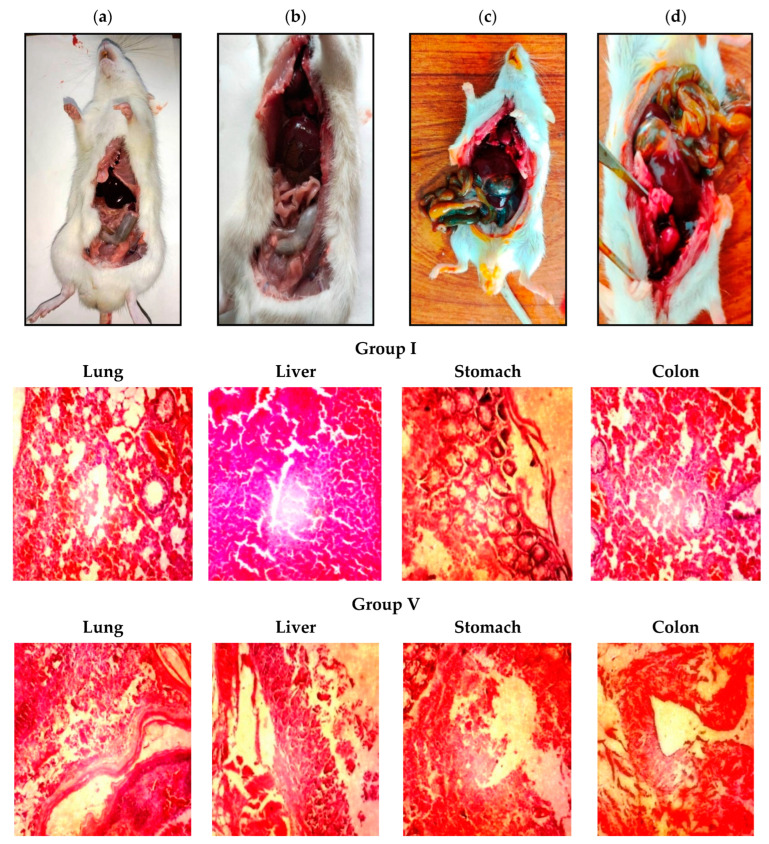
Physical examination of mice after (a,b) low and medium doses and (c,d) high dose in acute toxicity analysis. Microscopic evaluation of tissue histology of normal Group I mice organs and Group V mice treated with a lethal or toxic S-Cur-SMEDDS dose. 10× magnification.
Figure 6
Figure 6
(A) % Body weight change in Group I (control), Group II (IBD-induced), Group III (IBD (induced + mesalamine-treated), and Group IV (IBD-induced + S-Cur-SMEDDS-treated). (B) Effect of S-Cur-SMEDDS on disease activity index (DAI) compared to Group II (mean ± SD) (n = 6). (C) Results of macroscopic ulcer score (MUS) after IBD induction and treatment (p< 0.05) in 7 days (n = 6) along with images of colonic mucosa: (a) Group I; (b,c) Group II; (d) Group III; and (e) Group IV. (D) Colon weight (g)-to-length (cm) ratio showing a thicker and nodular wall with shorter length in IBD-induced rat compared to Group I (n = 6).
Figure 7
Figure 7
(A) Images of normal and anal bleeding rats after IBD induction through 1% v/v acetic acid solution. Effect of Cur-SMEDDS on the severity of inflammatory reactions in rats of Group IV for a total of 10 days. (B) Microscopic scoring criteria (MiSC) after 10 days of treatment (n = 6). (C) Histopathological scoring showing a description of the colon tissues of four groups on the basis of % area involved (denoted by A): inflammation, extent and Cryptosis are denoted by I, E and C. a is normal without treatment, b is IBD-induced without treatment, c, d, e and f are treatment after IBD induction.
Figure 7
Figure 7
(A) Images of normal and anal bleeding rats after IBD induction through 1% v/v acetic acid solution. Effect of Cur-SMEDDS on the severity of inflammatory reactions in rats of Group IV for a total of 10 days. (B) Microscopic scoring criteria (MiSC) after 10 days of treatment (n = 6). (C) Histopathological scoring showing a description of the colon tissues of four groups on the basis of % area involved (denoted by A): inflammation, extent and Cryptosis are denoted by I, E and C. a is normal without treatment, b is IBD-induced without treatment, c, d, e and f are treatment after IBD induction.

References

    1. Liu F., Li D., Wang X., Cui Y., Li X. Polyphenols intervention is an effective strategy to ameliorate inflammatory bowel disease: A systematic review and meta-analysis. Int. J. Food Sci. Nutr. 2021;72:14–25. doi: 10.1080/09637486.2020.1760220. - DOI - PubMed
    1. Singh S., Yadav K., Varma A.K. Inflammatory Bowel Disease: An Overview of Immune Mechanisms and Biological Treatments. Int. J. Pharm. Life Sci. 2019;10:32.
    1. Burge K., Gunasekaran A., Eckert J., Chaaban H. Curcumin and intestinal inflammatory diseases: Molecular mechanisms of protection. Int. J. Mol. Sci. 2019;20:1912. doi: 10.3390/ijms20081912. - DOI - PMC - PubMed
    1. Song Q., Jia J., Niu X., Zheng C., Zhao H., Sun L., Zhang H., Wang L., Zhang Z., Zhang Y. An oral drug delivery system with programmed drug release and imaging properties for orthotopic colon cancer therapy. Nanoscale. 2019;11:15958–15970. doi: 10.1039/C9NR03802G. - DOI - PubMed
    1. González-Ortega L.A., Acosta-Osorio A.A., Grube-Pagola P., Palmeros-Exsome C., Cano-Sarmiento C., García-Varela R., García H.S. Anti-inflammatory activity of curcumin in gel carriers on mice with atrial edema. J. Oleo Sci. 2020;69:123–131. doi: 10.5650/jos.ess19212. - DOI - PubMed

LinkOut - more resources