Review
. 2024 Nov 19;24(22):7383.
doi: 10.3390/s24227383.

No-Reference Objective Quality Metrics for 3D Point Clouds: A Review

Affiliations
Review

No-Reference Objective Quality Metrics for 3D Point Clouds: A Review

Simone Porcu et al. Sensors (Basel). .

Abstract

Three-dimensional (3D) applications lead the digital transition toward more immersive and interactive multimedia technologies. Point clouds (PCs) are a fundamental element in capturing and rendering 3D digital environments, but they present significant challenges due to the large amount of data typically needed to represent them. Although PC compression techniques can reduce the size of PCs, they introduce degradations that can negatively impact the PC's quality and therefore the object representation's accuracy. This trade-off between data size and PC quality highlights the critical importance of PC quality assessment (PCQA) techniques. In this article, we review the state-of-the-art no-reference (NR) objective quality metrics for PCs, which can accurately estimate the quality of generated and compressed PCs solely based on feature information extracted from the distorted PC. These characteristics make NR PCQA metrics particularly suitable in real-world application scenarios where the original PC data are unavailable for comparison, such as in streaming applications.

Keywords: 3D; model-based metric; no-reference metric; objective quality evaluation; point cloud; projection-based metric; quality of experience.


Conflict of interest statement

The authors declare no conflicts of interest.

Figures
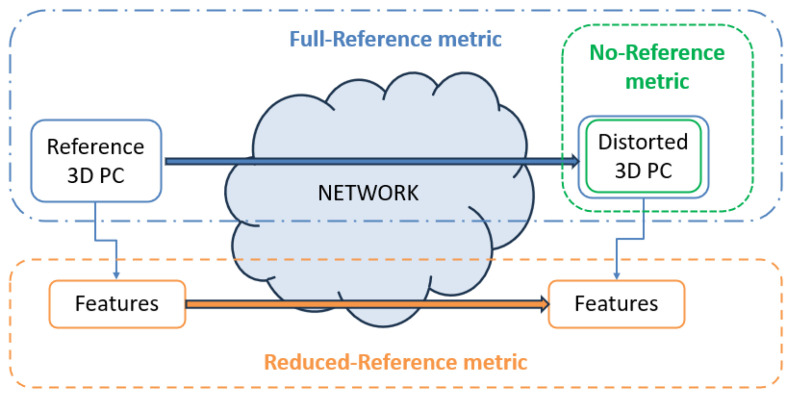
Figure 1
Figure 1
The scheme of full-reference (FR), reduced-reference (RR), and no-reference (NR) metrics.
Figure 2
Figure 2
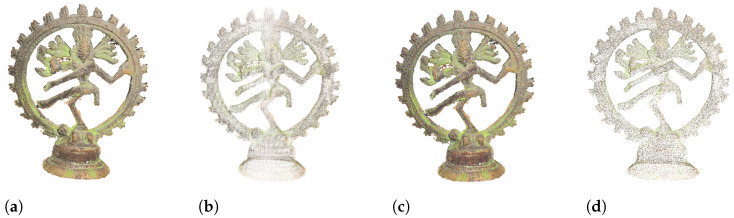
Examples of distorted PCs from the SJTU-PCQA dataset [13]. (a) Original Shiva PC. (b) OcTree-based compression (85%). (c) Color noise (70%). (d) Downscaling (90%).
Figure 3
Figure 3
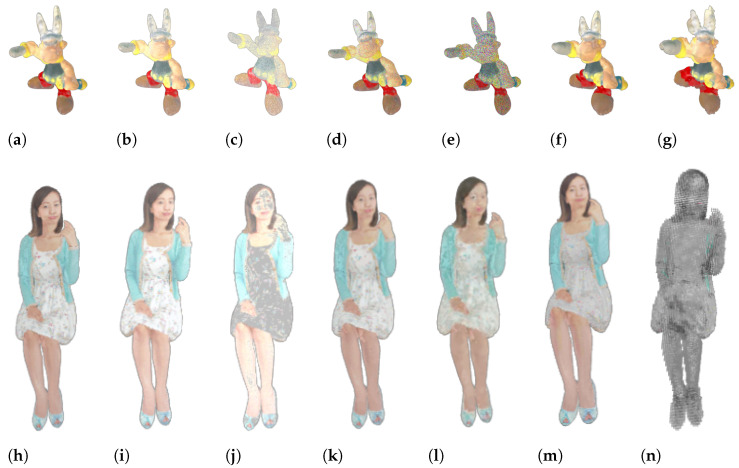
Examples of distorted PCs from the LS-PCQA dataset [19]. (a) Original Asterix PC. (b) Gamma noise with parameter 1. (c) Gamma noise with parameter 7. (d) Multiplicative Gaussian noise with parameter 1. (e) Multiplicative Gaussian noise with parameter 7. (f) Poisson Reconstruction with parameter 3. (g) Poisson Reconstruction with parameter 7. (h) Original Aya PC. (i) Poisson noise with parameter 3. (j) Poisson noise with parameter 7. (k) GPCC-Lossless geometry and lossy attributes with parameter 3. (l) GPCC-Lossless geometry and lossy attributes with parameter 7. (m) AVS-Limited lossy geometry and lossy attributes with parameter 3. (n) AVS-Limited lossy geometry and lossy attributes with parameter 7.
Figure 4
Figure 4
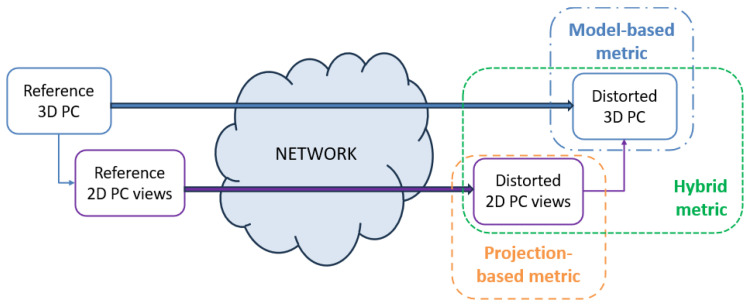
The scheme of model-based, projection-based and hybrid NR PCQA approaches.
Figure 5
Figure 5
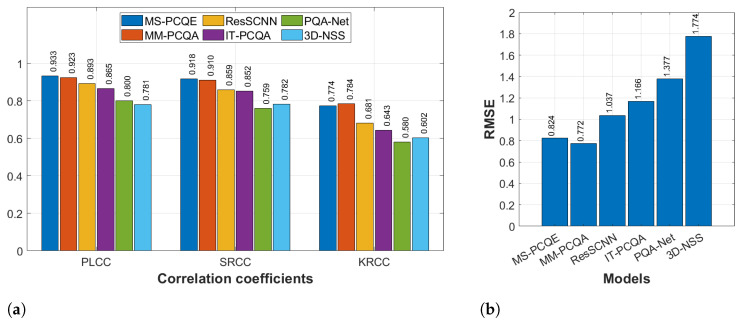
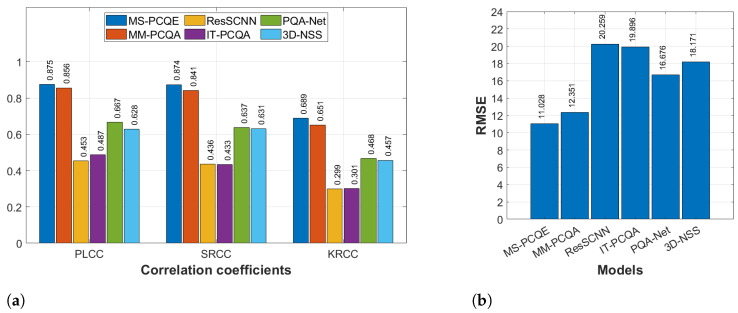
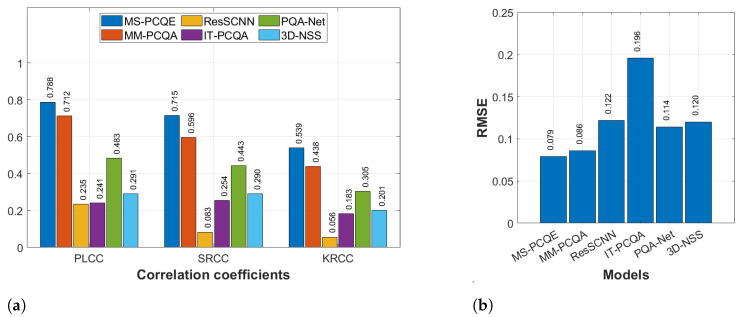
Performance comparison of six SOTA NR PCQA models on the SJTU-PCQA dataset as provided in [25]. (a) PLCC, SRCC, and KRCC. (b) RMSE.
Figure 6
Figure 6
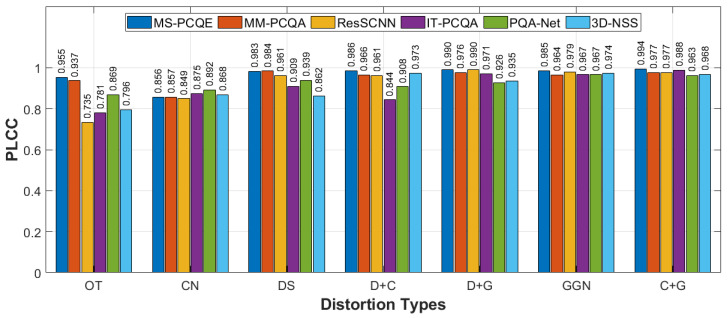
Performance comparison of six SOTA NR PCQA models, in terms of PLCC, on the various distortion types on the SJTU-PCQA dataset, as provided in [25].
Figure 7
Figure 7
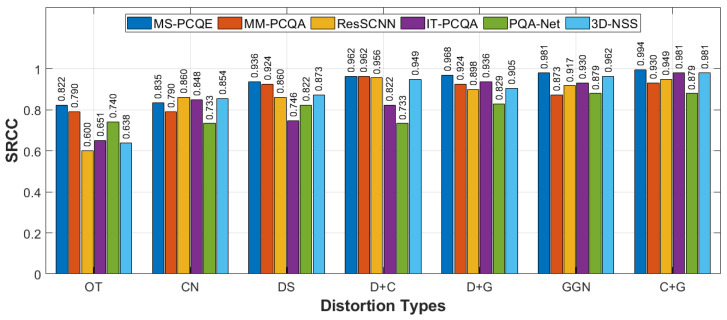
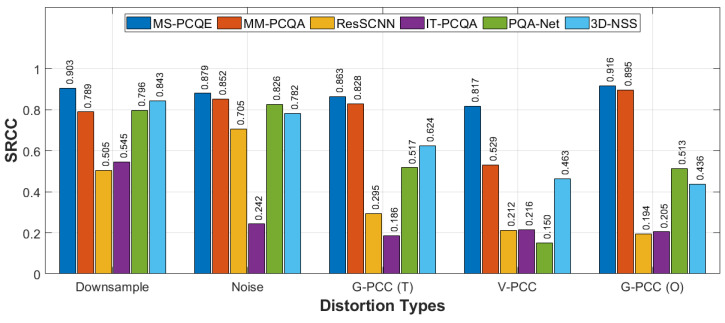
Performance comparison of six SOTA NR PCQA models, in terms of SRCC, on the various distortion types on the SJTU-PCQA dataset, as provided in [25].
Figure 8
Figure 8
Performance comparison of most SOTA NR PCQA models on the WPC dataset as provided in [25]. (a) PLCC, SRCC, and KRCC. (b) RMSE.
Figure 9
Figure 9
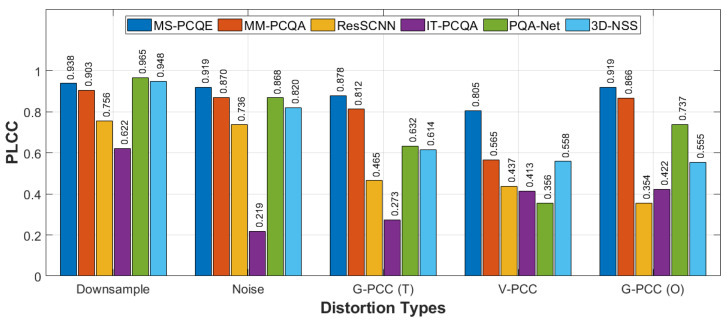
Performance comparison of most of the SOTA NR PCQA models, in terms of PLCC, on the various distortion types on the WPC dataset, as provided in [25].
Figure 10
Figure 10
Performance comparison of most of the SOTA NR PCQA models, in terms of SRCC, on the various distortion types on the WPC dataset, as provided in [25].
Figure 11
Figure 11
Performance comparison of most SOTA NR PCQA models on the SIAT-PCQD dataset as provided in [25]. (a) PLCC, SRCC, and KRCC. (b) RMSE.
Figure 12
Figure 12
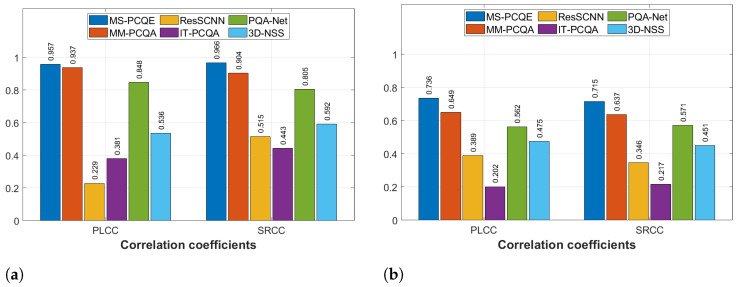
Performance comparison of most of the SOTA NR PCQA models in terms of PLCC and SRCC on the M-PCCD (a) and LS-PCQA (b) datasets as provided in [25].

References

    1. Macchi G., De Pisapia N. Virtual Reality, Face-To-Face, and 2D Video Conferencing in Group Work: A Comparative Study on Fatigue, Creativity, Flow, and Interactions. Sci. Rep. 2024;14:10260. doi: 10.1038/s41598-024-60942-6. - DOI - PMC - PubMed
    1. Dumic E., Duarte C.R., da Silva Cruz L.A. Subjective evaluation and objective measures for point clouds—State of the art; Proceedings of the 2018 First International Colloquium on Smart Grid Metrology (SmaGriMet); Split, Croatia. 24–27 April 2018; pp. 1–5. - DOI
    1. Tious A., Vigier T., Ricordel V. New challenges in point cloud visual quality assessment: A systematic review. Front. Signal Process. 2024;4:1420060. doi: 10.3389/frsip.2024.1420060. - DOI
    1. Porcu S., Floris A., Atzori L. Quality of Experience in the Metaverse: An Initial Analysis on Quality Dimensions and Assessment; Proceedings of the 2022 14th International Conference on Quality of Multimedia Experience (QoMEX); Lippstadt, Germany. 5–7 September 2022; pp. 1–4. - DOI
    1. Yang Q., Ma Z., Xu Y., Li Z., Sun J. Inferring Point Cloud Quality via Graph Similarity. IEEE Trans. Pattern Anal. Mach. Intell. 2022;44:3015–3029. doi: 10.1109/TPAMI.2020.3047083. - DOI - PubMed

LinkOut - more resources