Clinical Trial
. 2024 Nov 5;16(22):3796.
doi: 10.3390/nu16223796.

Efficacy and Safety of Weekly Calcifediol Formulations (75 and 100 µg) in Subjects with Vitamin D Deficiency: A Phase II/III Randomised Trial

Affiliations
Clinical Trial

Efficacy and Safety of Weekly Calcifediol Formulations (75 and 100 µg) in Subjects with Vitamin D Deficiency: A Phase II/III Randomised Trial

Esteban Jódar-Gimeno et al. Nutrients. .

Abstract

Background/objective: Optimal vitamin D levels are required for bone health and proper functionality of the nervous, musculoskeletal and immune systems. The objective of this study was to assess the efficacy and safety profiles of new weekly calcifediol formulations with the potential to improve adherence and outcome.

Methods: A Phase II-III, double-blind, randomized, multicentre trial (EudraCT 2020-001099-14 and NCT04735926). Subjects were randomized 2:2:1 to calcifediol 75 µg, 100 µg and placebo. 25(OH)D levels were measured at 4, 16, 24, 32 and 52 weeks. The main outcome was the percentage of subjects who achieved a response defined as 25(OH)D levels ≥20 ng/mL and/or ≥30 ng/mL at week 16.

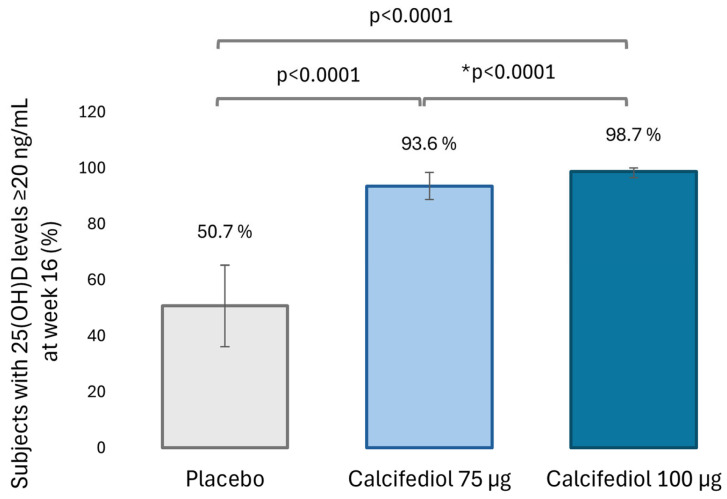
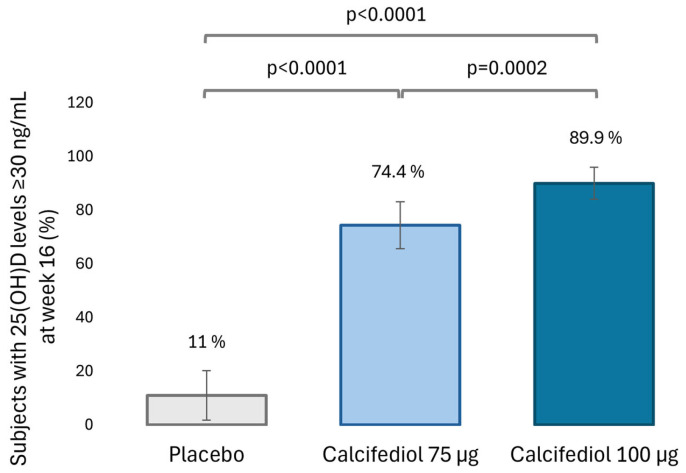
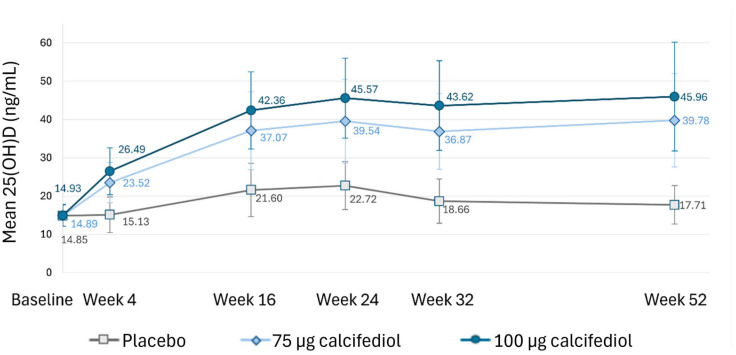
Results: 398 subjects (51.1 ± 15.96 years, 74.2% females, 98.7% Caucasian) with plasma 25(OH)D levels between 10 and 20 ng/mL were randomized. A total of 376 subjects completed 16 weeks of treatment, and 355 subjects completed the study. Six patients withdrew due to an adverse event, all unrelated to treatment. At week 16, 93.6% and 74.4% of subjects receiving calcifediol 75 µg achieved response levels of ≥20 ng/mL and ≥30 ng/mL, respectively. The calcifediol 100 µg group showed 98.7% and 89.9% of responders for ≥20 ng/mL and ≥30 ng/mL, respectively. Both calcifediol groups showed superiority over placebo at each response level at all time points analyzed (p < 0.0001). Calcifediol treatments increased 25(OH)D levels from baseline to week 24 and remained stable thereafter. The frequency of treatment-emergent adverse events was balanced between groups.

Conclusions: New weekly calcifediol 75 and 100 µg formulations showed an effective and sustained response with a good long-term safety profile.

Keywords: calcifediol; clinical trial; efficacy; phase II/III; safety; vitamin D deficiency; weekly.


Conflict of interest statement

The following authors: E.J.G, J.L.P.C., J.C., M.L., D.N., F.C.C., S.N., U.T. and N.M.C. declare that they have been involved in this clinical trial sponsored by FAES FARMA Company as Principal Investigators receiving the corresponding reimbursement approved by the Independent Ethics Committee. J.L.P.C. also acknowledges his participation as Investigator Coordinator of the study. Additionally, P.A., C.M.O., A.G.B., and I.G. are full-time employees of the study sponsor. This disclosure is made to ensure transparency and maintain the integrity of the research.

Figures
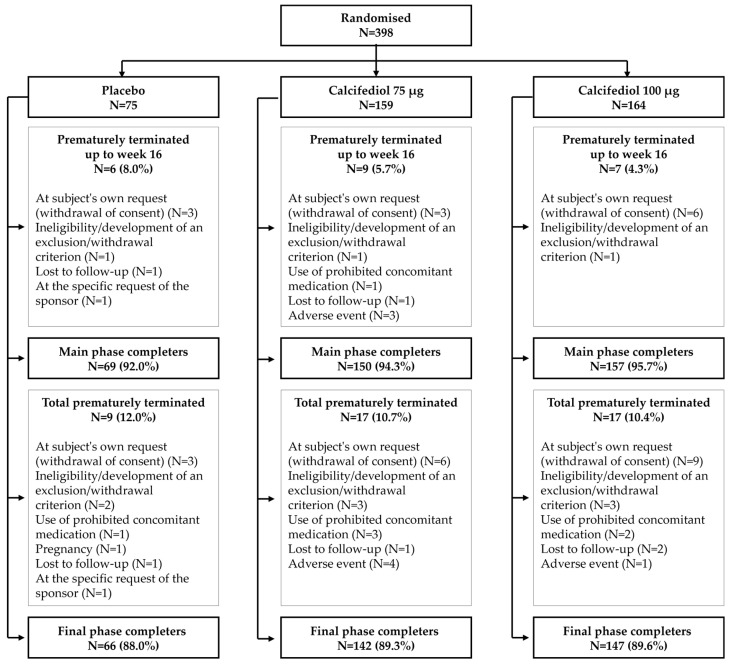
Figure 1
Figure 1
The patient flow diagram shows the number of patients randomized and conforming to each treatment group at the beginning of the study, at the completion of the main phase (week 16), and at the final phase (week 52).
Figure 2
Figure 2
Percentage of subjects with 25(OH)D levels ≥20 ng/mL at week 16 in the placebo (grey, N = 73), 75 µg calcifediol (bright blue, N = 156) and 100 µg calcifediol (dark blue, N = 159) treatment groups. p-values obtained by two-sided comparisons of proportions are indicated. * p-value of the non-inferiority test. 98.75% confidence intervals (CI) are depicted by error bars.
Figure 3
Figure 3
Percentage of subjects with 25(OH)D levels ≥30 ng/mL at week 16 in the placebo (gray, N = 73), 75 µg calcifediol (bright blue, N = 156) and 100 µg calcifediol (dark blue, N = 159) treatment groups. p-values obtained by two-sided comparisons of proportions are indicated. 98,75% confidence intervals (CI) are depicted by error bars.
Figure 4
Figure 4
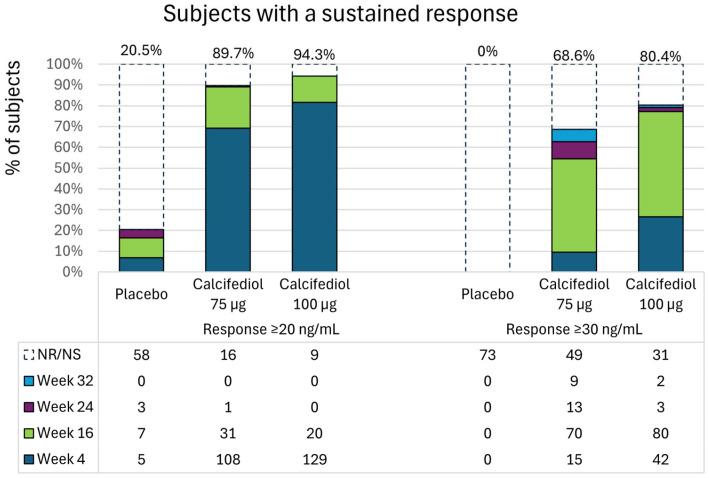
Percentage of patients starting a sustained response of ≥20 ng/mL (left) or ≥30 ng/mL (right) in the placebo, 75 µg calcifediol and 100 µg calcifediol treatment groups at week 4 (dark blue), week 16 (green), week 24 (purple) or week 32 (bright blue). The total percentage of respondents in each group is indicated in the upper part. The number of patients in each group who did not achieve a response or whose response was not sustained is denoted as Not response/Not sustained (NR/NS) in the table. In the subsequent rows, the number of subjects who achieved a sustained response is shown, grouped by the week in which this sustained response was first observed.
Figure 5
Figure 5
Mean plasma 25(OH)D levels (ng/mL) at each indicated timepoint for the placebo (grey), 75 µg calcifediol (bright blue), and 100 µg calcifediol (dark blue) treatment groups. Standard deviations are represented by error bars. p <0.0001 at every visit when comparing active treatment groups. p <0.0001 at every visit when comparing placebo to active treatments.

References

    1. Cui A., Zhang T., Xiao P., Fan Z., Wang H., Zhuang Y. Global and regional prevalence of vitamin D deficiency in population-based studies from 2000 to 2022: A pooled analysis of 7.9 million participants. Front. Nutr. 2023;10:1070808. doi: 10.3389/fnut.2023.1070808. - DOI - PMC - PubMed
    1. Szymczak-Pajor I., Drzewoski J., Śliwińska A. The Molecular Mechanisms by Which Vitamin D Prevents Insulin Resistance and Associated Disorders. Int. J. Mol. Sci. 2020;21:6644. doi: 10.3390/ijms21186644. - DOI - PMC - PubMed
    1. Lips P., Van Schoor N.M. The effect of vitamin D on bone and osteoporosis. Best Pract. Res. Clin. Endocrinol. Metab. 2011;25:585–591. doi: 10.1016/j.beem.2011.05.002. - DOI - PubMed
    1. Charoenngam N., Ayoub D., Holick M.F. Nutritional rickets and vitamin D deficiency: Consequences and strategies for treatment and prevention. Expert Rev. Endocrinol. Metab. 2022;17:351–364. doi: 10.1080/17446651.2022.2099374. - DOI - PubMed
    1. Carlberg C. A Pleiotropic Nuclear Hormone Labelled Hundred Years Ago Vitamin D. Nutrients. 2022;15:171. doi: 10.3390/nu15010171. - DOI - PMC - PubMed

Publication types

LinkOut - more resources