


Long-term follow-up of the conventional versus no-touch isolation technique for resection of primary colon cancer (JCOG1006): randomized clinical trial
- PMID: 39602807
- PMCID: PMC11602131
- DOI: 10.1093/bjsopen/zrae133
Long-term follow-up of the conventional versus no-touch isolation technique for resection of primary colon cancer (JCOG1006): randomized clinical trial
Abstract
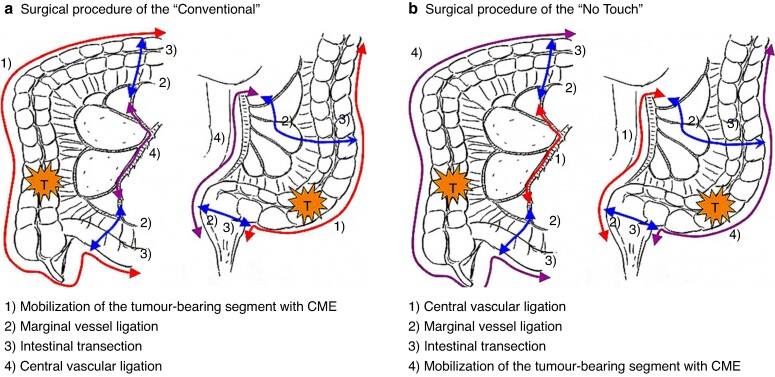
Background: The Japan Clinical Oncology Group (JCOG) 1006 was a phase III trial of patients with clinical T3/T4 colon cancer comparing the no-touch isolation technique ('No Touch') with the conventional technique ('Conventional'). The planned primary analysis at 3 years failed to confirm the superiority of the No Touch over the 'Conventional'. The present study aimed to compare the 'No Touch' and 'Conventional' using long-term (6-year) follow-up data.
Methods: Patients aged 20-80 years who had a clinical classification of T3-4, N0-2, and M0 with histologically proven colon cancer were randomly assigned (1 : 1) to undergo open surgery using 'Conventional' or 'No Touch' techniques. The primary endpoint was disease-free survival.
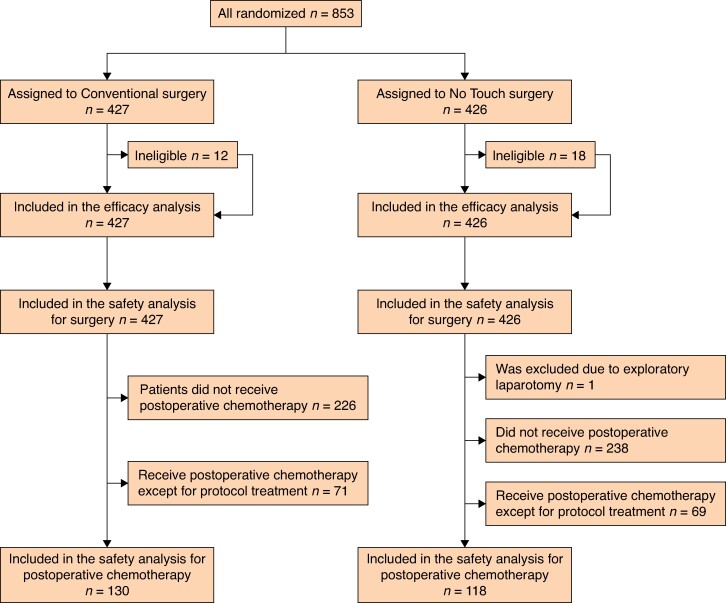
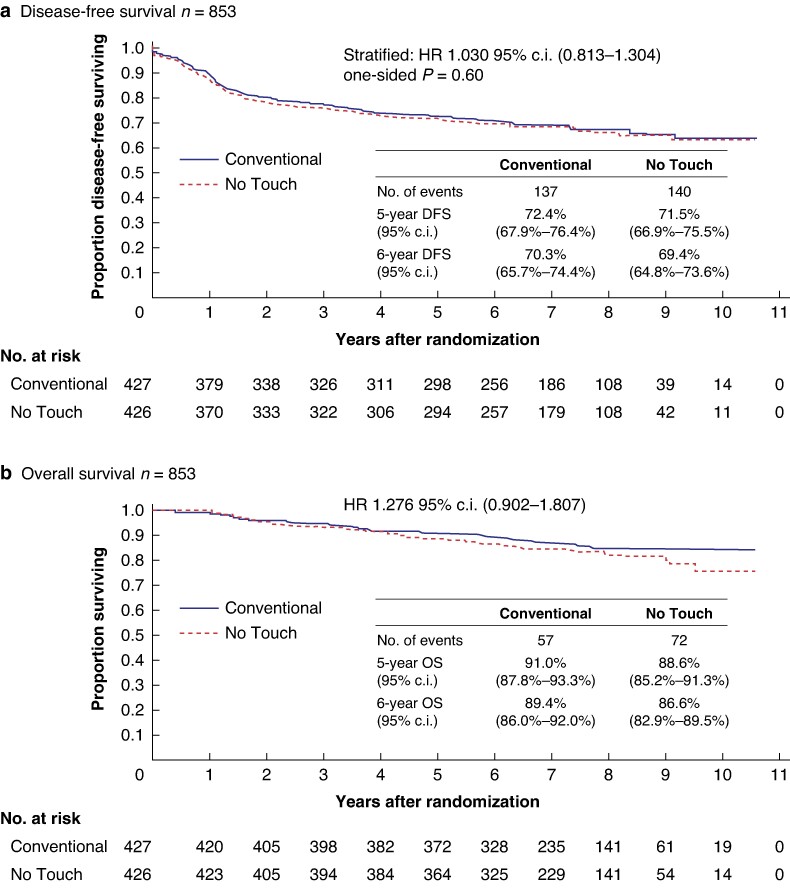
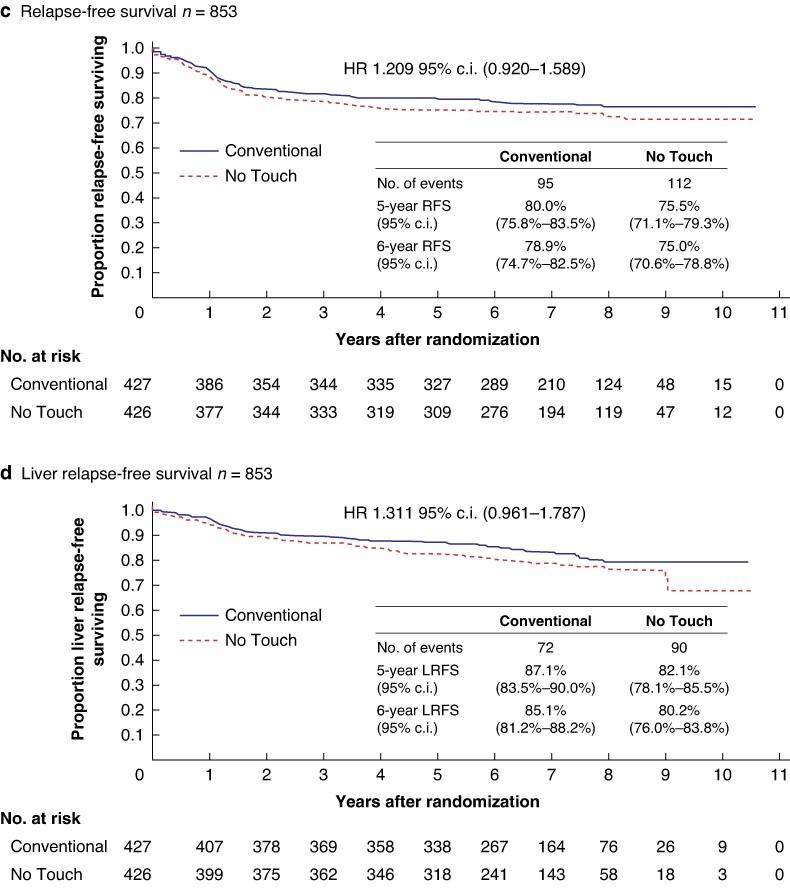
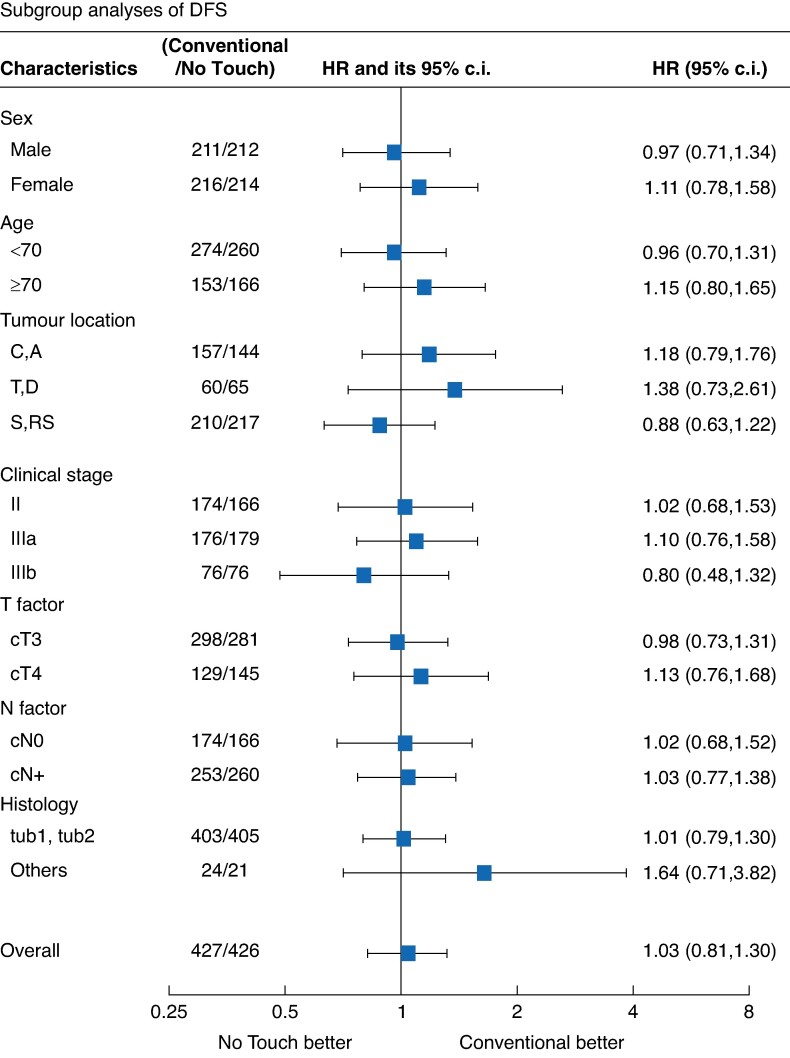
Results: In total, 853 patients from 30 institutions were assigned to the 'Conventional' (427) or 'No Touch' (426) groups between June 2011 and November 2015. The 6-year disease-free survival was 70.3% and 69.4% for 'Conventional' and 'No Touch' arms respectively (HR 1.030; 95% c.i. 0.813 to 1.304; one-sided P = 0.60). The 6-year overall survival was 89.4% and 86.6% respectively (HR 1.276; 95% c.i. 0.902 to 1.807). The 6-year relapse-free survival was 78.9% and 75.0% respectively (HR 1.209; 95% c.i. 0.920 to 1.589). The 6-year liver relapse-free survival was 85.1% and 80.2% respectively (HR 1.311; 95% c.i. 0.961 to 1.787).
Conclusion: Long-term follow-up data did not support the superiority of 'No Touch' over 'Conventional' technique in patients with stages II and III colon cancer. These study findings indicate that the conventional technique is still standard surgery for managing colon cancers.
Trial registration number: UMIN000004957.
© The Author(s) 2024. Published by Oxford University Press on behalf of BJS Foundation Ltd.
Figures
References
-
- Barnes JP. Physiologic resection of the right colon. Surg Gynecol Obstet 1952;94:722–726 - PubMed
-
- Slanetz CA Jr. Effect of no touch isolation on survival and recurrence in curative resections for colorectal cancer. Ann Surg Oncol 1998;5:390–398 - PubMed
-
- Wiggers T, Jeekel J, Arends JW, Brinkhorst AP, Kluck HM, Luyk CI et al. No-touch isolation technique in colon cancer: a controlled prospective trial. Br J Surg 1988;75:409–415 - PubMed
Publication types
MeSH terms
Grants and funding
LinkOut - more resources
Full Text Sources
