


Determinants of Leptomeningeal Collateral Status in Acute Ischemic Stroke: A Systematic Review and Meta-Analysis of Observational Studies
- PMID: 39604037
- PMCID: PMC11681590
- DOI: 10.1161/JAHA.124.034170
Determinants of Leptomeningeal Collateral Status in Acute Ischemic Stroke: A Systematic Review and Meta-Analysis of Observational Studies
Abstract
Background: Leptomeningeal collateral status is a major determinant of outcomes in patients with acute ischemic stroke; however, the factors that determine collateral status are not well understood. We conducted a comprehensive systematic review and meta-analysis to identify determinants associated with collateral status in patients with anterior circulation infarction.
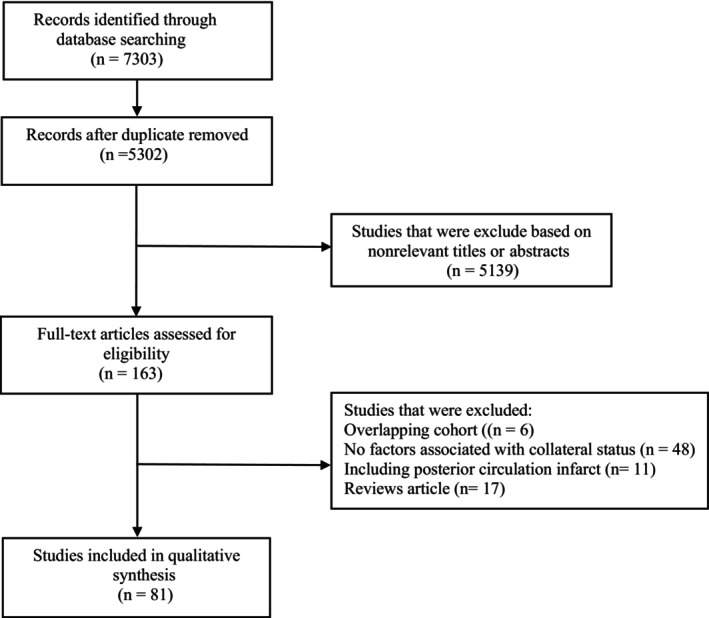
Methods and results: The PubMed, EMBASE, Web of Science, and Cochrane Central Register of Controlled Trials databases were searched for studies that reported the determinants of leptomeningeal collateral status in acute ischemic stroke between January 2000 and June 2023. A random-effects meta-analysis model was used to pool the determinants of leptomeningeal collateral status. Eighty-one studies with 17 366 patients met the inclusion criteria. We analyzed 31 potential risk factors, and the results indicated that worse leptomeningeal collateral status was significantly associated with older age (weighted mean difference, 1.22 [95% CI, 0.69 to 1.76]), male sex (odds ratio [OR], 1.12 [95% CI, 1.02 to 1.23]), hypertension (OR, 1.27 [95% CI, 1.15 to 1.40]), diabetes (OR, 1.21 [95% CI, 1.10 to 1.33]), atrial fibrillation (OR, 1.26 [95% CI, 1.09 to 1.46]), cardioembolic stroke (OR, 1.27 [95% CI, 1.04 to 1.55]), internal carotid artery occlusion (OR, 1.84 [95% CI, 1.50 to 2.25]), and higher admission blood glucose (weighted mean difference, 8.74 [95% CI, 2.52 to 18.51]).
Conclusions: Hypertension and diabetes could be modifiable risk factors associated with leptomeningeal collateral status. Older age and male sex could be nonmodified risk factors. Further high-quality therapeutic studies focusing on controlling risk factors are needed to support our findings.
Keywords: collateral status; meta; risk factor; stroke.
Conflict of interest statement
None.
Figures
References
-
- Anadani M, Finitsis S, Clarencon F, Richard S, Marnat G, Bourcier R, Sibon I, Dargazanli C, Arquizan C, Blanc R, et al. Collateral status reperfusion and outcomes after endovascular therapy: insight from the endovascular treatment in ischemic stroke (ETIS) registry. J Neurointerv Surg. 2022;14:551–557. doi: 10.1136/neurintsurg-2021-017553 - DOI - PubMed
-
- Gensicke H, Al‐Ajlan F, Fladt J, Campbell BCV, Majoie C, Bracard S, Hill MD, Muir KW, Demchuk A, San Román L, et al. Comparison of three scores of collateral status for their association with clinical outcome: the HERMES collaboration. Stroke. 2022;53:3548–3556. doi: 10.1161/strokeaha.122.039717 - DOI - PubMed
-
- Flores A, Rubiera M, Ribó M, Pagola J, Rodriguez‐Luna D, Muchada M, Boned S, Seró L, Sanjuan E, Meler P, et al. Poor collateral circulation assessed by multiphase computed tomographic angiography predicts malignant middle cerebral artery evolution after reperfusion therapies. Stroke. 2015;46:3149–3153. doi: 10.1161/strokeaha.115.010608 - DOI - PubMed
Publication types
MeSH terms
LinkOut - more resources
Full Text Sources
Medical
Miscellaneous
