. 2024 Nov 28;64(1):29.
doi: 10.1007/s00394-024-03511-x.

Development of metabolic signatures of plant-rich dietary patterns using plant-derived metabolites

Affiliations

Development of metabolic signatures of plant-rich dietary patterns using plant-derived metabolites

Yong Li et al. Eur J Nutr. .

Erratum in

Abstract

Background: Diet is an important modifiable lifestyle factor for human health, and plant-rich dietary patterns are associated with lower risk of non-communicable diseases in numerous studies. However, objective assessment of plant-rich dietary exposure in nutritional epidemiology remains challenging.

Objectives: This study aimed to develop and evaluate metabolic signatures of the most widely used plant-rich dietary patterns using a targeted metabolomics method comprising 108 plant food metabolites.

Methods: A total of 218 healthy participants were included, aged 51.5 ± 17.7 years, with 24 h urine samples measured using ultra-high-performance liquid chromatography-mass spectrometry. The validation dataset employed three sample types to test the robustness of the signature, including 24 h urine (n = 88), plasma (n = 195), and spot urine (n = 198). Adherence to the plant-rich diet was assessed using a priori plant-rich dietary patterns calculated using Food Frequency Questionnaires. A combination of metabolites evaluating the adherence to a specific diet was identified as metabolic signature. We applied linear regression analysis to select the metabolites significantly associated with dietary patterns (adjusting energy intake), and ridge regression to estimate penalized weights of each candidate metabolite. The correlation between metabolic signature and the dietary pattern was assessed by Spearman analysis (FDR < 0.05).

Results: The metabolic signatures consisting of 42, 22, 35, 15, 33, and 33 predictive metabolites across different subclasses were found to be associated with adherence to Amended Mediterranean Score (A-MED), Original MED (O-MED), Dietary Approaches to Stop Hypertension (DASH), Mediterranean-DASH Intervention for Neurodegenerative Delay (MIND), healthy Plant-based Diet Index (hPDI) and unhealthy PDI (uDPI), respectively. The overlapping and distinct predictive metabolites across six dietary patterns predominantly consisted of phenolic acids (n = 38), including 14 cinnamic acids, 14 hydroxybenzoic acids, seven phenylacetic acids, and three hippuric acids. Six metabolites were included in all signatures, including two lignans: enterolactone-glucuronide, enterolactone-sulfate, and four phenolic acids: cinnamic acid, cinnamic acid-4'-sulfate, 2'-hydroxycinnamic acid, and 4-methoxybenzoic acid-3-sulfate. The established signatures were robustly correlated with dietary patterns in the validation datasets (r = 0.13-0.40, FDR < 0.05).

Conclusions: We developed and evaluated a set of metabolic signatures that reflected the adherence to plant-rich dietary patterns, suggesting the potential of these signatures to serve as an objective assessment of free-living eating habits.

Keywords: Dietary assessment; Metabolic signature; Metabolomics; Plant-rich dietary pattern.


Conflict of interest statement

Declarations. Informed consent: was obtained from all subjects involved in the study. Conflict of interest: The authors declare no conflict of interest.

Figures
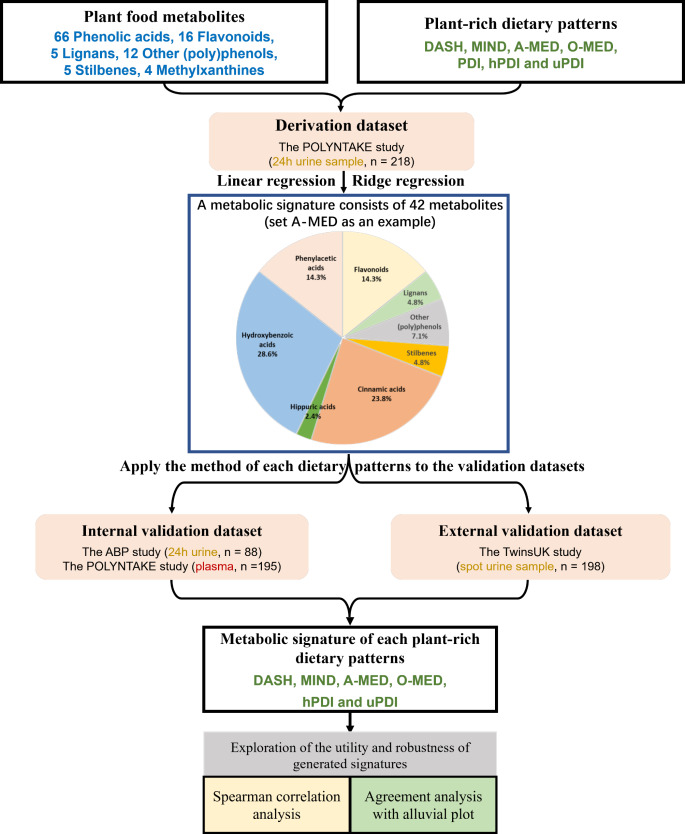
Fig. 1
Fig. 1
The flowchart of the analysis approach (generation and validation) of the metabolic signature adherence to the plant-rich dietary patterns. DASH, Dietary Approaches to Stop Hypertension; MIND, Mediterranean-DASH Intervention for Neurodegenerative Delay; O-MED, Original Mediterranean Score; A-MED, Amended Mediterranean Score; PDI, Plant-based Diet Index; hPDI, Healthy Plant-based Diet Index; uPDI, unhealthy Plant-based Diet Index
Fig. 2
Fig. 2
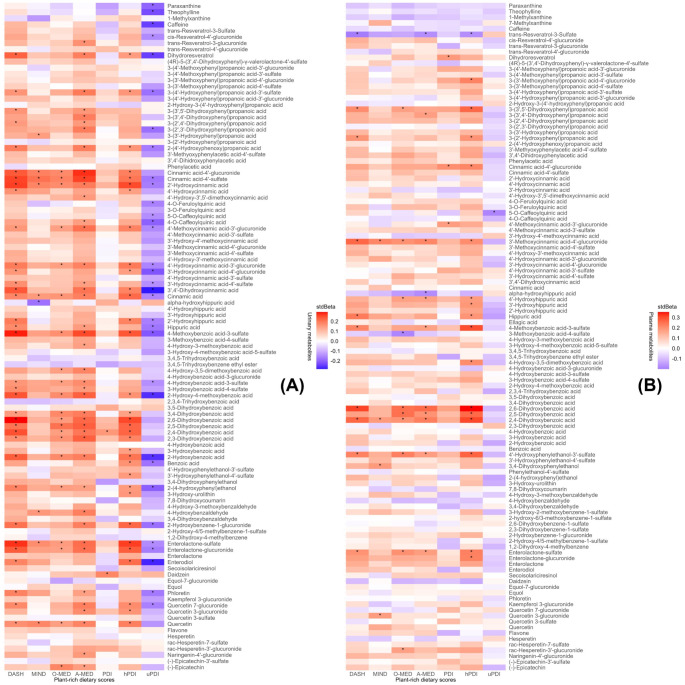
Association between (A) urinary and (B) plasma metabolites and plant-rich dietary scores. The heatmap was plotted according to the standardized regression coefficients (stdBeta). The colour scale indicates the effect (stdBeta) of each urinary or plasma metabolite on plant-rich dietary scores. Red and blue illustrate positive and negative effects, and colour intensity represents the degree of effect. The asterisks showed significance (*: FDR-adjusted p < 0.05). DASH, Dietary Approaches to Stop Hypertension; MIND, Mediterranean-DASH Intervention for Neurodegenerative Delay; O-MED, Original Mediterranean Score; A-MED, Amended Mediterranean Score; PDI, Plant-based Diet Index; hPDI, Healthy Plant-based Diet Index; uPDI, unhealthy Plant-based Diet Index. The associations were adjusted for energy intake
Fig. 3
Fig. 3
(A) Selected metabolites for each dietary pattern metabolic signature and (B) Correlation matrix between dietary patterns and metabolic signatures from the derivation set in the POLYNTAKE cohort with 24 h urine sample (n = 218). (A) The overlapping and distinct sets of the selected metabolites from each plant-rich dietary pattern. Yellow, purple, and white illustrated significant positive, negative, and non-significant associations in each dietary score. (B) The dietary scores were measured by FFQ. The metabolic signatures were derived based on the selected metabolites that were significantly associated with each plant-rich dietary score. The colour scale indicated the Spearman correlation coefficient between plant-rich dietary patterns and metabolic signatures. Red and blue illustrated positive and negative correlations and colour intensity represented the degree of the coefficient. The correlation with significance has listed the coefficient (FDR-adjusted, p < 0.05). DASH, Dietary Approaches to Stop Hypertension; MIND, Mediterranean-DASH Intervention for Neurodegenerative Delay; O-MED, Original Mediterranean Score; A-MED, Amended Mediterranean Score; hPDI, Healthy Plant-based Diet Index; uPDI, unhealthy Plant-based Diet Index
Fig. 4
Fig. 4
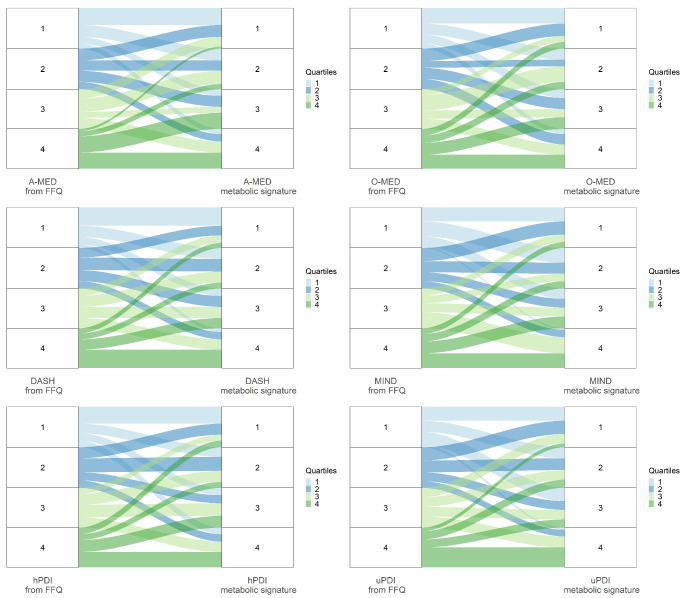
Agreements between plant-rich dietary patterns and their respective metabolic signatures in ranking participants into quartiles: The POLYNTAKE Study (24 h urine samples). DASH, Dietary Approaches to Stop Hypertension; MIND, Mediterranean-DASH Intervention for Neurodegenerative Delay; O-MED, Original Mediterranean Score; A-MED, Amended Mediterranean Score; hPDI, healthy Plant-based Diet Index; uPDI, unhealthy Plant-based Diet Index
Fig. 5
Fig. 5
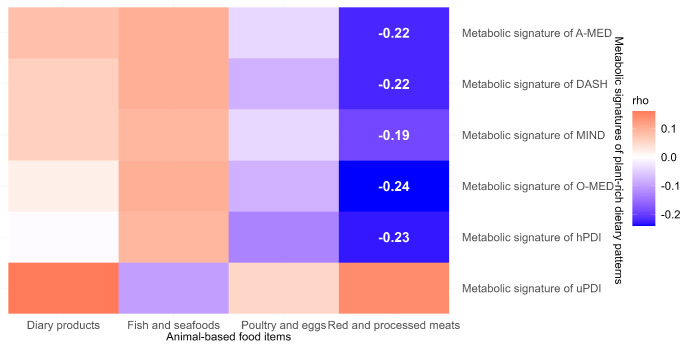
The Spearman correction between the metabolic signatures and animal-based food items. Red and blue illustrated respectively positive and negative correlations and colour intensity represented the degree of the coefficient. The correlation with significance were listed the coefficient (FDR-adjusted, p < 0.05), DASH, Dietary Approaches to Stop Hypertension; O-MED, Original Mediterranean Score; A-MED, Amended Mediterranean Score; MIND, Mediterranean-DASH Intervention for Neurodegenerative Delay; hPDI, healthy Plant-based Diet Index; uPDI, unhealthy Plant-based Diet Index

References

    1. Satija A, Hu FB (2018) Plant-based diets and cardiovascular health. Trends Cardiovasc Med 28(7):437–441. 10.1016/j.tcm.2018.02.004 - DOI - PMC - PubMed
    1. Trautwein EA, McKay S (2020) The role of Specific Components of a plant-based Diet in Management of Dyslipidemia and the Impact on Cardiovascular Risk. Nutrients 12(9). 10.3390/nu12092671 - PMC - PubMed
    1. Aljuraiban GS, Gibson R, Oude Griep LM, Okuda N, Steffen LM, Van Horn L, Chan Q (2020) Perspective: the application of a Priori Diet Quality scores to Cardiovascular Disease Risk-A critical evaluation of current Scoring systems. Adv Nutr 11(1):10–24. 10.1093/advances/nmz059 - DOI - PMC - PubMed
    1. Trichopoulou A, Costacou T, Bamia C, Trichopoulos D (2003) Adherence to a Mediterranean diet and survival in a Greek population. N Engl J Med 348(26):2599–2608. 10.1056/NEJMoa025039 - DOI - PubMed
    1. Fung TT, Chiuve SE, McCullough ML, Rexrode KM, Logroscino G, Hu FB (2008) Adherence to a DASH-style diet and risk of coronary heart disease and stroke in women. Arch Intern Med 168(7):713–720. 10.1001/archinte.168.7.713 - DOI - PubMed

LinkOut - more resources