Comparison of Population Attributable Fractions of Cancer Incidence and Mortality Linked to Excess Body Weight in Korea from 2015 to 2030
- PMID: 39604804
- PMCID: PMC11695475
- DOI: 10.3803/EnM.2024.2071
Comparison of Population Attributable Fractions of Cancer Incidence and Mortality Linked to Excess Body Weight in Korea from 2015 to 2030
Abstract
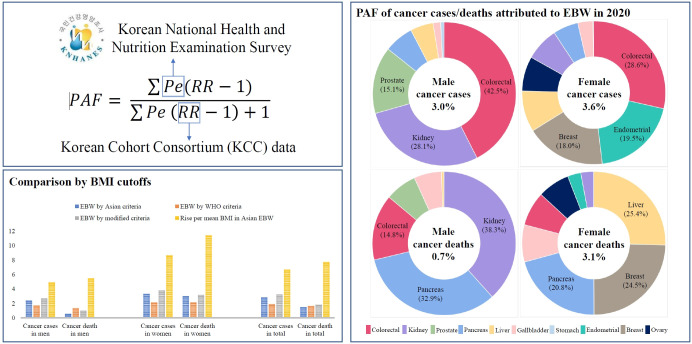
Backgruound: The increasing rate of excess body weight (EBW) in the global population has led to growing health concerns, including cancer-related EBW. We aimed to estimate the population attributable fraction (PAF) of cancer incidence and deaths linked to EBW in Korean individuals from 2015 to 2030 and to compare its value with various body mass index cutoffs.
Methods: Levin's formula was used to calculate the PAF; the prevalence rates were computed using the Korean National Health and Nutrition Examination Survey data, while the relative risks of specific cancers related to EBW were estimated based on the results of Korean cohort studies. To account for the 15-year latency period when estimating the PAF in 2020, the prevalence rates from 2015 and attributable cases or deaths from 2020 were used.
Results: The PAF attributed to EBW was similar for both cancer incidence and deaths using either the World Health Organization (WHO) Asian-Pacific region standard or a modified Asian standard, with the WHO standard yielding the lowest values. In the Korean population, the PAFs of EBW for cancer incidence were 2.96% in men and 3.61% in women, while those for cancer deaths were 0.67% in men and 3.06% in women in 2020. Additionally, PAFs showed a gradual increase in both sexes until 2030.
Conclusion: The EBW continues to have a significant impact on cancer incidence and deaths in Korea. Effective prevention strategies targeting the reduction of this modifiable risk factor can substantially decrease the cancer burden.
Keywords: Body mass index; Excess body weight; Population attributable fractions; Prevalence rates.
Conflict of interest statement
No potential conflict of interest relevant to this article was reported.
Figures


References
-
- Romieu I, Dossus L, Willett WC. Lyon: International Agency for Research on Cancer; 2017. Energy balance and obesity. Chapter 6, Physical activity, sedentary behaviour, and obesity; p. 43-8. - PubMed
-
- International Agency for Research on Cancer . Lyon: IARC; 2018. Absence of excess body fatness: IARC handbooks of cancer prevention. Vol. 16. [cited 2024 Sep 19]. Available from: https://publications.iarc.fr/570. - PubMed
-
- International Agency for Research on Cancer . Lyon: IARC; 2002. Weight control and physical activity: IARC handbooks of cancer prevention. Vol. 6. [cited 2024 Sep 19]. Available from: https://publications.iarc.fr/Book-And-Report-Series/Iarc-Handbooks-Of-Ca....
-
- World Cancer Research Fund International . London: WCRF; 2018. Alcoholic drinks and cancer risk [Internet] [cited 2024 Sep 19]. Available from: https://www.wcrf.org/dietandcancer/alcoholic-drinks.
Publication types
MeSH terms
Grants and funding
LinkOut - more resources
Full Text Sources
Medical