


Use of the WHO partograph and Zhang's guideline for labor and delivery in China: implications for clinical practice
- PMID: 39604879
- PMCID: PMC11600908
- DOI: 10.1186/s12884-024-06985-z
Use of the WHO partograph and Zhang's guideline for labor and delivery in China: implications for clinical practice
Abstract
Background: There is an unmet need for a large comprehensive population-based dataset documenting national birthing trends in China and a partograph specifically tailored to Chinese women. This study assessed the impact of using the World Health Organization (WHO) partograph or Zhang's guideline to manage labor and delivery in China and inform the development of a partograph that specifically aligns with the progression of labor in Chinese women.
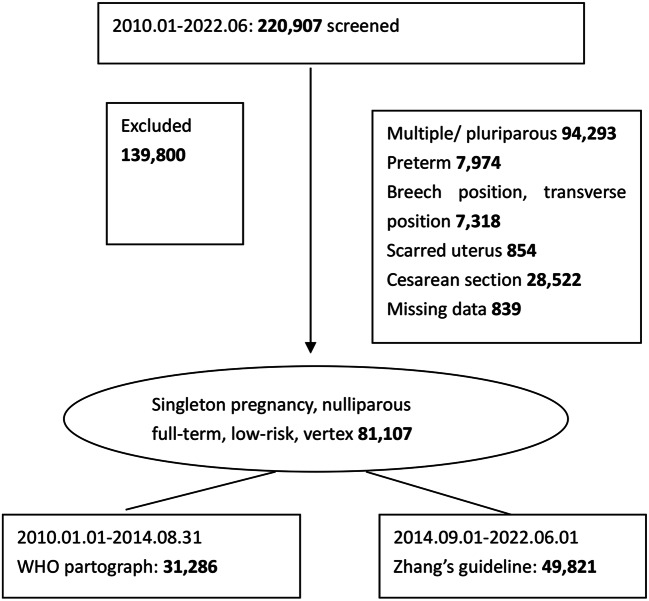
Methods: This retrospective analysis included low-risk nulliparous women with a singleton, full-term fetus in cephalic presentation entering spontaneous labor at a specialized obstetric hospital in China between January 2010 and June 2022. Pregnant women were managed according to the WHO partograph (January 2010-August 2014, n = 31,286) or Zhang's guideline (September 2014-June 2022, n = 49,821).
Results: Rates of assisted reproduction (4.57% vs. 1.05%; p < 0.0001) and hypertension (7.44% vs. 6.71%; p < 0.0001) were significantly higher for pregnant women managed according to Zhang's guideline compared to the WHO partograph. Rates of labor intervention (35.31% vs. 13.95%; p < 0.0001), including induction of labor by oxytocin, artificial rupture of membranes, lateral episiotomy and conversion to cesarean section (all, p < 0.0001), were significantly higher for pregnant women managed according to the WHO partograph. Rates of forceps assisted vaginal deliveries (12.67% vs. 6.42%; p < 0.0001) and postpartum hemorrhage (10.9% vs. 6.2%; p < 0.0001) were significantly higher, and birth asphyxia (0.15% vs. 0.09%; p = 0.02) was significantly lower, for pregnant women managed according to Zhang's guideline.
Conclusions: This study provides valuable insights into the utilization of the WHO partograph and Zhang's guideline in managing labor and delivery among Chinese women. Findings indicate that women managed according to Zhang's guideline had higher rates of assisted reproduction and hypertension, suggesting a potentially different demographic profile or underlying health conditions compared to women managed according to the WHO partograph. Notably, the use of the WHO partograph was linked to a significant increase in labor interventions, while Zhang's guideline resulted in higher rates of forceps-assisted vaginal deliveries and postpartum hemorrhage, yet interestingly, a lower incidence of birth asphyxia. These contrasting outcomes underscore the importance of aligning labor management tools with the specific needs and progression of labor in Chinese women. The results advocate for a tailored partograph that could better reflect the unique characteristics of Chinese women and optimize decision making and maternal and neonatal outcomes.
Keywords: Forceps delivery; Intrapartum caesarean section; Labor intervention; Neonatal asphyxia; Postpartum; WHO partograph; Zhang’s guideline for labor progression.
© 2024. The Author(s).
Conflict of interest statement
Declarations. Ethics approval and consent to participate: The study was approved by the Ethics Committee of the Beijing Obstetrics and Gynecology Hospital, Capital Medical University on 5th Jan, 2014 (no. 2024-KY-013-01) and was conducted in accordance with the 1964 Helsinki Declaration and its later amendments or comparable ethical standards. Informed consent was waived by our Institutional Review Board because of the retrospective nature of our study. Consent for publication: Not applicable. Competing interests: The authors declare no competing interests.
References
-
- Karaçam Z, Walsh D, Bugg GJ. Evolving understanding and treatment of labour dystocia. Eur J Obstet Gynecol Reprod Biol. 2014;182:123–7. - PubMed
-
- Cohen WR, Friedman EA. Perils of the new labor management guidelines. Am J Obstet Gynecol. 2015;212:420–7. - PubMed
-
- World Health Organization partograph in management of labour. World Health Organization Maternal Health and Safe Motherhood Programme. Lancet. 1994;343:1399 – 404. - PubMed
MeSH terms
Grants and funding
LinkOut - more resources
Full Text Sources
Medical
