. 2024 Nov 27;12(1):184.
doi: 10.1186/s40478-024-01893-x.

ALS-linked mutant TDP-43 in oligodendrocytes induces oligodendrocyte damage and exacerbates motor dysfunction in mice

Affiliations

ALS-linked mutant TDP-43 in oligodendrocytes induces oligodendrocyte damage and exacerbates motor dysfunction in mice

Mai Horiuchi et al. Acta Neuropathol Commun. .

Abstract

Nuclear clearance and cytoplasmic aggregation of TAR DNA-binding protein of 43 kDa (TDP-43) are pathological hallmarks of amyotrophic lateral sclerosis (ALS) and its pathogenic mechanism is mediated by both loss-of-function and gain-of-toxicity of TDP-43. However, the role of TDP-43 gain-of-toxicity in oligodendrocytes remains unclear. To investigate the impact of excess TDP-43 on oligodendrocytes, we established transgenic mice overexpressing the ALS-linked mutant TDP-43M337V in oligodendrocytes through crossbreeding with Mbp-Cre mice. Two-step crossbreeding of floxed TDP-43M337V and Mbp-Cre mice resulted in the heterozygous low-level systemic expression of TDP-43M337V with (Cre-positive) or without (Cre-negative) oligodendrocyte-specific overexpression of TDP-43M337V. Although Cre-negative mice also exhibit subtle motor dysfunction, TDP-43M337V overexpression in oligodendrocytes aggravated clasping signs and gait disturbance accompanied by myelin pallor in the corpus callosum and white matter of the lumbar spinal cord in Cre-positive mice. RNA sequencing analysis of oligodendrocyte lineage cells isolated from whole brains of 12-month-old transgenic mice revealed downregulation of myelinating oligodendrocyte marker genes and cholesterol-related genes crucial for myelination, along with marked upregulation of apoptotic pathway genes. Immunofluorescence staining showed cleaved caspase 3-positive apoptotic oligodendrocytes surrounded by activated microglia and astrocytes in aged transgenic mice. Collectively, our findings demonstrate that an excess amount of ALS-linked mutant TDP-43 expression in oligodendrocytes exacerbates motor dysfunction in mice, likely through oligodendrocyte dysfunction and neuroinflammation. Therefore, targeting oligodendrocyte protection, particularly through ameliorating TDP-43 pathology, could represent a potential therapeutic approach for ALS.

Keywords: Amyotrophic lateral sclerosis; Animal model; Apoptosis; Behavioral test; Myelin; Neuroinflammation; Oligodendrocyte; RNA-sequencing; TDP-43.


Conflict of interest statement

Declarations. Ethics approval and consent to participate: The experiments using genetically modified mice were approved by the Animal Care and Use Committee and the recombinant DNA experiment committee of Nagoya University (approval numbers RIEM240005, and #143, respectively). Consent for publication: Not applicable. Competing interests: The authors report no biomedical financial interests or potential conflicts of interest.

Figures

Fig. 1
Fig. 1
Generation and characterization of oligodendrocyte-specific human TDP-43M337V transgenic mice. A Left: Schematic of the murine Rosa26 locus, the gene-targeting vector for inserting the floxed human TDP-43M337V expression cassette, and the resultant mutant Rosa26 locus after homologous recombination. Human TDP-43M337V cDNA under the control of the CAG promoter, interrupted by a neomycin resistance gene (Neor) and polyA sequences flanked by loxP sequences, was integrated into the Rosa26 locus. A Myc-Tag was inserted at the N-terminal end of hTDP-43 cDNA. DTA: diphtheria toxin A fragment; WPRE: woodchuck hepatitis virus posttranscriptional regulatory element. Right: Schematic of crossbreeding to generate Mbp-Cre; hTDP-43M337V-fl*/fl mice. Asterisks indicate recombinant alleles. B Representative genotyping images of nontransgenic mice (nTg), hTDP-43M337V-fl/fl mice (lox), Mbp-Cre; hTDP-43M337V-fl*/fl mice [Cre(−)] and Mbp-Cre+; hTDP-43M337V-fl*/fl mice [Cre(+)] from PCR. Genotyping results of Cre recombinase (top), the mutant Rosa26 locus carrying the floxed TDP-43M337V cassette (middle), and Cre-dependent recombination (bottom). Image showing Cre-dependent recombination also occurring in Cre(−). White and black arrows in (A) indicate specific primers for PCR of the mutant Rosa26 locus and Cre-dependent recombination, respectively. C Representative immunoblotting images showing Myc-hTDP-43M337V expression. Lysates from the corpus callosum and lumbar spinal cord of mice with the specified genotype were subjected to immunoblotting using anti-Myc, anti-TDP-43, or anti-β-actin antibodies. Asterisks denote nonspecific bands. Relative myc expression levels are presented as means ± standard errors of the mean (SEMs). P-values were determined using one-way ANOVA followed by Tukey–Kramer multiple comparison tests (n = 3)
Fig. 2
Fig. 2
TDP-43M337V overexpression in oligodendrocytes exacerbates motor dysfunction in mice. A Body weights of nTg [n = 25 (male: 11; female: 14)], Cre(−) [n = 20 (male: 12; female: 8)], and Cre(+) [n = 23 (male: 10; female: 13)] mice were plotted according to age. Male Cre(+) mice exhibited lower body weights. B Clasping signs were scored at indicated ages on a 0 (no phenotype) to 3 (severe phenotype) scale [left: nTg: n = 16; Cre(−): n = 20; Cre(+): n = 23]. Clasping scores at 12 months are shown as a bar graph for mice with specific genotypes (right). Approximately 90% of Cre(+) mice (20/23) exhibited mild clasping signs at 12 months of age (right). C Results of balance beam tests using a 14-mm-wide beam. Average beam crossings, total steps, total hindpaw slips, and the slip ratio (total slips to total steps) are plotted [nTg: n = 23; Cre(−): n = 14; Cre(+): n = 23)]. D Phenotype scoring in the grip strength test [(male nTg: n = 11: Cre(−): n = 10; Cre(+): n = 9)], E rotarod test [(nTg: n = 25; Cre(−): n = 20; Cre(+): n = 23)], and F stride length test [(male nTg: n = 8; Cre(−): n = 12; Cre(+): n = 10)]. Scores for body weight, clasping, grip strength, rotarod performance, and stride length are presented as means ± SEMs; p-values were determined via two-way ANOVA followed by Sidak’s multiple comparisons test. Clasping scores at 12 months are presented as means ± SEMs; p-values were determined via one-way ANOVA followed by Tukey–Kramer multiple comparison tests. *p < 0.05, **p < 0.01, ***p < 0.001, and ****p < 0.0001
Fig. 3
Fig. 3
Myelin pallor observed in the white matter of Mbp-Cre+; hTDP-43M337V-fl*/fl mice. A Representative images of Woelcke staining and quantification relative to nTg in the regions indicated by dashed squares in the corpus callosum and the white matter of the lumbar spinal cord in 12-month-old mice (n = 4 sections per mouse for the corpus callosum, n = 3 sections per mouse for the lumbar spinal cord). B Representative immunofluorescence images of OPCs (PDGFRα, green) and oligodendrocytes (APC, red) in the corpus callosum and the lumbar spinal cord of 12-month-old mice. Mean number of PDGFRα/DAPI- or APC/DAPI-double-positive cells was quantified and plotted (per 0.09 mm2 of the corpus callosum, per 0.1 mm2 of the white matter of the lumbar spinal cord, n = 3 sections per mouse). Number of oligodendrocytes and OPCs did not differ significantly among genotypes. Data are presented as means ± SEMs. P-values were determined using one-way ANOVA followed by Tukey–Kramer multiple comparison tests. Scale bars: 10 µm (A, upper panel), 20 µm (A, lower panel), and 50 µm (B)
Fig. 4
Fig. 4
Cholesterol biosynthetic and apoptotic pathway are deregulated in oligodendrocytes from Mbp-Cre+; hTDP-43M337V-fl*/fl mice. A Schematic of RNA-seq analysis for oligodendrocyte lineage cells, which were isolated from the whole brains of nTg or Cre(+) mice via magnetic-activated cell sorting [nTg: n = 3, Cre(+): n = 3]. B Transcripts per million (TPM) of nTg in RNA-seq for representative markers of oligodendrocytes, microglia, astrocytes, pericytes, and neurons. Oligodendrocytes were highly enriched in the analyzed RNA-seq samples. TPM values are plotted as means ± SEMs. C Principal component analysis plot and heatmap of differentially expressed genes (DEGs; q-value < 0.05 and |fold change| > 1.2). D List of representative genes for oligodendrocyte lineage cell markers. Downregulated and upregulated DEGs (q-value < 0.05 and |fold change| > 1.2) are highlighted in blue and red, respectively. Expression levels of myelinating oligodendrocyte markers and monocarboxylate transporter 1 (Mct1) were downregulated in Cre(+) oligodendrocytes. E List of representative genes involved in cholesterol biosynthesis. Srebf2, the master regulator of cholesterol biosynthesis, and its downstream genes were downregulated in Cre(+) oligodendrocytes. F Top 10 Gene Ontology (GO) terms for biological process. GO analysis revealed the upregulation of genes related to immunity, inflammation, and apoptosis. G List of representative genes of apoptosis pathway-related genes. Expression levels of Tnfrsf1a and its downstream genes were upregulated in Cre(+). Gene IDs are presented with fold changes [Cre(+) / nTg] and q-values (D, E, and G)
Fig. 5
Fig. 5
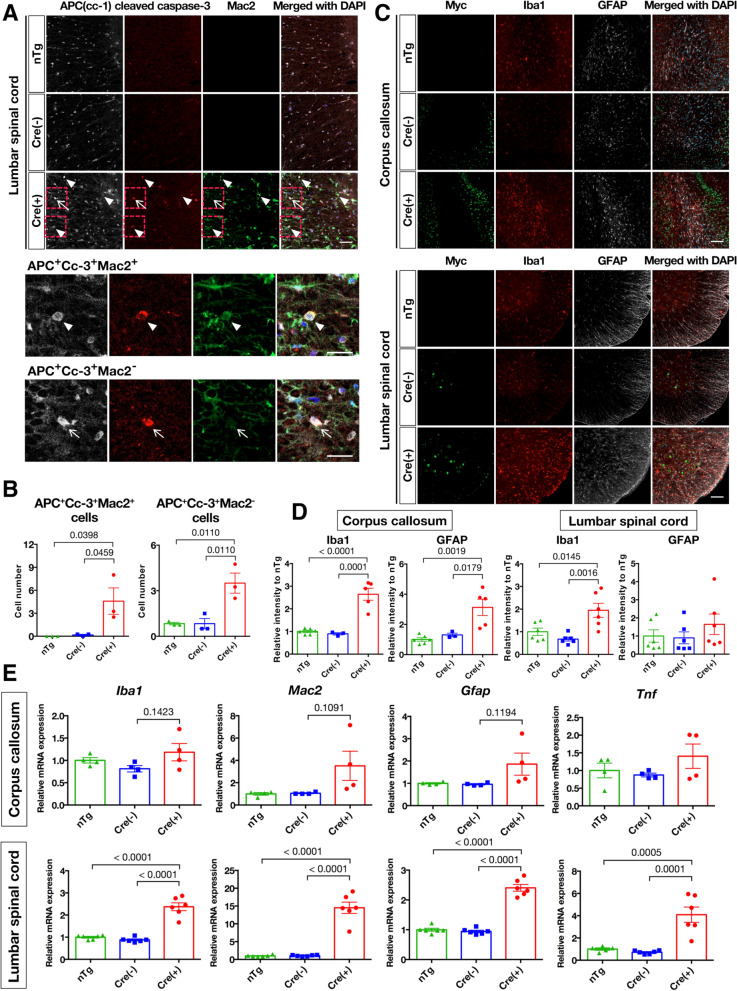
Apoptosis is induced in the oligodendrocytes of the white matter from Mbp-Cre+; hTDP-43M337V-fl*/fl mice. A Representative immunofluorescence images of lumbar spinal cords from 12-month-old mice stained for APC, cleaved caspase-3 (Cc-3), and Mac2. Bottom panels show magnified images of the areas indicated by dashed squares. Some mature oligodendrocytes expressed Cc-3. Arrowheads indicate colocalization of apoptotic oligodendrocytes and activated microglia; arrows indicate apoptotic oligodendrocytes without microglial colocalization. B Mean number of APC+Cc-3+Mac2+ and APC+Cc-3+Mac2 cells per 0.1 mm2 was quantified and plotted (n = 4 sections per mouse). C Representative images of the corpus callosum and white matter of the lumbar spinal cord of 12-month-old mice immunostained for Myc, Iba1, and GFAP. D Quantification of relative intensity to nTg per 0.1 mm2 in the corpus callosum and the white matter of the lumbar spinal cord in 12-month-old mice (n = 4 sections per mouse). E mRNA levels of representative microglia and astrocyte markers in 12-month-old mice were determined via quantitative PCR. Data are presented as means ± SEMs; p-values were determined using one-way ANOVA followed by Tukey–Kramer multiple comparison tests. Scale bars: 50 µm (A, top), 25 µm (A, bottom), and 100 µm (C)

References

    1. Akay LA, Effenberger AH, Tsai LH (2021) Cell of all trades: oligodendrocyte precursor cells in synaptic, vascular, and immune function. Genes Dev 35:180–198. 10.1101/gad.344218.120 - PMC - PubMed
    1. Arai T, Hasegawa M, Akiyama H, Ikeda K, Nonaka T, Mori H, Mann D, Tsuchiya K, Yoshida M, Hashizume Y et al (2006) TDP-43 is a component of ubiquitin-positive tau-negative inclusions in frontotemporal lobar degeneration and amyotrophic lateral sclerosis. Biochem Biophys Res Commun 351:602–611. 10.1016/j.bbrc.2006.10.093 - PubMed
    1. Arnold ES, Ling SC, Huelga SC, Lagier-Tourenne C, Polymenidou M, Ditsworth D, Kordasiewicz HB, McAlonis-Downes M, Platoshyn O, Parone PA et al (2013) ALS-linked TDP-43 mutations produce aberrant RNA splicing and adult-onset motor neuron disease without aggregation or loss of nuclear TDP-43. Proc Natl Acad Sci USA 110:E736-745. 10.1073/pnas.1222809110 - PMC - PubMed
    1. Bilican B, Serio A, Barmada SJ, Nishimura AL, Sullivan GJ, Carrasco M, Phatnani HP, Puddifoot CA, Story D, Fletcher J et al (2012) Mutant induced pluripotent stem cell lines recapitulate aspects of TDP-43 proteinopathies and reveal cell-specific vulnerability. Proc Natl Acad Sci USA 109:5803–5808. 10.1073/pnas.1202922109 - PMC - PubMed
    1. Brettschneider J, Arai K, Del Tredici K, Toledo JB, Robinson JL, Lee EB, Kuwabara S, Shibuya K, Irwin DJ, Fang L et al (2014) TDP-43 pathology and neuronal loss in amyotrophic lateral sclerosis spinal cord. Acta Neuropathol 128:423–437. 10.1007/s00401-014-1299-6 - PMC - PubMed

Publication types