


This is a preprint.
A meta-analysis of the effects of early life stress on the prefrontal cortex transcriptome suggests long-term effects on myelin
- PMID: 39605735
- PMCID: PMC11601536
- DOI: 10.1101/2024.11.22.624315
A meta-analysis of the effects of early life stress on the prefrontal cortex transcriptome suggests long-term effects on myelin
Update in
-
A Meta-Analysis of the Effects of Early Life Stress on the Prefrontal Cortex Transcriptome Reveals Long-Term Downregulation of Myelin-Related Gene Expression.Brain Behav. 2025 Jun;15(6):e70608. doi: 10.1002/brb3.70608. Brain Behav. 2025. PMID: 40524640 Free PMC article. Review.
Abstract
Background: Early life stress (ELS) refers to exposure to negative childhood experiences, such as neglect, disaster, and physical, mental, or emotional abuse. ELS can permanently alter the brain, leading to cognitive impairment, increased sensitivity to future stressors, and mental health risks. The prefrontal cortex (PFC) is a key brain region implicated in the effects of ELS.
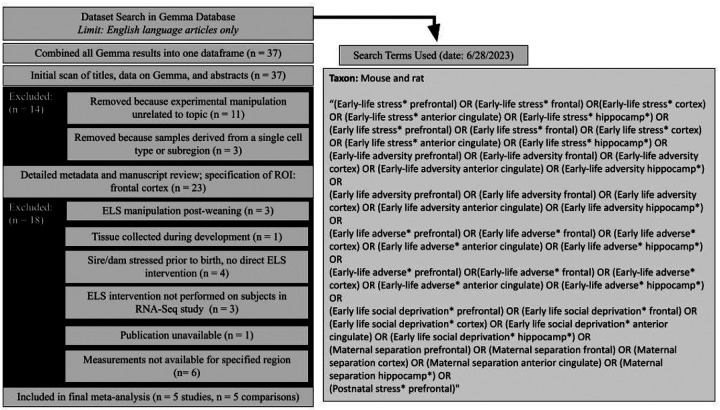
Methods: To better understand the effects of ELS on the PFC, we ran a meta-analysis of publicly available transcriptional profiling datasets. We identified five datasets (GSE89692, GSE116416, GSE14720, GSE153043, GSE124387) that characterized the long-term effects of multi-day postnatal ELS paradigms (maternal separation, limited nesting/bedding) in male and female laboratory rodents (rats, mice). The outcome variable was gene expression in the PFC later in adulthood as measured by microarray or RNA-Seq. To conduct the meta-analysis, preprocessed gene expression data were extracted from the Gemma database. Following quality control, the final sample size was n=89: n=42 controls & n=47 ELS: GSE116416 n=23 (no outliers); GSE116416 n=44 (2 outliers); GSE14720 n=7 (no outliers); GSE153043 n=9 (1 outlier), and GSE124387 n=6 (no outliers). Differential expression was calculated using the limma pipeline followed by an empirical Bayes correction. For each gene, a random effects meta-analysis model was then fit to the ELS vs. Control effect sizes (Log2 Fold Changes) from each study.
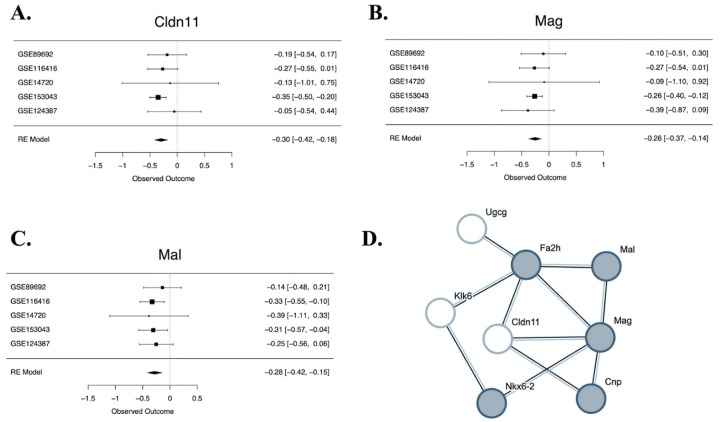
Results: Our meta-analysis yielded stable estimates for 11,885 genes, identifying five genes with differential expression following ELS (false discovery rate< 0.05): transforming growth factor alpha (Tgfa), IQ motif containing GTPase activating protein 3 (Iqgap3), collagen, type XI, alpha 1 (Col11a1), claudin 11 (Cldn11) and myelin associated glycoprotein (Mag), all of which were downregulated. Broadly, gene sets associated with oligodendrocyte differentiation, myelination, and brain development were downregulated following ELS. In contrast, genes previously shown to be upregulated in Major Depressive Disorder patients were upregulated following ELS.
Conclusion: These findings suggest that ELS during critical periods of development may produce long-term effects on the efficiency of transmission in the PFC and drive changes in gene expression similar to those underlying depression.
Keywords: Early Life Stress; Meta-analysis; Microarray; RNA-Seq.
Conflict of interest statement
Competing Interests The authors declare no potential conflict of interests. Several authors are members of the Pritzker Neuropsychiatric Disorders Research Consortium (MHH, HA, SJW), which is supported by the Pritzker Neuropsychiatric Disorders Research Fund L.L.C. A shared intellectual property agreement exists between this philanthropic fund and the University of Michigan, Stanford University, the Weill Medical College of Cornell University, the University of California at Irvine, and the HudsonAlpha Institute for Biotechnology to encourage the development of appropriate findings for research and clinical applications.
Figures
References
-
- Benekareddy M., Goodfellow N. M., Lambe E. K., & Vaidya V. A. (2010). Enhanced function of prefrontal serotonin 5-HT(2) receptors in a rat model of psychiatric vulnerability. The Journal of Neuroscience: The Official Journal of the Society for Neuroscience, 30 (36), 12138–12150. 10.1523/JNEUROSCI.3245-10.2010 - DOI - PMC - PubMed
-
- Bonnefil V., Dietz K., Amatruda M., Wentling M., Aubry A. V., Dupree J. L., Temple G., Park H.-J., Burghardt N. S., Casaccia P., & Liu J. (2019). Region-specific myelin differences define behavioral consequences of chronic social defeat stress in mice. eLife, 8, e40855. 10.7554/eLife.40855 - DOI - PMC - PubMed
Publication types
Grants and funding
LinkOut - more resources
Full Text Sources
Research Materials
Miscellaneous
