


First report of Neospora caninum from aborted fetuses of cattle, sheep, and goats in Bangladesh
- PMID: 39605763
- PMCID: PMC11590592
- DOI: 10.5455/javar.2024.k811
First report of Neospora caninum from aborted fetuses of cattle, sheep, and goats in Bangladesh
Abstract
Objectives: The study aimed to detect Neospora caninum by nested PCR (nPCR) in aborted fetuses of cattle, sheep, and goats in Bangladesh.
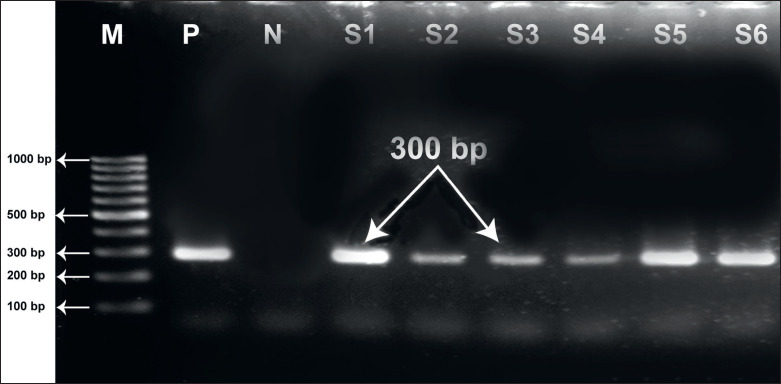
Materials and methods: The head portion of each aborted fetus (111) was dissected at each sampling site and transferred to the laboratory in an ice box. Data on risk factors associated with N. caninum infection were simultaneously collected. Deoxyribonucleic acid was extracted from brain tissue to perform nPCR targeting the internal transcribed spacer 1 (ITS1) ribosomal DNA (rDNA) gene of N. caninum and sequencing was performed from the representative positive samples.
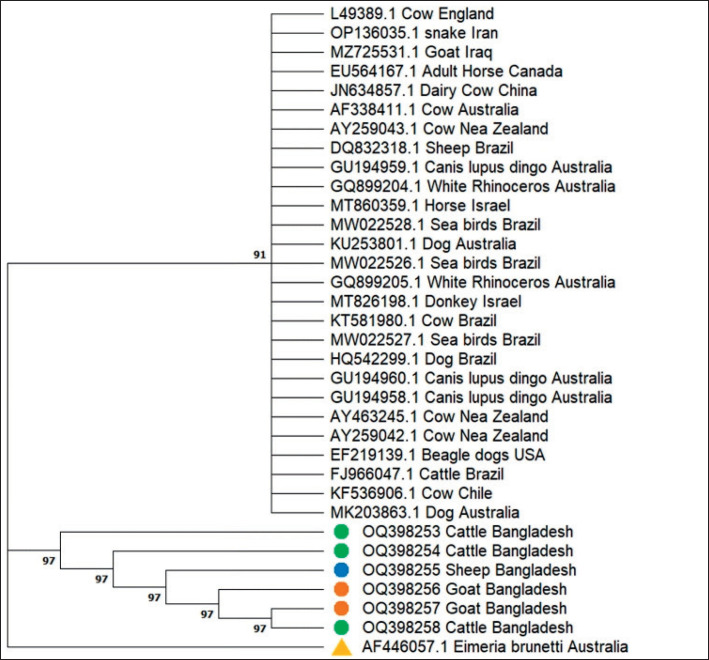
Results: By nPCR, N. caninum was found in 16.0% of aborted fetuses of cattle, followed by sheep (14.81%) and goats (11.78%). The highest prevalence was found in aborted fetuses of animals during the second trimester (27.78%) of pregnancy aged 2 to 4 years (18.75%). Obtained sequences showed they were completely matched with N. caninum ITS1 rDNA gene deposited in GenBank. Univariate analysis demonstrated that pregnancy stages (trimesters), abortion history of the animals, and access to dogs in animal farms were significantly (p ≤ 0.05) correlated with N. caninum infection.
Conclusion: This study represents the first investigation into the molecular detection, phylogenetic characterization, and analysis of risk factors associated with N. caninum in livestock in Bangladesh. According to the research findings, N. caninum infection may have a role in abortion cases and the ensuing financial losses in the nation's livestock industry.
Keywords: Aborted fetuses; Neospora caninum; cattle; goat; nested-PCR; sheep.
© The authors.
Conflict of interest statement
The authors declare that there is no conflict of interest.
Figures

References
-
- Dubey JP. Review of Neospora caninum and neosporosis in animals. Korean J Parasitol. 2003;41(1):1–16. https://doi.org/10.3347/kjp.2003.41.1.1. - PMC - PubMed
-
- Nayeri T, Moosazadeh M, Sarvi S, Daryani A. Neospora caninum infection in aborting bovines and lost fetuses: a systematic review and meta-analysis. PLoS One. 2022a;17(5):e0268903. https://doi.org/10.1371/journal.pone.0268903. - PMC - PubMed
-
- Nayeri T, Sarvi S, Moosazadeh M, Daryani A. The global prevalence of Neospora caninum infection in sheep and goats that had an abortion and aborted fetuses: a systematic review and meta-analysis. Front Vet Sci. 2022b;9:870904. https://doi.org/10.3389/fvets.2022.870904. - PMC - PubMed
-
- Reichel MP, Wahl LC, Ellis JT. Research into Neospora caninum-what have we learnt in the last thirty years? Pathogens. 2020;9(6):505. https://doi.org/10.3390/pathogens9060505. - PMC - PubMed
-
- Calarco L, Ellis J. Species diversity and genome evolution of the pathogenic protozoan parasite, Neospora caninum. Infect Genet Evol. 2020;84:104444. https://doi.org/10.1016/j.meegid.2020.104444. - PubMed
LinkOut - more resources
Full Text Sources