


Adverse outcome pathway for the neurotoxicity of Per- and polyfluoroalkyl substances: A systematic review
- PMID: 39605965
- PMCID: PMC11599988
- DOI: 10.1016/j.eehl.2024.08.002
Adverse outcome pathway for the neurotoxicity of Per- and polyfluoroalkyl substances: A systematic review
Abstract
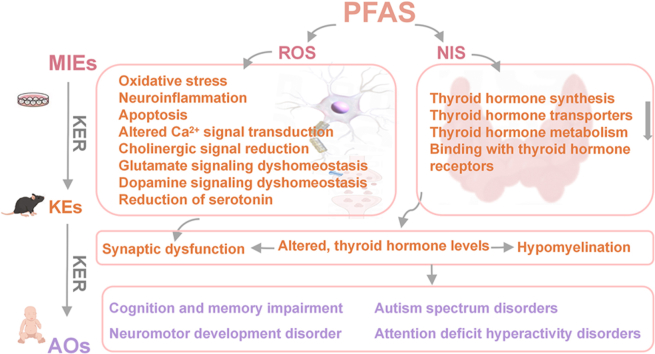
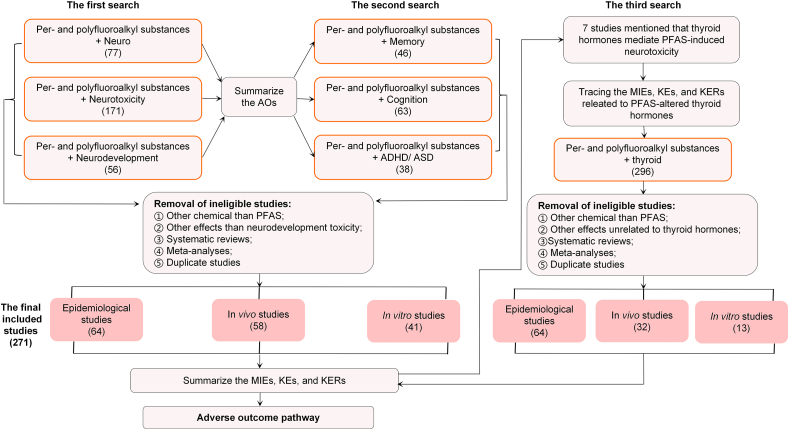
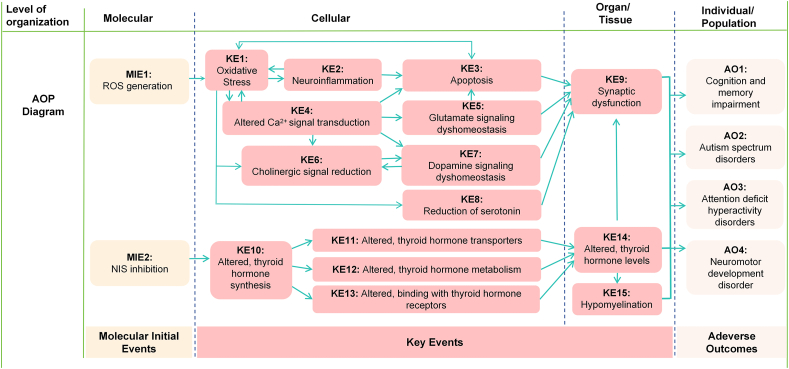
Per- and polyfluoroalkyl substances (PFAS) are endocrine disruptors with unambiguous neurotoxic effects. However, due to variability in experimental models, population characteristics, and molecular endpoints, the elucidation of mechanisms underlying PFAS-induced neurotoxicity remains incomplete. In this review, we utilized the adverse outcome pathway (AOP) framework, a comprehensive tool for evaluating toxicity across multiple biological levels (molecular, cellular, tissue and organ, individual, and population), to elucidate the mechanisms of neurotoxicity induced by PFAS. Based on 271 studies, the reactive oxygen species (ROS) generation emerged as the molecular initiating event 1 (MIE1). Subsequent key events (KEs) at the cellular level include oxidative stress, neuroinflammation, apoptosis, altered Ca2+ signal transduction, glutamate and dopamine signaling dyshomeostasis, and reduction of cholinergic and serotonin. These KEs culminate in synaptic dysfunction at organ and tissue levels. Further insights were offered into MIE2 and upstream KEs associated with altered thyroid hormone levels, contributing to synaptic dysfunction and hypomyelination at the organ and tissue levels. The inhibition of Na+/I- symporter (NIS) was identified as the MIE2, initiating a cascade of KEs at the cellular level, including altered thyroid hormone synthesis, thyroid hormone transporters, thyroid hormone metabolism, and binding with thyroid hormone receptors. All KEs ultimately result in adverse outcomes (AOs), including cognition and memory impairment, autism spectrum disorders, attention deficit hyperactivity disorders, and neuromotor development impairment. To our knowledge, this review represents the first comprehensive and systematic AOP analysis delineating the intricate mechanisms responsible for PFAS-induced neurotoxic effects, providing valuable insights for risk assessments and mitigation strategies against PFAS-related health hazards.
Keywords: Adverse outcome pathway; Neurotoxicity; PFAS; Risk assessment; Thyroid hormones.
© 2024 The Author(s).
Conflict of interest statement
The authors declare no competing financial interest.
Figures
References
-
- Organisation for Economic Co-operation and Development (OECD) Toward a new comprehensive global database of per-and polyfluoroalkyl substances (PFASs): summary report on updating the OECD 2007 list of per-and polyfluoroalkyl substances (PFASs) 2018. https://one.oecd.org/document/ENV/JM/MONO(2018)7/en/pdf
-
- Ti B., Li L., Liu J., Chen C. Global distribution potential and regional environmental risk of F-53B. Sci. Total Environ. 2018;640:1365–1371. - PubMed
-
- Cao Y., Ng C. Absorption, distribution, and toxicity of per- and polyfluoroalkyl substances (PFAS) in the brain: a review. Environ. Sci. Process Impacts. 2021;23(11):1623–1640. - PubMed
-
- Li A., Hou J., Fu J., Wang Y., Hu Y., Zhuang T., et al. Association between serum levels of TSH and free T4 and per- and polyfluoroalkyl compounds concentrations in pregnant women. J. Environ. Sci. 2023;124:11–18. - PubMed
Publication types
LinkOut - more resources
Full Text Sources
Miscellaneous
