


5-Aza-2'-deoxycytidin (Decitabine) increases cancer-testis antigen expression in head and neck squamous cell carcinoma and modifies immune checkpoint expression, especially in CD39-positive CD8 and CD4 T cells
- PMID: 39608124
- PMCID: PMC11636331
- DOI: 10.1016/j.neo.2024.101086
5-Aza-2'-deoxycytidin (Decitabine) increases cancer-testis antigen expression in head and neck squamous cell carcinoma and modifies immune checkpoint expression, especially in CD39-positive CD8 and CD4 T cells
Abstract
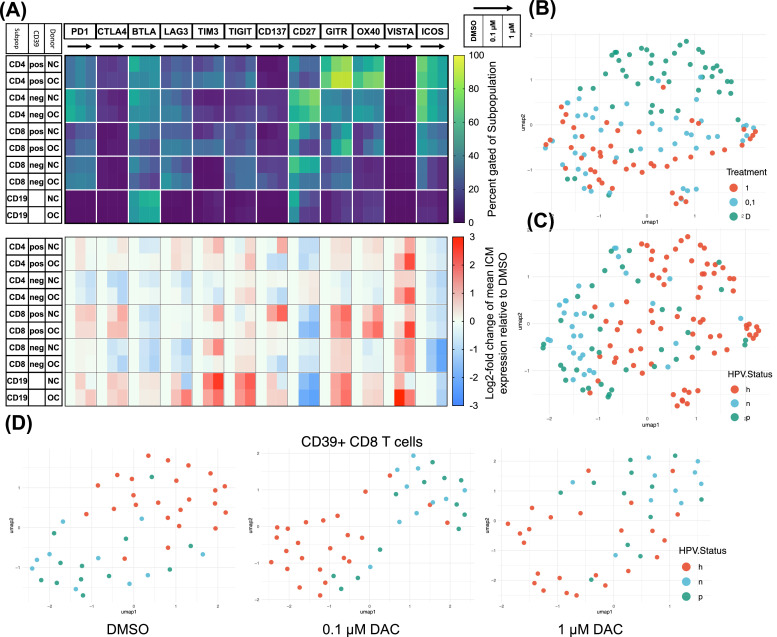
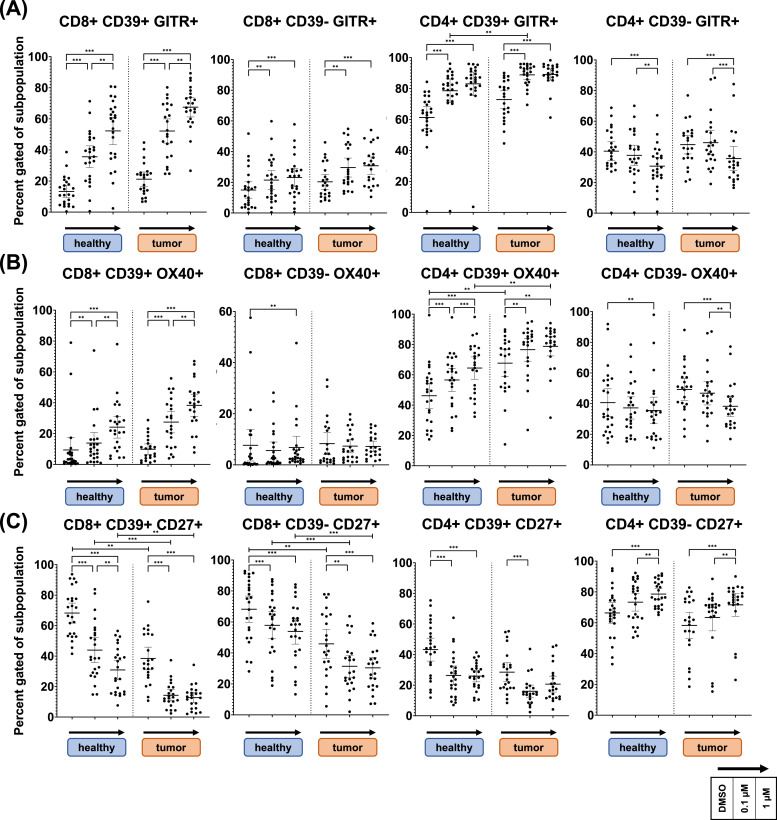
Failure of immunotherapy in head and neck squamous cell carcinoma (HNSCC) patients represents an unmet need to augment leverage of adaptive immunity. Immunogenic cancer-testis antigen (CTA) expression as well as lymphocyte differentiation and function are regulated by DNA methylation. Therefore, epigenetic therapy via inhibition of DNA-Methyltransferases by 5-Aza-2'-deoxycytidine (DAC) serves a promising adjuvant in immunotherapy. We investigated the effects of DAC on CTA expression and proliferative capacity in HNSCC cell lines and on the expression of 12 immune checkpoint molecules (ICM) on lymphocytes of oropharyngeal squamous cell carcinoma (OPSCC) patients and healthy donors. In all cell lines CTA were upregulated accompanied by decreased proliferation. In lymphocytes pronounced alterations of the ICM repertoire were observed, influenced by donor type and subpopulation. On CD39+ CD4 and CD8 T cells, the expression of co-stimulatory ICM GITR and OX40 increased dose dependently, whereas expression decreased on CD39- CD4 T cells. PD1 expression increased primarily on CD39+ CD8 T cells and decreased on CD39- CD4 T cells. CD27 expression decreased primarily in CD8 T cells, but increased in CD39- CD4 T cells, whereas ICOS expression was lowered in both CD39+ and CD39- subsets of CD4 as well as CD8 T cells. DAC treatment increased immunogenicity and decreased proliferation in HNSCC cells while enhancing expression of co-stimulatory ICM GITR and OX40. We propose low dose DAC treatment as a adjuvant to immunotherapy.
Keywords: Cancer Testis Antigens; DNA-Methylation; Decitabine; HPV; Immune-Checkpoint-Molecules; OPSCC.
Copyright © 2024. Published by Elsevier Inc.
Conflict of interest statement
Declaration of competing interest The authors declare the following financial interests/personal relationships which may be considered as potential competing interests: Simon Laban: Advisory Boards: Merck Sharp & Dohme (MSD), Bristol Myers Squibb (BMS), Sanofi Genzyme, Astra Zeneca (AZ). Honoraria: MSD, BMS. Travel reimbursement: Merck Serono, Astra Zeneca. Thomas K Hoffmann: Advisory Boards: Merck Sharp & Dohme (MSD), Bristol Myers Squibb (BMS), Sanofi Genzyme.
Figures



References
-
- Burtness B., et al. Pembrolizumab alone or with chemotherapy versus cetuximab with chemotherapy for recurrent or metastatic squamous cell carcinoma of the head and neck (KEYNOTE-048): a randomised, open-label, phase 3 study. Lancet. 2019;394:1915–1928. - PubMed
-
- Argiris A., et al. LBA36 Nivolumab (N) + ipilimumab (I) vs EXTREME as first-line (1L) treatment (tx) for recurrent/metastatic squamous cell carcinoma of the head and neck (R/M SCCHN): Final results of CheckMate 651. Ann. Oncol. 2021;32:S1310–S1311.
-
- Lee P.P., et al. A Critical Role for Dnmt1 and DNA Methylation in T Cell Development, Function, and Survival. Immunity. 2001;15:763–774. - PubMed
-
- Hanahan D. Hallmarks of Cancer: New Dimensions. Cancer Discov. 2022;12:31–46. - PubMed
-
- Lübbert M., et al. Low-dose decitabine versus best supportive care in elderly patients with intermediate- or high-risk myelodysplastic syndrome (MDS) ineligible for intensive chemotherapy: final results of the randomized phase III study of the European Organisation for Research and Treatment of Cancer Leukemia Group and the German MDS Study Group. J. Clin. Oncol. 2011;29:1987–1996. - PubMed
Publication types
MeSH terms
Substances
LinkOut - more resources
Full Text Sources
Research Materials
