A conserved acidic residue drives thyroxine synthesis within thyroglobulin and other protein precursors
- PMID: 39608720
- PMCID: PMC11730217
- DOI: 10.1016/j.jbc.2024.108026
A conserved acidic residue drives thyroxine synthesis within thyroglobulin and other protein precursors
Abstract
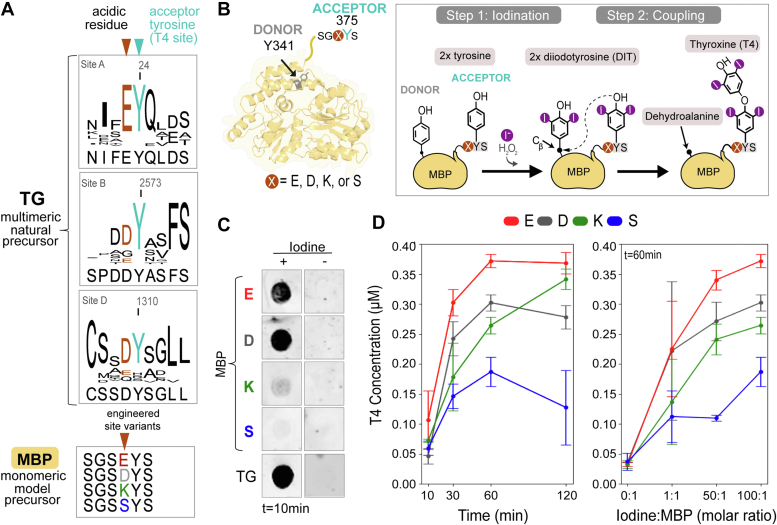
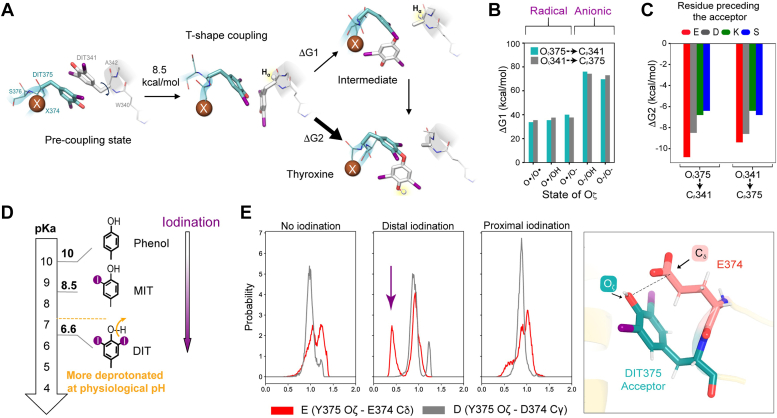
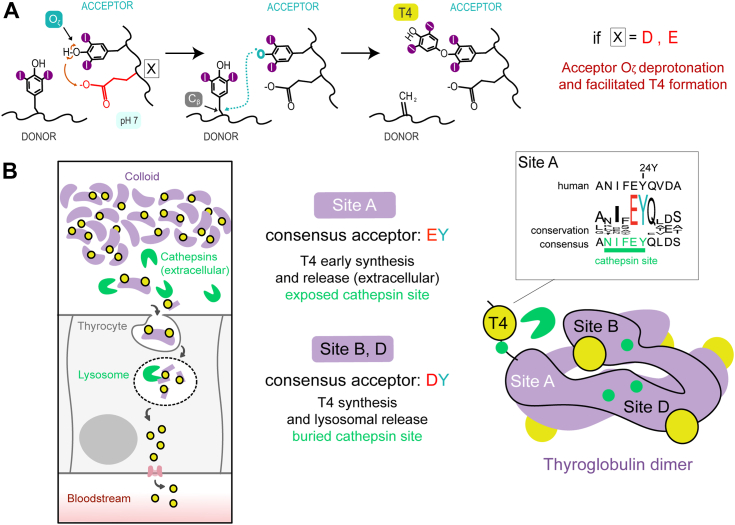
Thyroxine, the main hormone product of the thyroid, is produced at multiple sites within its protein precursor thyroglobulin. Each site consists of two tyrosine residues which undergo iodination and coupling, resulting in the synthesis of thyroxine at the acceptor tyrosine, where the hormone synthesis is later completed by proteolysis. Within the structurally resolved sites, the role of an essential conserved acidic residue preceding the acceptor remains elusive. To elucidate the mechanism of thyroxine synthesis we engineered a single-site minimal protein precursor. First, by its in vitro iodination and site-directed mutagenesis we show that the presence of the acidic residue, preferably glutamate, favors thyroxine synthesis. Secondly, within the designed precursor, we computationally modeled the reaction of iodination and iodotyrosine coupling giving rise to thyroxine. Our results reveal that hormone formation is triggered by iodotyrosine deprotonation, facilitated by proximity to a carboxylic group, closer in the case of glutamate, in line with our experimental findings and sequence conservation. Hereafter, we surmise that in the natural precursor thyroglobulin, two evolutionary late and slower hormonogenic sites coexist with an early evolutionary and faster one. Indeed, the latter is overlapping with a proteolytic site, thereby allowing prompt thyroxine release from thyroglobulin.
Keywords: density functional theory; iodination; molecular dynamics; protein engineering; thyroglobulin; thyroid hormones; thyroxine.
Copyright © 2024 The Authors. Published by Elsevier Inc. All rights reserved.
Conflict of interest statement
Conflict of interest The authors declare that they have no conflicts of interest with the contents of this article.
Figures