


Exercise strategies for reversing cardiopulmonary deconditioning in obese children with bronchial asthma: A randomized comparative effectiveness study of constant-load and graded aerobic training
- PMID: 39612435
- PMCID: PMC11608701
- DOI: 10.1097/MD.0000000000040667
Exercise strategies for reversing cardiopulmonary deconditioning in obese children with bronchial asthma: A randomized comparative effectiveness study of constant-load and graded aerobic training
Abstract
Background: This study evaluates the differential effects of constant-load (CL-AE) and graded (G-AE) aerobic exercise training approaches on cardiopulmonary fitness and functional capacity in obese children with bronchial asthma (BA).
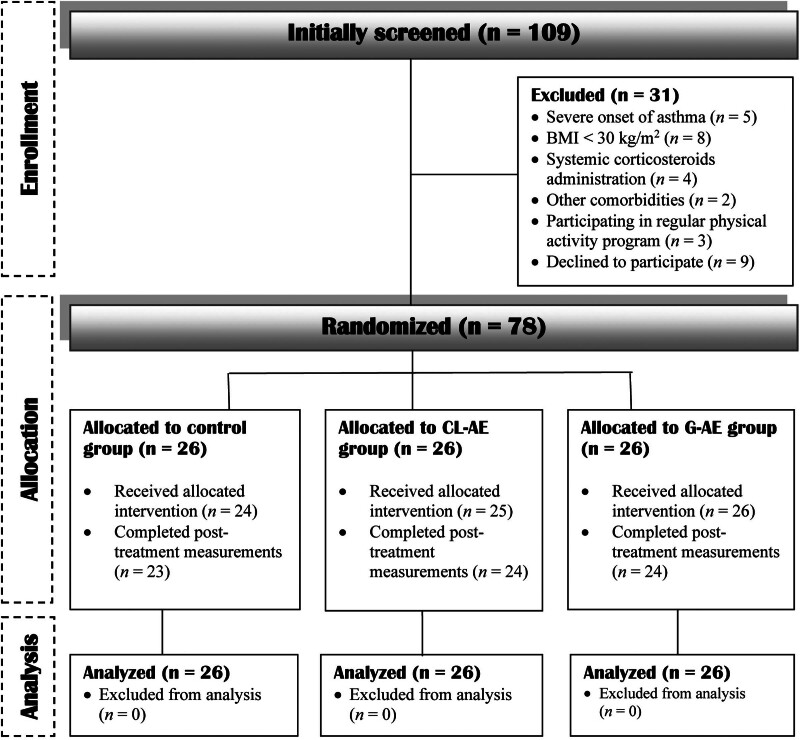
Methods: Seventy-eight obese children with moderate BA (age: 14.14 ± 2.31 years; body mass index: 31.93 ± 1.26 kg/m2) were randomly assigned to 3 intervention-based groups: control, CL-AE, or G-AE group (n = 26 in a group). The cardiorespiratory fitness (peak oxygen uptake, minute ventilation [VE], ventilation-oxygen uptake ratio, stroke volume of oxygen, oxygen/carbon-dioxide exchange ratio, heart rate maximum, and heart rate recovery at one minute) and functional capacity (6-minute walk test and perceived dyspnea and fatigue) were assessed at the baseline and posttreatment.
Results: The G-AE group exhibited more favorable changes in cardiorespiratory fitness [VO2peak (P = .03), VE (P = .021), VE/VO2 (P = .032), SVO2 (P = .025), O2/CO2 ratio (P = .004), HRmax (P = .016), HRR1 (P = .046)] and functional capacity [6-minute walk test (P = .021), dyspnea (P = .041), fatigue (P = .04)] as compared to the CL-AE group.
Conclusion: The G-AE, compared to CL-AE, appears to be a more potent stimulus for enhancing cardiorespiratory fitness and functional capacity in obese children with BA. Further investigations are, however, required to corroborate the observed effects.
Copyright © 2024 the Author(s). Published by Wolters Kluwer Health, Inc.
Conflict of interest statement
The authors have no conflicts of interest to disclose.
Figures
References
-
- Noutsios GT, Floros J. Childhood asthma: causes, risks, and protective factors; a role of innate immunity. Swiss Med Wkly. 2014;144:w14036. - PubMed
-
- Elnaggar RK, Osailan AM, Elbanna MF. The rationale of applying inspiratory/expiratory muscle training within the same respiratory cycle in children with bronchial asthma: a placebo-controlled randomized clinical investigation. J Asthma. 2023;60:900–11. - PubMed
-
- Lizzo JM, Cortes S. Pediatric asthma. StatPearls. Treasure Island (FL): StatPearls Publishing; 2021.
-
- Hellebrandová L, Chlumský J, Vostatek P, Novák D, Rýznarová Z, Bunc V. Airflow limitation is accompanied by diaphragm dysfunction. Physiol Res. 2016;65:469–79. - PubMed
Publication types
MeSH terms
LinkOut - more resources
Full Text Sources
Medical
