


An automated blood test for glial fibrillary acidic protein (GFAP) and ubiquitin carboxy-terminal hydrolase L1 (UCH-L1) to predict the absence of intracranial lesions on head CT in adult patients with mild traumatic brain injury: BRAINI, a multicentre observational study in Europe
- PMID: 39612652
- PMCID: PMC11647500
- DOI: 10.1016/j.ebiom.2024.105477
An automated blood test for glial fibrillary acidic protein (GFAP) and ubiquitin carboxy-terminal hydrolase L1 (UCH-L1) to predict the absence of intracranial lesions on head CT in adult patients with mild traumatic brain injury: BRAINI, a multicentre observational study in Europe
Abstract
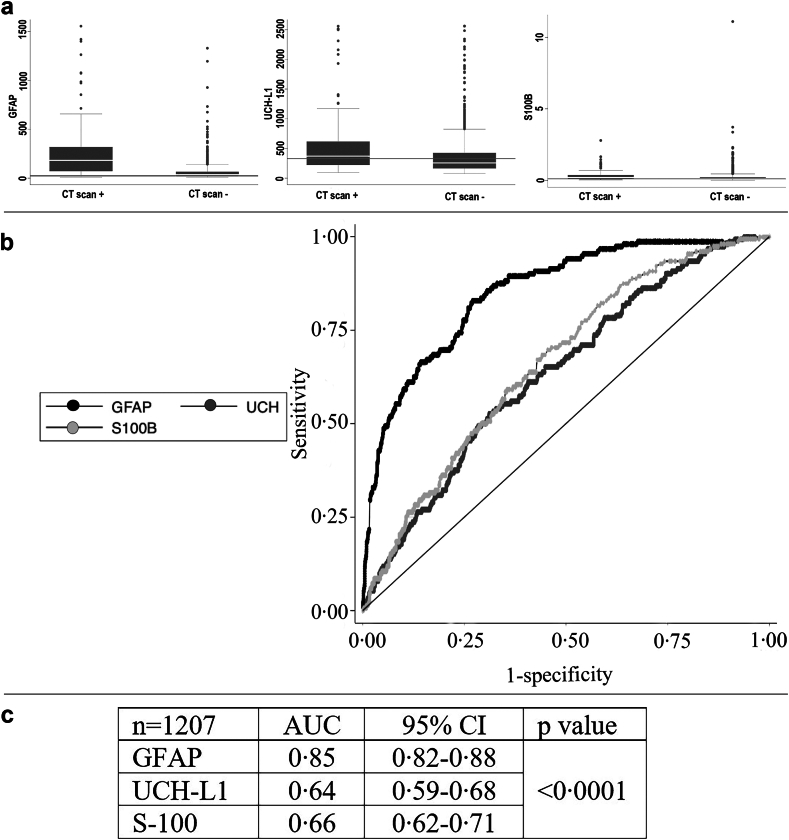
Background: Following mild traumatic brain injury (mTBI), elevated concentrations of brain-specific blood proteins glial fibrillary acidic protein (GFAP) and ubiquitin C-terminal hydrolase-L1 (UCH-L1) may be indicative of intracranial lesions normally detected by head CT scans. We sought to validate the performance of this combination of biomarkers at predetermined cutoff values with an automated immunoassay to predict which patients did not have intracranial lesions.
Methods: This prospective, observational study was conducted in France and Spain at 16 emergency departments. Adult patients with mTBI were eligible if they had a head CT scan and gave a 10-ml blood sample within 12 h of injury. GFAP and UCH-L1 serum concentrations were measured and analysed, in less than an hour time, according to predefined cutoff values of 22 pg/ml and 327 pg/ml, respectively. Serum concentrations of S100B protein were concomitantly determined in a subset of patients. The primary outcome measures were the sensitivity and negative predictive value (NPV) of the combined GFAP-UCH-L1 test to rule out intracranial lesions on head CT scans.
Clinicaltrials: gov (NCT04032509).
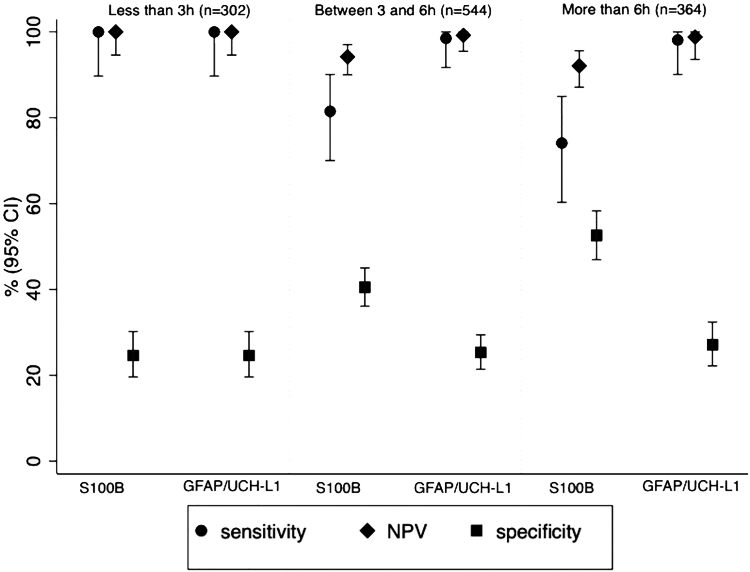
Findings: Between August 2019 and June 2021, 1508 patients were recruited, and 1438 were included in the main analysis. Median age was 69 years (IQR 44-83). Most patients (74%) presented 3 h after trauma. 179 (12.4%) patients were positive for intracranial lesions by CT. The sensitivity of the combined test was 98.3% (95% CI 95.0-99.7) and the specificity 24.9 (95% CI 22.6-27.4), with a NPV of 99.1% (95% CI 97.1-99.8). Three patients with a positive CT scan had negative biomarker test results. S100B had a sensitivity of 83.0% (95% CI 76.2-88.2) and a NPV of 94.2% (95% CI 91.6-96.0). Patients with higher biomarker values more frequently had poorer recovery at 3 months after injury.
Interpretation: Testing for GFAP and UCH-L1, using validated cutoffs obtained with a new, fast automated immunoassay platform, accurately predicted the absence of intracranial lesions on head CT following mTBI.
Funding: This study is co-funded by the European Institute of Innovation and Technology (EIT) Health, a body of the European Union (Grant nº19474). Biomarkers tests were funded by bioMérieux.
Keywords: Biomarkers; CT scan; Clinical laboratory techniques; Diagnosis; Mild traumatic brain injury; Prognosis.
Copyright © 2024 The Authors. Published by Elsevier B.V. All rights reserved.
Conflict of interest statement
Declaration of interests OM is an employee of bioMérieux. Dr. Pavlov was an employee of bioMérieux, and is currently an employee of Roche Diagnostics France. JFP has received payments or honoraria from lectures or educational events from Integra Lifesciences, Sedana Medical, IDD-CDM Lavoisier, IdMed. The consortium was co-funded as Innovation project by the European Institute of Innovation and Technology (EIT) Health, a body of the European Union (Activity Grant nº19474). AL, JdC and HT were recipients of the grant project. AL received payments for lectures and educational events from bioMérieux.
Figures

References
-
- Dewan M.C., Rattani A., Gupta S., et al. Estimating the global incidence of traumatic brain injury. J Neurosurg. 2018;130:1080–1097. - PubMed
-
- Haydel M.J., Preston C.A., Mills T.J., Luber S., Blaudeau E., DeBlieux P.M.C. Indications for computed tomography in patients with minor head injury. N Engl J Med. 2000;343:100–105. - PubMed
Publication types
MeSH terms
Substances
Associated data
LinkOut - more resources
Full Text Sources
Medical
Miscellaneous
