Review
. 2024 Nov 29;2(1):114.
doi: 10.1038/s44271-024-00159-5.

Behavioural determinants of physiologically-relevant light exposure

Affiliations
Review

Behavioural determinants of physiologically-relevant light exposure

Anna M Biller et al. Commun Psychol. .

Abstract

Light exposure triggers a range of physiological and behavioural responses that can improve and challenge health and well-being. Insights from laboratory studies have recently culminated in standards and guidelines for measuring and assessing healthy light exposure, and recommendations for healthy light levels. Implicit to laboratory paradigms is a simplistic input-output relationship between light and its effects on physiology. This simplified approach ignores that humans actively shape their light exposure through behaviour. This article presents a novel framework that conceptualises light exposure as an individual behaviour to meet specific, person-based needs. Key to healthy light exposure is shaping behaviour, beyond shaping technology.


Conflict of interest statement

Competing interests: The authors declare no competing interests.

Figures
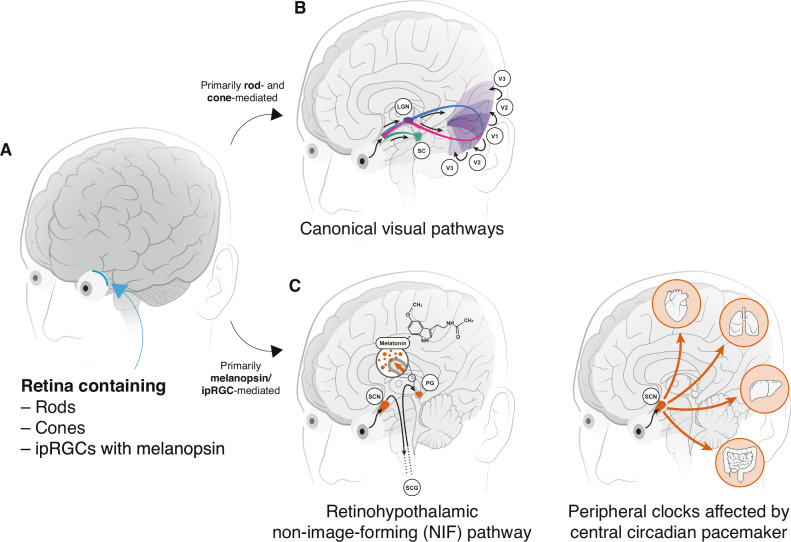
Fig. 1
Fig. 1. Overview of the visual and non-image forming pathway in humans.
A Retinal photoreceptors. Schematic of the brain with the retina at the back of the eye (blue) containing the rods, cones, and the intrinsically photosensitive retinal ganglion cells (ipRGCs) expressing the photopigment melanopsin. B Canonical visual pathways. Diagram of the canonical rod- and cone-mediated visual pathway. Rod and cone signals from the retina relayed to the lateral geniculate nucleus (LGN) from which they further travel to the primary visual cortex (V1), and then higher visual areas (V2, V3). Information from the right visual field in each eye is relayed to the left visual cortex, and vice versa (blue/pink). A second pathway (green) relays light directly to the superior colliculus (SC). C Retinohypothalamic non-image-forming pathway. The melanopsin/ipRGC-mediated pathway connects the retina to the hypothalamus, and more specifically, the suprachiasmatic nucleus (SCN). The pathway from the SCN to the pineal gland involves a multi-synaptic route: the signal travels from the SCN to the intermediolateral cell column of the spinal cord, then to the superior cervical ganglion (SCG), which is part of the sympathetic nervous system. From the SCG, the signal reaches the pineal gland (PG) to trigger melatonin release in response to darkness. D Peripheral clocks affected by the circadian pacemaker. Downstream peripheral clocks, e.g. located in the heart, liver, kidney, or colon are also affected by the central circadian pacemaker, the suprachiasmatic nucleus (SCN).
Fig. 2
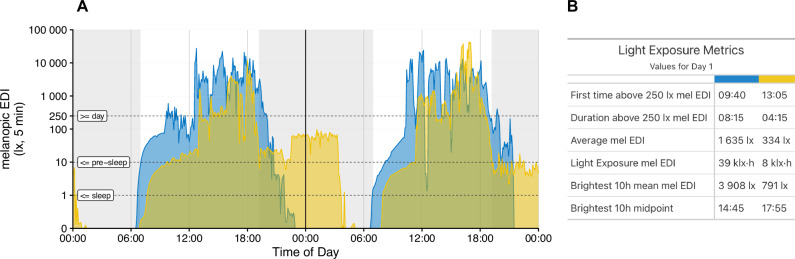
Fig. 2. Light exposure profiles from two different individuals.
A Double plot of light exposure profiles averaged over five-minute bins for two individuals (blue vs yellow) over two consecutive days. B Quantification for each light exposure profile for the first 24 h. Black vertical line separates day 1 from day 2. Dotted lines show the recommended minimum light levels expressed in melanopic equivalent daylight illumination (melanopic EDI) during sleep (≤1 lx), 3 h before sleep (≤10 lx) and during day time (≥250 lx) according to Brown et al. . The two light exposure profiles in (A) vary drastically and are associated with different behavioural subtypes (yellow vs blue profiles): while both individuals experience the same light onset in the morning around 06:30, individual 1 (blue) receives brighter light earlier in the day (first time above 250 lx mel EDI at 09:40) compared to individual 2 (yellow; at 13:05), spends more time above 250 lx (08:15 vs 04:14), receives brighter light on average (1635 lx vs 334 lx) and experiences the brightest hours earlier in the day (brightest 10 h midpoint at 14:45 vs 17:35). These differences could be due to job situations (e.g., shift work, lighting conditions at work, office vs outdoor job), individual preferences (e.g., sunseeker vs avoider), hobbies (indoor vs outdoor sports activities) or chronotype (Individual 1 is an intermediate chronotype while individual 2 is classified as late from the Munich Chronotype Questionnaire; MCTQ). In the current example, subjective light exposure data revealed (data not shown) that individual 1 slept until 9:00, spent the morning indoors until 12:00 (daylight indoors), remained outdoors until 21:00 (daylight outdoors), received some electric light indoors until 22:00 and then spent the night sleeping without any reported light source. Individual 1 thus mostly reaches recommended light levels for pre-sleep and during sleep but could receive more bright light early in the morning. Individual 2 (yellow) experienced electric light exposure from midnight to 1:00, spent the night sleeping with light coming in through the window until 14:00, received daylight indoors until 18:00, spent 1 h outdoors in daylight until 19:00 and was inside with electric light until midnight. Individual 2 thus receives light above the recommended levels for pre-sleep and the sleep environment and receives too little light in the morning. Data based on a data collection in Tübingen, Germany, following the protocol described in Guidolin et al. and visualised with the R package LightLogR.
Fig. 3
Fig. 3. Individual light behaviour is embedded within the location, culture and built environment.
A Individual behaviours related to light (light interactions and affordances, lifestyle choices, preferences) interact with the built environment and are always influenced and shaped by culture and the respective living location. B Examples for typical light (interaction) behaviours and their dependence on location include using umbrellas to shield from the sun in the Louang Namthat Province (Laos), open to sky balconies with tables and chairs in in Berlin (Germany), a shaded veranda with seating in Kannur, Kerala (India), meeting for a picnic in London’s Primrose Hill to enjoy the rare sunny weather (UK), commuting by bike in Amsterdam (Netherlands), or caring for plants near a window in Singapore. Photos shown in (B) are licenced under CC-BY. Photo from Laos by recoverling from https://openverse.org/image/a4c2eba9-915b-49ab-8068-020a492f251e; photos from Berlin, Kerala and Singapore by Priji Balakrishnan; photo from London by Diliff from https://openverse.org/image/f23f8914-4927-4e18-9df8-ff89c944a1df (CC BY-SA 3.0 licence); photo from Amsterdam by _dChris from https://openverse.org/image/67142cba-d655-4c72-851c-9dbffa23be24.
Fig. 4
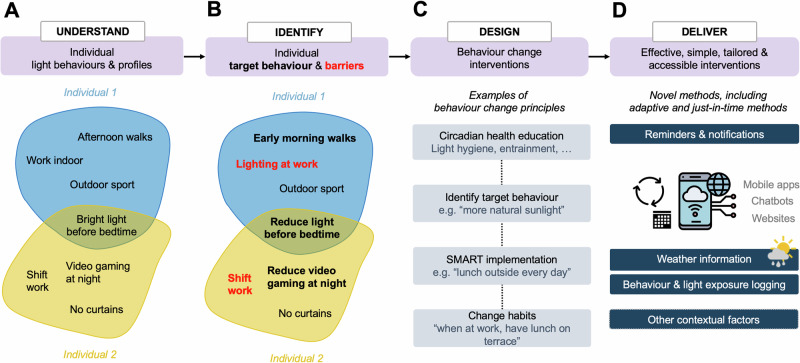
Fig. 4. A framework for identifying and delivering precision behavioural health.
The framework consists of four pillars including (A) understanding individual light behaviours and profiles (examples are for yellow and blue profiles of Fig. 2) to then (B) identify individual target behaviours and barriers that hinder optimal light exposure for circadian health. After these two individual steps, (C) individual behaviour change techniques embedded within tailored interventions need to be designed and (D) delivered in effective, simple, and accessible ways. These could also integrate external information sources such as whether data or wearable logging to give feedback on the fly to the user.

References

    1. Roenneberg, T. & Merrow, M. The circadian clock and human health. Curr. Biol.26, R432–R443 (2016). - PubMed
    1. Kuhlman, S. J., Craig, L. M. & Duffy, J. F. Introduction to chronobiology. Cold Spring Harb. Perspect. Biol.10, a033613 (2018). - PMC - PubMed
    1. Roenneberg, T. & Klerman, E. B. Chronobiology: a short introduction. Somnologie23, 142–146 (2019). - PMC - PubMed
    1. Roenneberg, T., Wirz-Justice, A. & Merrow, M. Life between clocks: daily temporal patterns of human chronotypes. J. Biol. Rhythms18, 80–90 (2003). - PubMed
    1. Roenneberg, T. Having trouble typing? What on Earth is chronotype? J. Biol. Rhythms30, 487–491 (2015). - PubMed

LinkOut - more resources