


Modulating the tumor microenvironment in a mouse model of colon cancer using a combination of HIF-1α inhibitors and Toll-Like Receptor 7 agonists
- PMID: 39614894
- PMCID: PMC11985627
- DOI: 10.1007/s00210-024-03658-8
Modulating the tumor microenvironment in a mouse model of colon cancer using a combination of HIF-1α inhibitors and Toll-Like Receptor 7 agonists
Abstract
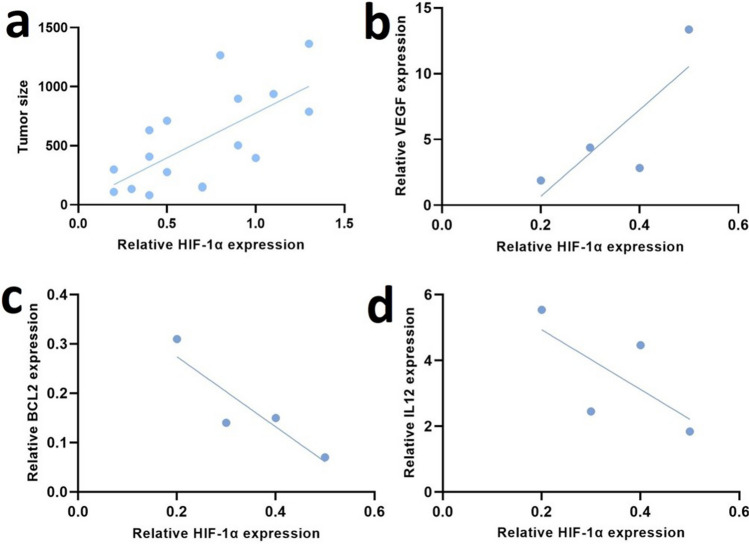
The immunosuppressive tumor microenvironment (TME) plays a pivotal role in the response to various anticancer therapies, such as immune and chemotherapeutic agents. In this study, the synergistic effects of gene-targeting HIF-1α siRNA combined with Toll-Like Receptor 7 agonist on TME remodeling were investigated in a mouse model of colorectal cancer (CRC). A HIF-1α-specific siRNA duplex was formulated based on the ionic gelation of tripolyphosphate (TPP) with cationic chitosan (CH) as a nanoplex and evaluated in terms of size, charge, polydispersity index and gel retardation assay. MTT assay was conducted to assess the cytotoxicity of the specific siRNA duplex against CT26 cells. Hypoxic condition was generated to evaluate the gene and protein expression levels of HIF-1α, respectively. CT26 mouse model was established to assess the synergistic effect of silencing HIF-1α combined with oxaliplatin (OXA) and imiquimod (IMQ) on tumor growth. The mean diameter of the CH/siRNA nanoparticles was 243 ± 6 nm, as confirmed with Micrograph scanning electron microscope. There were no significant differences observed between the CT26 cells treated with nanoparticles alone and the untreated cells, indicating that these nanoparticles are safe and physiologically biocompatible (p ≥ 0.05). Triple combination therapy involving HIF-1α siRNA, OXA, and IMQ significantly retarded tumor growth and led to elevated levels of cytokines linked to cellular immunity (INF-γ and IL-12) compared with those in the other groups (P < 0.05). The positive correlation coefficient (r = 0.68) between tumor size and HIF-1α expression levels was statistically significant (P = 0.003). Compared with those in the control group, the expression levels of the anti-inflammatory cytokines IL-10 and IL-4 significantly decreased (P < 0.05). In conclusion, our findings suggest that inhibiting HIF-1α could serve as a rational strategy to enhance the antitumor response in the TME.
Keywords: Chemotherapy; Colorectal cancer; Combination therapy; Gene therapy; HIF-1α; Immunotherapy; TLR; Tumor microenvironment.
© 2024. The Author(s).
Conflict of interest statement
Declarations. Ethics statement: Institutional Review Board Statement: All animal procedures were conducted in accordance with the ethical guidelines set forth by the National Institutes of Health guidelines, as approved by the Tabriz University of Medical Sciences (IR.TBZMED.VCR.REC.1399.056). Competing interests: The authors declare no competing interests.
Figures


References
-
- Ahmadian S et al (2021) Sensitization of A-549 lung cancer cells to Cisplatin by Quinacrine-loaded lipidic nanoparticles via suppressing Nrf2 mediated defense mechanism. Naunyn Schmiedebergs Arch Pharmacol 394:1521–1528 - PubMed
-
- Alhazami AJZ, Pouresmaeil V, Homayouni Tabrizi M (2024) The Methylurolithin A-loaded PLGA-Folate-Chitosan Nanoparticles (Mu-PFCNPs), as the novel safe selective anti-colon cancer drug delivery system. J Clust Sci 35:1719–1730
-
- Aznar MA et al (2017) Intratumoral delivery of immunotherapy—act locally, think globally. J Immunol 198(1):31–39 - PubMed
