. 2024 Dec;31(58):66079-66089.
doi: 10.1007/s11356-024-35551-5. Epub 2024 Nov 30.

Dirty habits: potential for spread of antibiotic-resistance by black-headed gulls from waste-water treatment plants

Affiliations

Dirty habits: potential for spread of antibiotic-resistance by black-headed gulls from waste-water treatment plants

Víctor Martín-Vélez et al. Environ Sci Pollut Res Int. 2024 Dec.

Abstract

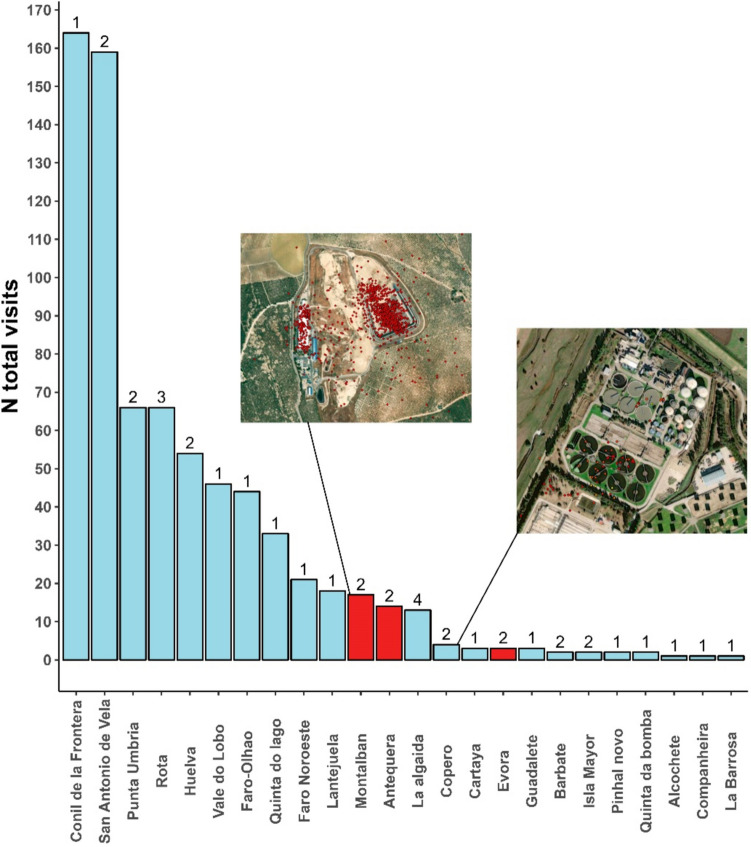
Anthropogenic environments such as wastewater treatment plants (WWTPs) and landfills are sources of antimicrobial resistance (AMR). Black-headed gulls (Chroicocephalus ridibundus) frequently use WWTPs and may be vectors for AMR. We used GPS tracking data for 39 gulls for up to 8 months, combined with a shedding curve, to study sources and dispersal distances of AMR in Iberia. The gulls used 21 different WWTPs (684 visits) and three landfills (21 visits). Areas of high risk of AMR dissemination were an average of 25 km from the infection source, with a maximum of 500 km. Solar saltworks and natural waterbodies were particularly exposed to AMR dissemination, followed by agriculture, sports facilities, and tourist beaches. There was important variability between individual gulls in their habitat specialization, and which WWTPs they visited. Studying the spatial movements of gulls after visiting WWTPs and landfills helps pinpoint sensitive locations where pathogen transmission is most likely.

Keywords: Chroicocephalus ridibundus; Escherichia coli; GPS tracking; Landfills; WWTPs.


Conflict of interest statement

Declarations. Ethics approval: All fieldwork procedures were approved by the CSIC ethical committee (REF: 1183/2021), and the Consejería de Agricultura, Pesca y Desarrollo Rural de la Junta de Andalucía. Permission to conduct the work in Doñana Natural Space was given by the Dirección General de Espacios Naturales Protegidos (permit 2021/14). In Costa Ballena, permission was granted by the local councils in Rota (2022-E-RE-14542) and Chipiona (13043). Consent to participate: This declaration is not applicable. Consent for pubication: This declaration is not applicable. Competing interests: The authors declare that they have no competing interests.

Figures

Fig. 1
Fig. 1
a Location of capture areas within Spain and Europe. b Location of capture sites at Veta la Palma fish ponds within Doñana, and in Costa Ballena in Rota, Cadiz. c Location of the black-headed gull tagging site within VLP. Image credits: Martí Franch.
Fig. 2
Fig. 2
Number of visits made by tagged gulls to each of the WWTPs (in blue) or landfills (in red) visited during the study. The number of tagged gull individuals that visited each AMR source is given above each bar. Examples of a WWTP (e.g., Copero in Sevilla) and a landfill (Montalban, Cordoba) used are given with satellite images
Fig. 3
Fig. 3
Rarefaction analysis showing the accumulated number of AMR sources (WWTPs and landfills) in relation to a number of tagged black-headed gulls (continuous line). The discontinuous line shows the extrapolation if the number of tagged individuals was increased. Error bars represent 95% confidence intervals
Fig. 4
Fig. 4
a Location of waste water treatment plants (WWTPs, blue dots) and landfills (yellow dots) used by black-headed gulls in the Iberian Peninsula. Close-ups show the concentrations of potential AMR dissemination (CFU/g) based on Inverse Distance Weight (IDW) showing the main zones for high risk transmission in b surroundings of Lisbon, c Faro, d boundary between Portugal (Vila Real de San Antonio) and Spain (Huelva), e Conil de la Frontera (Cadiz), f Rota (Cadiz) and g Lantejuela (Sevilla, on the left side) and Fuente de Piedra (Malaga, on the right side). 95% confidence intervals (CIs) for affected areas were based on the shedding curve from Franklin et al. (2020)
Fig. 5
Fig. 5
Individual variation in habitats used during the 30-day interval after visiting AMR sources for 21 GPS-tracked black-headed gulls from May 2022 to January 2023. Each individual (x-axis) is represented by a vertical bar (with the individual identifier), subdivided by the proportion of locations in each habitat in relation to the total number of GPS locations. The habitat specialization index PSi is indicated by black dots (connected with a black line; 0 = extreme specialist; 1 = extreme generalist). Mean habitat use and mean PSi for the set of tagged individuals that visited an AMR source are given in the right-hand bar

References

    1. Ahlstrom CA, Bonnedahl J, Woksepp H, Hernandez J, Olsen B, Ramey AM (2018) Acquisition and dissemination of cephalosporin-resistant E. coli in migratory birds sampled at an Alaska landfill as inferred through genomic analysis. Sci Rep 8(1):7361 - PMC - PubMed
    1. Ahlstrom CA, van Toor ML, Woksepp H, Chandler JC, Reed JA, Reeves AB, Waldenström J et al (2021) Evidence for continental-scale dispersal of antimicrobial resistant bacteria by landfill-foraging gulls. Sci Total Environ 764:144551 - PubMed
    1. Ahmad M, Khan AU (2019) Global economic impact of antibiotic resistance: a review. J Glob Antimicrob Resist 19:313–316 - PubMed
    1. Alm EW, Daniels-Witt QR, Learman DR, Ryu H, Jordan DW, Gehring TM, Santo Domingo J (2018) Potential for gulls to transport bacteria from human waste sites to beaches. Sci Total Environ 615:123–130 - PMC - PubMed
    1. Arnold KE, Williams NJ, Bennett M (2016) ‘Disperse abroad in the land’: the role of wildlife in the dissemination of antimicrobial resistance. Biol Let 12(8):20160137 - PMC - PubMed