


The MED13L Foundation strategic research plan: a roadmap to the future
- PMID: 39619418
- PMCID: PMC11605767
- DOI: 10.1177/26330040241290252
The MED13L Foundation strategic research plan: a roadmap to the future
Abstract
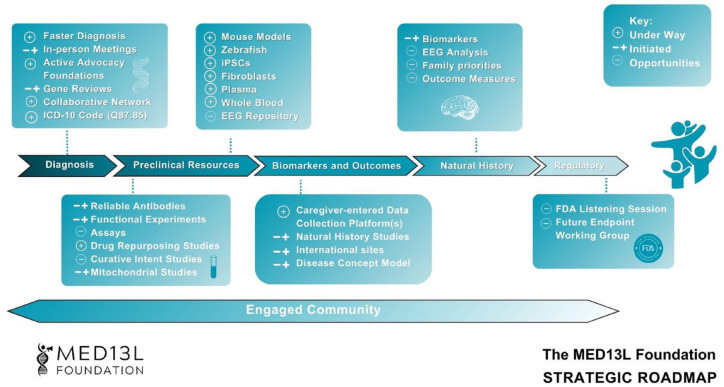
A strategic research plan (SRP) serves as a compass for the patient advocacy organizations driving the therapeutic options for their rare disorder. The MED13L Foundation commissioned the SRP in 2022 through COMBINEDBrain, a consortium of patient advocacy organizations of rare neurodevelopmental disorders, working toward clinical trial readiness. The MED13L Foundation SRP is an objective evaluation of MED13L literature including clinical and basic science knowledge interwoven with an assessment of preclinical trial readiness tools necessary for achieving therapeutic interventions. Clinical evaluation is conducted through a review of the literature documenting symptoms and variant information for each individual with MED13L syndrome. Data is collated and presented as a summary, providing any unique genotype-phenotype, as applicable. Scientific literature is reviewed in the same manner, identifying areas of opportunity to expand knowledge of MED13L syndrome. Researchers and clinicians responsible for growing the understanding of MED13L syndrome are interviewed and information is shared to create an open and collaborative network. Preclinical trial readiness tools are largely framed through Food and Drug Administration guidelines for the development of therapeutics from bench to bedside. Finally, the Foundation infrastructure and community engagement are assessed providing areas of strengths and opportunities to elevate the bond formed to drive patient-centered research forward. Completed, this SRP becomes a living resource for the MED13L Foundation to set priorities, share with researchers and clinicians, and provide direction to reach their organizational goals, including therapies for their community affected by MED13L syndrome.
Keywords: MED13L; advocacy led research; drug development resources; neurodevelopmental rare disease; patient advocacy organization; research roadmap.
Plain language summary
The MED13L Foundation strategic research plan The Strategic Research Plan (SRP) serves as a guide for patient advocacy groups working to find treatments for rare disorders. The MED13L Foundation collaborated with COMBINEDBrain to create a specific SRP for MED13L Syndrome to direct clinical trial readiness. Once completed, the SRP becomes a tool for the MED13L Foundation, researchers, clinicians, and the community. It helps set priorities and guides goals. A summary of the plan, presented as a roadmap, provides a quick overview of existing tools and what else needs to be done to prepare for clinical trials. The ultimate goal is to discover therapeutics that improve the lives of those affected by MED13L Syndrome.
© The Author(s), 2024.
Figures
References
-
- Muncke N, Jung C, Rüdiger H, et al. Missense mutations and gene interruption in PROSIT240, a novel TRAP240-like gene, in patients with congenital heart defect (transposition of the great arteries). Circulation 2003; 108: 2843–2850. - PubMed
-
- Musante L, Bartsch O, Ropers H-H, et al. cDNA cloning and characterization of the human THRAP2 gene which maps to chromosome 12q24, and its mouse ortholog Thrap2. Gene 2004; 332: 119–127. - PubMed
-
- U.S. Food and Drug Administration. Rare diseases: considerations for the development of drugs and biological products [internet], https://www.fda.gov/regulatory-information/search-fda-guidance-documents... (2023, accessed 21 February 2024).
Grants and funding
LinkOut - more resources
Full Text Sources