


Self-Management Intervention for Reducing Epilepsy Burden Among Adult Ugandans with Epilepsy (SMART-U): Randomised Clinical Trial Protocol
- PMID: 39619495
- PMCID: PMC11606334
- DOI: 10.2147/NDT.S490050
Self-Management Intervention for Reducing Epilepsy Burden Among Adult Ugandans with Epilepsy (SMART-U): Randomised Clinical Trial Protocol
Abstract
Background: People of all ages are affected by epilepsy, a prevalent chronic brain illness that is primarily found in underdeveloped nations. It is very necessary to implement epilepsy self-management techniques to support individuals with epilepsy in order to impact outcomes related to epilepsy. The purpose of this 2-site randomised controlled experiment is to investigate this further, based on encouraging preliminary evidence.
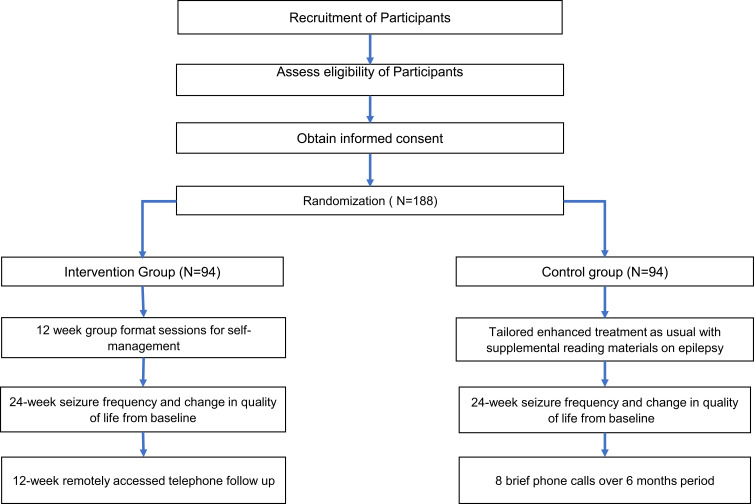
Methods: A total of 188 adult people with epilepsy (PWE) attending the neurology clinics at Mulago and Mbarara hospitals and consent to participate in the study will be recruited. They will be randomised into intervention versus enhanced treatment control (eTAU) study groups. The intervention group will receive 12-week "intensive" educational sessions and a 12-week remotely accessed telephone follow-up stage. The controls will continue in their usual care supplemented by written materials on epilepsy in their preferred language and tailored to the reading level of most patients at the clinic. SMART-U consists of 2 main components: a 12-week "intensive" group format stage and a 12-week remotely accessed telephone follow-up stage. SMART-U will be assessed for acceptability, fidelity, and efficacy compared to eTAU. The primary study outcome is the mean change in cumulative past 24-week seizure frequency (24 weeks prior to the study baseline compared to the 24-week follow-up). Seizure frequency will be via self-report with corroboration by family/support system informants whenever possible. Participants will self-report the seizure frequency (numeric count) that they experienced between baseline and 13 weeks and again between 13 and 24 weeks, and the mean change from baseline to 24 weeks in QOL.
Discussion: The curriculum-guided Self-Management intervention for Reducing The epilepsy burden among Ugandans (SMART-U) program is anticipated to reduce the epilepsy burden seizure frequency and improve other health outcomes, including depression, functional status and health resource use.
Trial registration number trn: NCT06139198.
Date of registration: November142023.
Keywords: epilepsy; intervention; self-management; targeted management.
© 2024 Mbalinda et al.
Conflict of interest statement
Professor Martha Sajatovic reports grants from US National Institute of Neurological Disorders and Stroke, during the conduct of the study; grants from Neurelis, Intra-Cellular, Merck, Otsuka, Alkermes, International Society for Bipolar Disorders (ISBD), personal fees from Alkermes, Otsuka, Lundbeck, Janssen, Teva, Publication royalties from Springer Press, Johns Hopkins University Press, Oxford Press, UpToDate, Compensation for preparation of continuing medical education activities from American Physician’s Institute (CMEtoGo), Psychopharmacology Institute, American Epilepsy Society, Clinical Care Options, outside the submitted work. The authors declare that they have no other competing interests.
Figures
Update of
-
Self-management Intervention for Reducing Epilepsy Burden Among Adult Ugandans With Epilepsy (Smart-u), Randomised Clinical Trial Protocol.Res Sq [Preprint]. 2023 Dec 2:rs.3.rs-3667486. doi: 10.21203/rs.3.rs-3667486/v1. Res Sq. 2023. Update in: Neuropsychiatr Dis Treat. 2024 Nov 25;20:2277-2286. doi: 10.2147/NDT.S490050. PMID: 38077080 Free PMC article. Updated. Preprint.
References
-
- Epilepsy. Available from: http://www.who.int/mental_health/neurology/epilepsy/en/. Accessed November 19, 2024.
Associated data
Grants and funding
LinkOut - more resources
Full Text Sources
Medical
Research Materials
Miscellaneous
