


Molecular docking analysis of Salvia sclarea flower extracts evaluated for protein target affinity based on different extraction methods
- PMID: 39619984
- PMCID: PMC11606907
- DOI: 10.1002/fsn3.4467
Molecular docking analysis of Salvia sclarea flower extracts evaluated for protein target affinity based on different extraction methods
Abstract
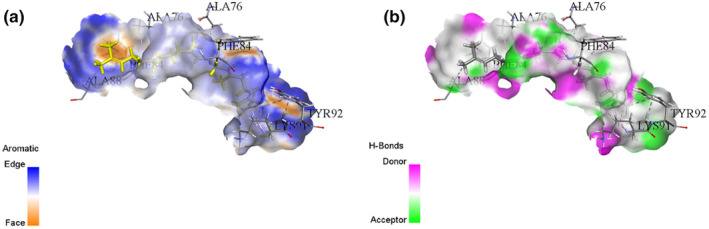
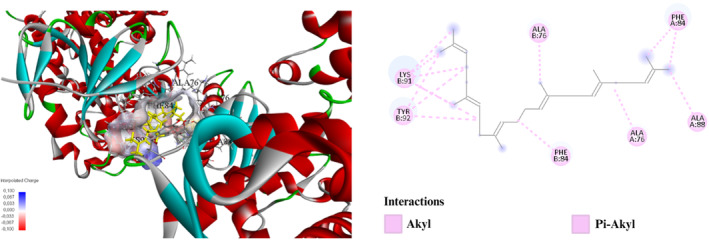
This study evaluates the antioxidant activity and total phenolic, flavonoid, flavonol, and tannin contents of extracts obtained from the flower parts of Salvia sclarea using different extraction methods, such as maceration and rotavapor (RE). The results indicate that the maceration method yields extracts with higher antioxidant activity compared to the rotavapor method (DPPH IC50: 260.70 ± 65.41 mg/mL vs. 345.48 ± 27.91 mg/mL). Additionally, the maceration method produces higher values in terms of total phenolic (26.4 ± 7.78 mg GAE/g extract), flavonoid (10.44 ± 0.21 mg QE/g extract), flavonol (9.20 ± 0.84 mg QE/g extract), and tannin contents (8.36 ± 0.39 mg GAE/g extract), whereas the RE method shows lower values (phenolics: 19.8 ± 3.31 mg GAE/g extract, flavonoids: 10.35 ± 0.35 mg QE/g extract, flavanol's: 5.45 ± 0.01 mg QE/g extract, and tannins: 7.72 ± 0.10 mg GAE/g extract). The gas chromatography-mass spectrometry (GC-MS) analysis of the extracts identified various bioactive compounds. Molecular docking studies revealed that Terpinen-4-ol obtained through maceration exhibits a strong binding affinity to a specific protein target, indicating potential biological activity. The predicted pharmacokinetic (ADME (absorption, distribution, metabolism, and excretion)) parameters for Terpinen-4-ol suggest favorable absorption and central nervous system (CNS) penetration, while Squalene obtained through maceration shows different pharmacokinetic properties. S. sclarea highlights significant antioxidant potential and provides insight into the bioactive compounds obtained through different extraction methods. To further investigate the potential biological interactions arising from these differences, molecular docking studies were conducted.
Keywords: GC–MS analysis; Salvia sclarea; antioxidant activity; maceration; molecular docking.
© 2024 The Author(s). Food Science & Nutrition published by Wiley Periodicals LLC.
Conflict of interest statement
The authors declare no conflicts of interest.
Figures
References
-
- Aghaei Jeshvaghani, Z. , Rahimmalek, M. , Talebi, M. , & Goli, S. A. H. (2015). Comparison of total phenolic content and antioxidant activity in different salvia species using three model systems. Industrial Crops and Products, 77, 409–414. 10.1016/J.INDCROP.2015.09.005 - DOI
-
- Ali, J. , Camilleri, P. , Brown, M. B. , Hutt, A. J. , & Kirton, S. B. (2012). Revisiting the general solubility equation: In silico prediction of aqueous solubility incorporating the effect of topographical polar surface area. Journal of Chemical Information and Modeling, 52(2), 420–428. - PubMed
-
- Ariani, D. , Almurdani, M. , Hendra, R. , & Teruna, H. Y. (2023). Antioxidant activity of Loranthus ferrugineus twigs extracts. Pharmacy Education, 23(2), 244–247.
-
- Asadi, S. , Ahmadiani, A. , Esmaeili, M. A. , Sonboli, A. , Ansari, N. , & Khodagholi, F. (2010). In vitro antioxidant activities and an investigation of neuroprotection by six salvia species from Iran: A comparative study. Food and Chemical Toxicology, 48(5), 1341–1349. - PubMed
-
- Aytar, E. C. (2024). Antioxidant and antimicrobial properties of Stachys maritima via quantum dots and molecular docking. Chemistry & Biodiversity, e202401057. - PubMed
LinkOut - more resources
Full Text Sources
Miscellaneous
