. 2024 Dec 24;103(12):e210078.
doi: 10.1212/WNL.0000000000210078. Epub 2024 Dec 2.

Population-Based Study of the Epidemiology of Stiff Person Syndrome in a Large Colorado-Based Health System

Affiliations

Population-Based Study of the Epidemiology of Stiff Person Syndrome in a Large Colorado-Based Health System

Paul Daniel Crane et al. Neurology. .

Abstract

Background and objectives: Stiff person syndrome spectrum disorder (SPSD) is a rare autoimmune disorder characterized by progressive muscle stiffness and painful spasms with an estimated prevalence of 1-2 cases per million people. Population-based epidemiologic studies are lacking because of both poor patient capture and the lack of standardized diagnostic criteria. Objectives of this study were to describe the incidence and prevalence of SPSD within the University of Colorado Health (UCH) system and apply previously proposed published criteria for SPSD within this population.

Methods: We queried Health Data Compass, an electronic health data repository for a large academic health care system, from 2012 through 2022 for all patients older than 18 years with International Classification of Diseases, 10th Revision (ICD-10) codes pertaining to stiff person syndrome. Records were reviewed for diagnostic confirmation. We calculated yearly and period prevalence and incidence rates based on observable person-time exposure of our cohort. We applied previously published Mayo Clinic and Johns Hopkins criteria for SPSD and compared period prevalence based on each criterion and evaluated for agreement.

Results: Two hundred and seventy-three patients met the initial inclusion criteria using ICD-10 codes; 59 were confirmed to have SPSD. The mean age was 49.7 years (SD = 12.9), 59.3% were female, 59.3% were considered antibody positive. The total database population over the interval was 2,801,674 persons. The estimated prevalence of SPSD based on our UCH cohort was 2.11 (95% CI 1.57-2.64) per 100,000 persons. The average yearly incidence was 0.35 per 100,000 person-years (95% CI 0.27-0.46). Applying different clinical diagnostic criteria, the estimated prevalence ranged from 1.36 (95% CI 0.93-1.79) to 1.82 (95% CI 1.32-2.32) per 100,000 persons.

Discussion: We describe a prevalence of SPSD of 2.11 per 100,000 persons in our UCH cohort. Prevalence estimates differed depending on which clinical diagnostic criteria were applied and whether possible SPSD cases were included. Using the most stringent criteria for diagnosis, we report a prevalence of 1.36 per 100,000 persons. While our study uniquely captures many US demographic groups, limitations remain because this is a retrospective review of a single system. Additional studies are needed to determine whether these results are representative of a national or global population.


Conflict of interest statement

P.D. Crane, S. Sillau, R. Dreher, R. Fix, P. Winters, R.V. Coevering, E. Engebretson, B. Valdez, and E.A. Matthews report no disclosures. K.V. Nair reports research grants from Genentech, PhRMA Foundation, Bristol Myers Squibb, Alexion, Squibb, Novartis, Horizon Biogen, and National Institute of Neurological Disorders and Stroke, and consulting fees from Bristol Myers Squibb, Novartis, Biogen, TG Therapeutics, Genentech and EMD Serono. In addition, she reports speakers bureau affiliation with Sanofi-Genzyme, Amgen and AJCM speaker series. A.M. Carlson reports unrelated grant funding from Horizon Therapeutics and recent service on the Health Services Subcommittee for the American Academy of Neurology. A.L. Piquet reports research grants from the University of Colorado, research funding from the Endowed Chair supported by the Céline Dion Foundation, Rocky Mountain MS Center, and the Foundation for Sarcoidosis; consulting fees from Genentech/Roche, UCB, EMD Serono, Kyverna and Alexion; honoraria from MedLink; and publication royalties from Springer as co-editor of a medical textbook. Go to Neurology.org/N for full disclosures.

Figures

Figure 1
Figure 1. Study Design
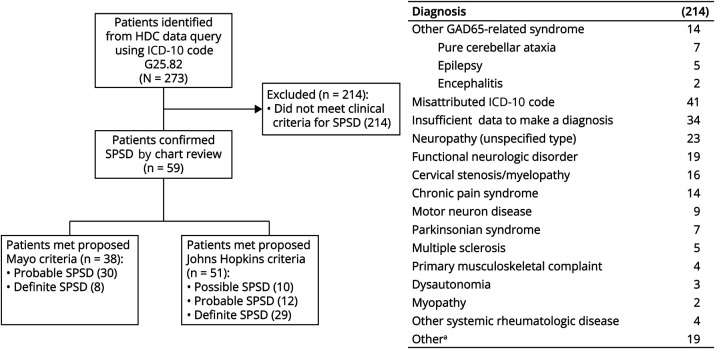
Two hundred and seventy-three patients were identified by a query of the HDC database. Two hundred and fourteen patients were removed from the cohort because of other GAD65-related syndromes, misattributed diagnostic codes, insufficient data in the chart, or confirmation of alternative diagnoses. The table summarizes the breakdown of these 214 patients. SPS diagnosis was substantiated in 59 patients by chart review. Fifty of these patients were personally evaluated by members of our Neuroimmunology group, and 45 of the patients were evaluated by faculty with specific training in Autoimmune Neurology. Proposed diagnostic criteria for SPS were then applied, with 38 patients meeting proposed Mayo Clinic criteria (8 definite, 30 probable) and 51 meeting Johns Hopkins criteria (29 definite, 12 probable, and 10 possible). GAD65 = glutamic acid decarboxylase 65-kilodalton isoform; HDC = Health Data Compass; SPS = stiff person syndrome; SPSD = stiff person spectrum disorder.
Figure 2
Figure 2. Immune Therapy and Symptomatic Treatments by Disease Phenotype
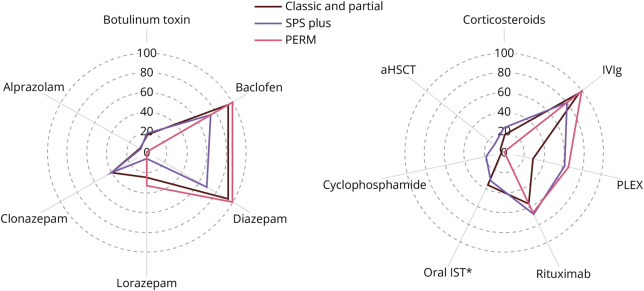
Treatment data were collected from chart review. We highlighted some common immune therapies and symptomatic treatments administered during the disease course among the various SPSD phenotypes. The use of steroids was defined as chronic steroids for ≥3 consecutive months and included 18.6% (11/59). IVIg was administered to most patients regardless of disease phenotype (93.2% [55/59]), followed by rituximab (61.0% [36/59]) and then PLEX (40.0 [23/59]). Cyclophosphamide was administered to a total of 4 patients (3 patients with SPS plus and 1 patient with classic SPS). Four patients underwent autologous hematopoietic stem cell transplant (2 patients with classic SPS, 2 patients with SPS plus, and 1 patient with pure cerebellar ataxia). Symptomatic treatment included baclofen (89.8% [53/59]), diazepam (89.8% [53/59]), and less frequently other benzodiazepines (clonazepam, lorazepam, temazepam, alprazolam, and/or chlordiazepoxide). Botulinum toxin was also used in the treatment of a minority of patients. aHSCT = autologous hematopoietic stem cell transplant; IVIg = IV immunoglobulin G; PERM = progressive encephalomyelitis with rigidity and myoclonus; PLEX = plasma exchange; SPS = stiff person syndrome; SPSD = stiff person spectrum disorder.
Figure 3
Figure 3. Yearly Incidence and Prevalence of Stiff Person Spectrum Disorder
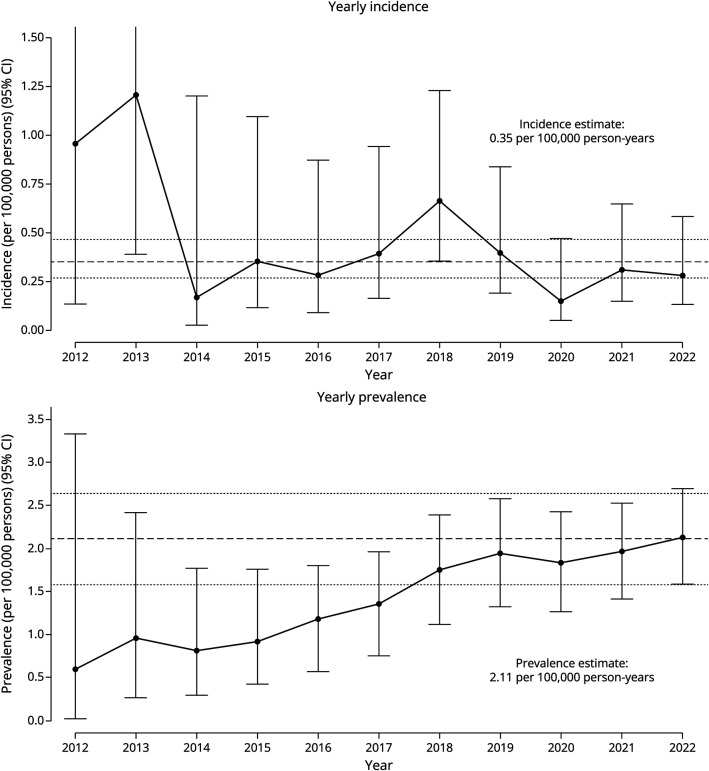
Yearly incidence and prevalence were calculated based on observable person-year exposure to the University of Colorado Healthcare system. The upper bounds of the first 2 years on the yearly incidence rate graph are removed to allow for enhanced visibility of subsequent years. The upper bound of 2012 and 2013 are, respectively, (6.7965–3.7280).
Figure 4
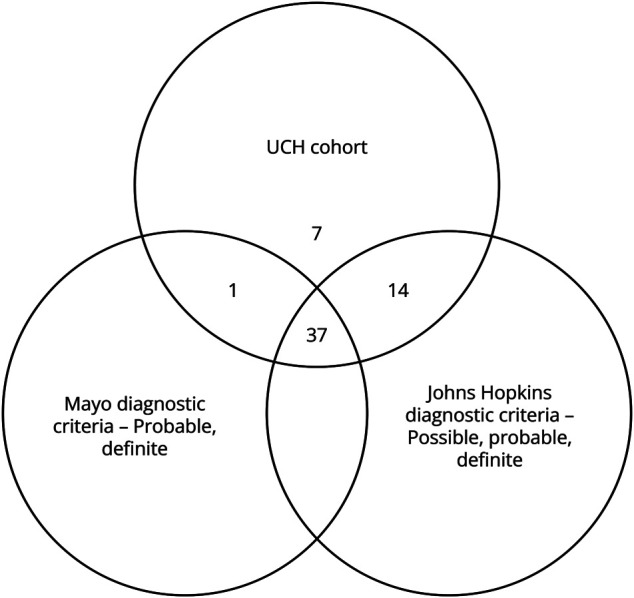
Figure 4. Diagnosis Prevalence Based on Diagnostic Criteria
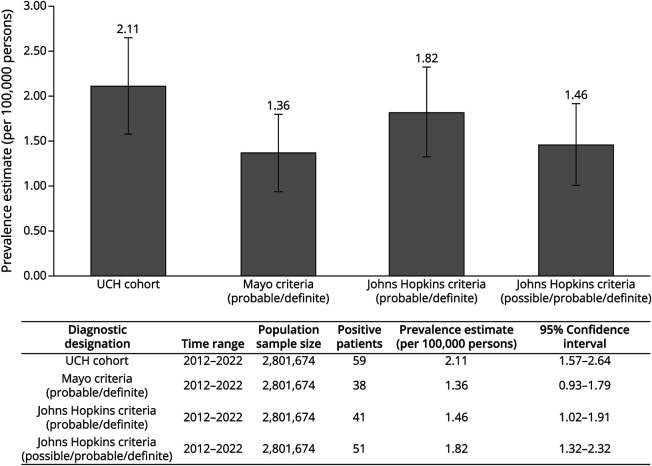
The estimated prevalence of SPSD within this cohort is 2.11 (95% CI 1.79–2.92) per 100,000 persons for the UCH cohort. Accounting for differences in diagnostic criteria, the estimated prevalence was calculated for the Mayo Clinic criteria at 1.36 per 100,000 (95% CI 0.92–1.78), Johns Hopkins criteria (including probable/definite only) at 1.46 per 100,000 (95% CI 1.02–1.91), and Johns Hopkins criteria (possible/probable/definite) at 1.82 per 100,000 (95% CI 1.32–2.32). SPSD = stiff person spectrum disorder; UCH = University of Colorado Health.
Figure 5
Figure 5. Criteria Agreement
Proposed diagnostic criteria were applied to the 59 patients in the UCH cohort. Among them, 38 patients met the Mayo Clinic criteria (8 definite and 30 probable). Notably, many patients not meeting the definite criteria lacked EMG analysis. Furthermore, 51 patients fulfilled the Johns Hopkins criteria (29 definite, 12 probable, and 10 possible). Application of the 2 proposed diagnostic criteria (possible/probable/definite Johns Hopkins vs probable/definite Mayo) in this real-world data set explores the agreement between these criteria, with a κ coefficient of 0.36 (95% CI 0.13–0.58). With removal of the “possible” cases in the Johns Hopkins criteria, we saw a κ statistic of 0.73 (95% CI 0.55–0.92). When only considering classical phenotypes, we calculated a κ of 0.30 (95% CI 0.05–0.55) with inclusion of the possible cases and 0.74 (95% CI 0.53–0.95) with exclusion of the possible cases in the Johns Hopkins criteria. UCH = University of Colorado Health.

References

    1. Moersch FP, Woltman HW. Progressive fluctuating muscular rigidity and spasm (“stiff-man” syndrome); report of a case and some observations in 13 other cases. Proc Staff Meet Mayo Clin. 1956;31(15):421-427. - PubMed
    1. Barker RA, Revesz T, Thom M, Marsden CD, Brown P. Review of 23 patients affected by the stiff man syndrome: clinical subdivision into stiff trunk (man) syndrome, stiff limb syndrome, and progressive encephalomyelitis with rigidity. J Neurol Neurosurg Psychiatry. 1998;65(5):633-640. doi: 10.1136/jnnp.65.5.633. - DOI - PMC - PubMed
    1. Wang Y, Hu C, Aljarallah S, et al. Expanding clinical profiles and prognostic markers in stiff person syndrome spectrum disorders. J Neurol. 2024;271(4):1861-1872. doi: 10.1007/s00415-023-12123-0 - DOI - PMC - PubMed
    1. Ariño H, Höftberger R, Gresa-Arribas N, et al. Paraneoplastic neurological syndromes and glutamic acid decarboxylase antibodies. JAMA Neurol. 2015;72(8):874-881. doi: 10.1001/jamaneurol.2015.0749 - DOI - PMC - PubMed
    1. Dalakas MC, Li M, Fujii M, Jacobowitz DM. Stiff person syndrome: quantification, specificity, and intrathecal synthesis of GAD65 antibodies. Neurology. 2001;57(5):780-784. doi: 10.1212/wnl.57.5.780 - DOI - PubMed

LinkOut - more resources