Global, Regional, and National Trends in Liver Disease-Related Mortality Across 112 Countries From 1990 to 2021, With Projections to 2050: Comprehensive Analysis of the WHO Mortality Database
- PMID: 39623966
- PMCID: PMC11611658
- DOI: 10.3346/jkms.2024.39.e292
Global, Regional, and National Trends in Liver Disease-Related Mortality Across 112 Countries From 1990 to 2021, With Projections to 2050: Comprehensive Analysis of the WHO Mortality Database
Abstract
Background: Liver disease causes over two million deaths annually worldwide, comprising approximately 4% of all global fatalities. We aimed to analyze liver disease-related mortality trends from 1990 to 2021 using the World Health Organization (WHO) Mortality Database and forecast global liver disease-related mortality rates up to 2050.
Methods: This study examined age-standardized liver disease-related death rates from 1990 to 2021, employing data from the WHO Mortality Database across 112 countries across five continents. The rates over time were calculated using a locally weighted scatter plot smoother curve, with weights assigned based on the population of each country. Furthermore, this study projected liver disease-related mortality rates up to 2050 using a Bayesian age-period-cohort (BAPC) model. Additionally, a decomposition analysis was conducted to discern influencing factors such as population growth, aging, and epidemiological changes.
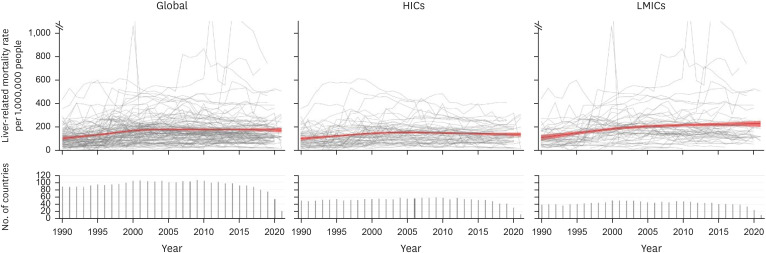
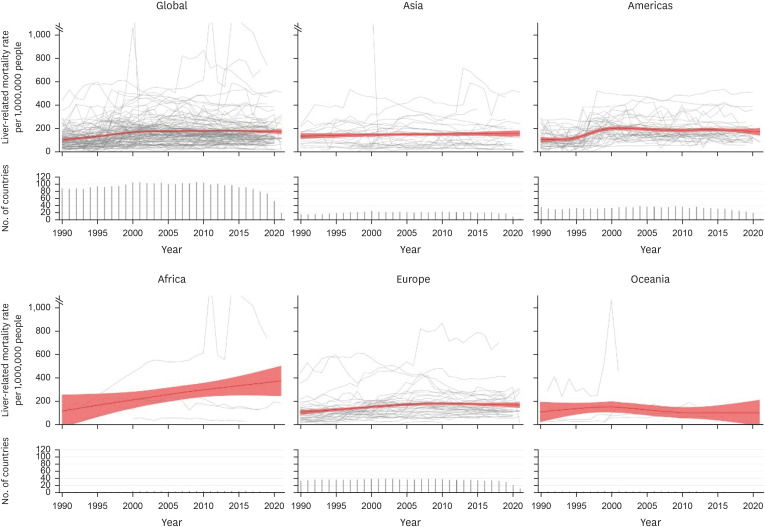
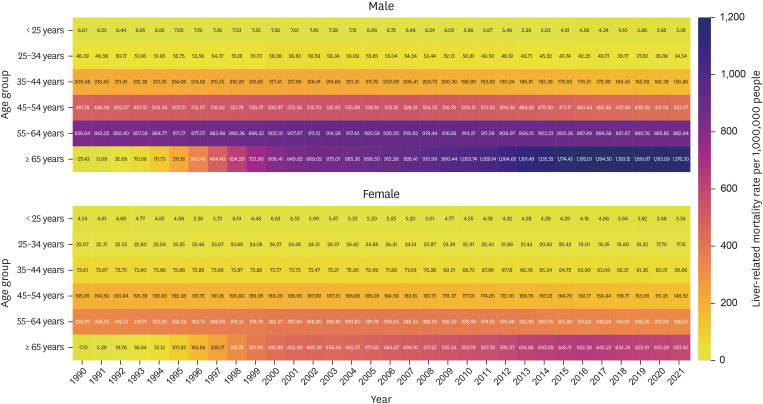
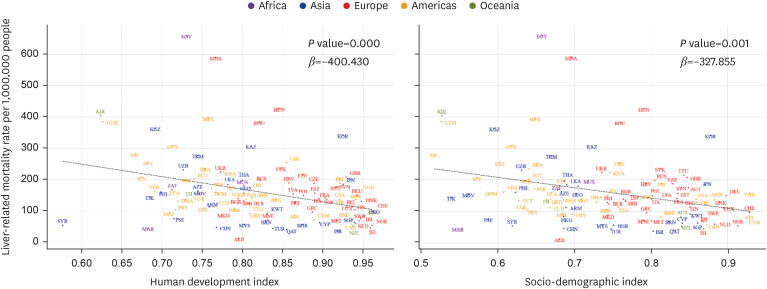
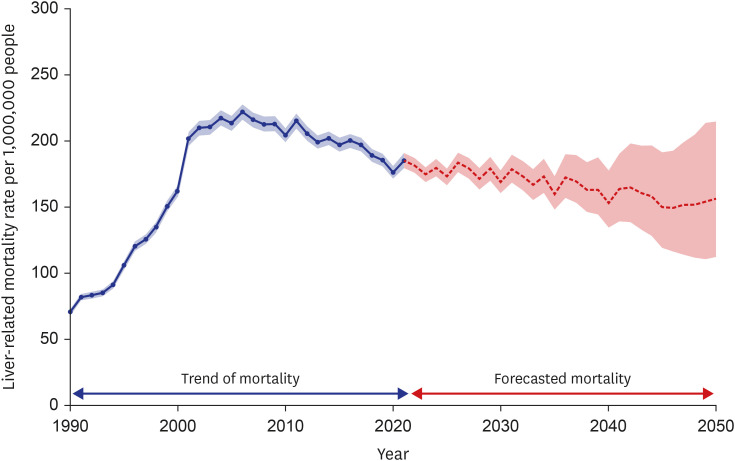
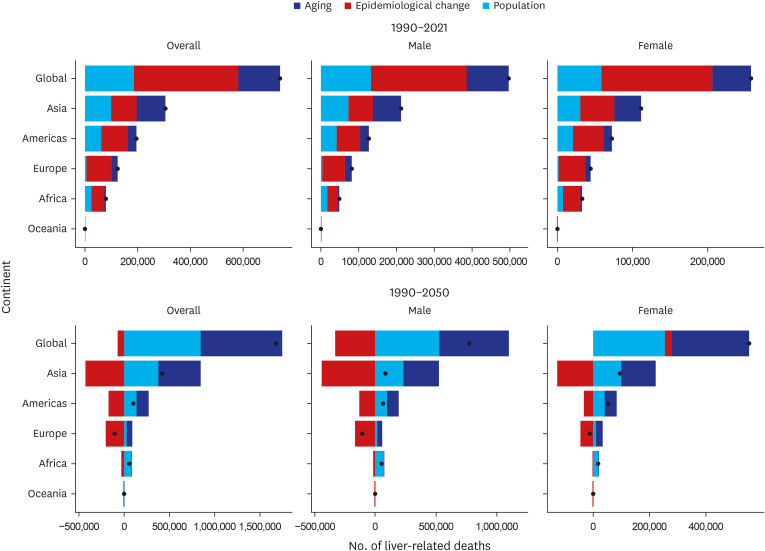
Results: The estimated global age-standardized liver disease-related mortality rates surged significantly from 1990 to 2021 across 112 countries, rising from 103.4 deaths per 1,000,000 people (95% confidence interval [CI], 88.16, 118.74) in 1990 to 173.0 deaths per 1,000,000 people (95% CI, 155.15, 190.95) in 2021. This upward trend was particularly pronounced in low- and middle-income countries, in Africa, and in populations aged 65 years and older. Moreover, age-standardized liver disease-related mortality rates were correlated with a lower Human Development Index (P < 0.001) and sociodemographic index (P = 0.001). According to the BAPC model, the projected trend indicated a sustained and substantial decline in liver disease-related mortality rates, with an estimated decrease from 185.08 deaths per 1,000,000 people (95% CI, 179.79, 190.63) in 2021 to 156.29 (112.32, 214.77) in 2050. From 1990 to 2021, age-standardized liver disease-related deaths surged primarily due to epidemiological changes, whereas from 1990 to 2050, the impact of population aging and growth became the primary contributing factors to the overall increase.
Conclusion: Global age-standardized liver disease-related mortality has increased significantly and continues to emerge as a crucial global public health issue. Further investigation into liver disease-related mortality rates in Africa is needed, and updating policies is necessary to effectively manage the global burden of liver disease.
Keywords: Global Trend; Liver Disease; Mortality; Prediction Model; WHO Mortality Database.
© 2024 The Korean Academy of Medical Sciences.
Conflict of interest statement
The authors have no potential conflicts of interest to disclose.
Figures
References
-
- Devarbhavi H, Asrani SK, Arab JP, Nartey YA, Pose E, Kamath PS. Global burden of liver disease: 2023 update. J Hepatol. 2023;79(2):516–537. - PubMed
-
- Younossi ZM, Wong G, Anstee QM, Henry L. The global burden of liver disease. Clin Gastroenterol Hepatol. 2023;21(8):1978–1991. - PubMed
-
- Easterbrook P, Luhmann N, Newman M, Walsh N, Lesi O, Doherty M. New WHO guidance for country validation of viral hepatitis B and C elimination. Lancet Gastroenterol Hepatol. 2021;6(10):778–780. - PubMed
MeSH terms
Grants and funding
LinkOut - more resources
Full Text Sources
Medical