Review
. 2024 Dec 4;9(1):340.
doi: 10.1038/s41392-024-02030-9.

Chromatin accessibility: biological functions, molecular mechanisms and therapeutic application

Affiliations
Review

Chromatin accessibility: biological functions, molecular mechanisms and therapeutic application

Yang Chen et al. Signal Transduct Target Ther. .

Abstract

The dynamic regulation of chromatin accessibility is one of the prominent characteristics of eukaryotic genome. The inaccessible regions are mainly located in heterochromatin, which is multilevel compressed and access restricted. The remaining accessible loci are generally located in the euchromatin, which have less nucleosome occupancy and higher regulatory activity. The opening of chromatin is the most important prerequisite for DNA transcription, replication, and damage repair, which is regulated by genetic, epigenetic, environmental, and other factors, playing a vital role in multiple biological progresses. Currently, based on the susceptibility difference of occupied or free DNA to enzymatic cleavage, solubility, methylation, and transposition, there are many methods to detect chromatin accessibility both in bulk and single-cell level. Through combining with high-throughput sequencing, the genome-wide chromatin accessibility landscape of many tissues and cells types also have been constructed. The chromatin accessibility feature is distinct in different tissues and biological states. Research on the regulation network of chromatin accessibility is crucial for uncovering the secret of various biological processes. In this review, we comprehensively introduced the major functions and mechanisms of chromatin accessibility variation in different physiological and pathological processes, meanwhile, the targeted therapies based on chromatin dynamics regulation are also summarized.


Conflict of interest statement

Competing interests: The authors declare no competing interest. Consent for publication: All authors have read the manuscript and consent to publication

Figures

Fig. 1
Fig. 1
Dynamics of chromatin accessibility in eukaryote. The chromatin of eukaryote is multistage compressed and encapsulated in mitotic interphase nuclei. Majority of the chromatin is highly condensed, which is usually inaccessible. The remaining region is dynamically bound by histones, transcription factors, and other chromatin interaction molecules, characterizing by dynamic accessible, which is crucial for DNA transcription, replication, damage repair, and so on. This picture was drawn by Freescience
Fig. 2
Fig. 2
The key discovery in chromatin accessibility research. The research on the accessibility of chromatin can trace back to 1973. Following, many achievements have been obtained in this field. From detecting general accessibility alteration, specific loci changes, to the genome-wide accessibility state. Recently, we are able to detect spatial chromatin accessibility, organelle chromatin accessibility, as well as different epigenetic modifications, transcriptome, and chromatin state in the same specimen at the single-cell resolution. This picture was drawn by Freescience
Fig. 3
Fig. 3
The principal methods to measure chromatin accessibility. The free and occupied DNA are distinct in hypersensitive to MNase- and DNase-mediated cleavage, solubility in different solvents, DNA methylation, as well as transposase-mediated transposition. Combining with high-throughput sequencing, MNase-seq (a), DNase-seq (b), FAIRE-seq (c), NOMe-seq (d), and ATAC-seq (e) are widely used in genome-wide accessibility studies. This picture was drawn by Freescience
Fig. 4
Fig. 4
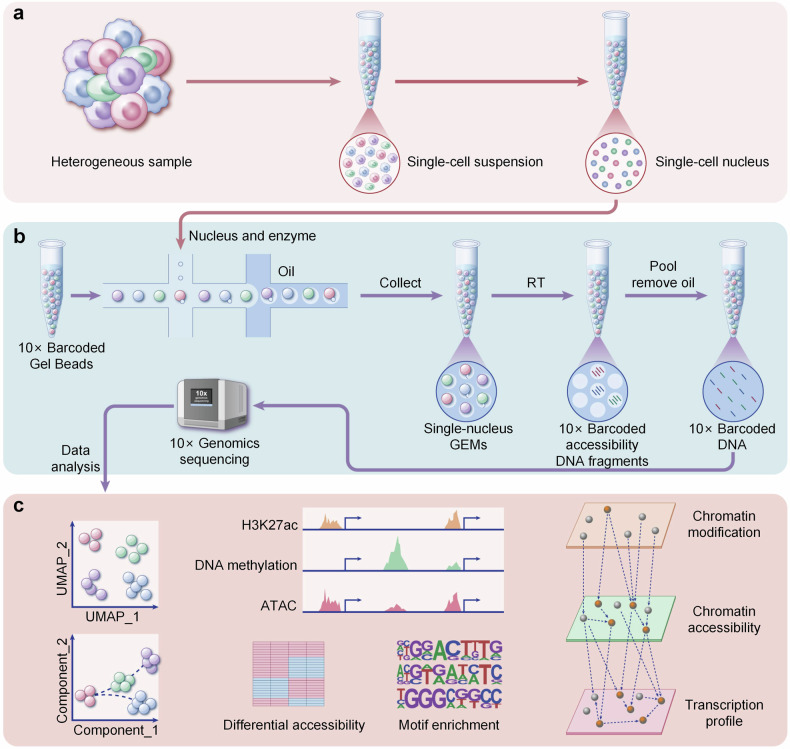
A general process for multimodal single-cell detection of chromatin dynamics. Currently, 10× Genomics sequencing platform is widely applied to obtain the gene expression and epigenetic information in single cell. The process is divided into single-cell nucleus preparation (a), library construction and sequencing (b), and data analysis (c). The sample sources include various tissues or cultured cells. After obtaining single cell suspension, the intact nuclei were obtained by gentle lysis and centrifugation. By adjusting the combination of enzymes, we can obtain gene expression, DNA methylation, histone modification, and chromatin accessibility profiles in the same single cell. Based on the significantly different genes, we can divide cells into different clusters and construct the pseudotemporal differentiation paths, as well as analyze the correlation and difference between gene expression, epigenetic modifications, and chromatin accessibility. This picture was drawn by Freescience
Fig. 5
Fig. 5
The primary remodellers of chromatin accessibility. The chromatin accessibility is determined by multiple regulators, mainly including chromatin remodellers (a), DNA methylation (b), histone modifications (c, d), pioneer transcription factors (e), non-coding RNAs (f), DNA sequence (g), and chromatin 3D structure (h). This picture was drawn by Freescience
Fig. 6
Fig. 6
Chromatin accessibility variation is involved in multiple physiological processes. The chromatin accessibility is dynamically varied in many physiological processes, such as embryonic and organ development, tissue regeneration, organ function execution, circadian rhythm, gender difference, senescence, and so on. This picture was drawn by Freescience
Fig. 7
Fig. 7
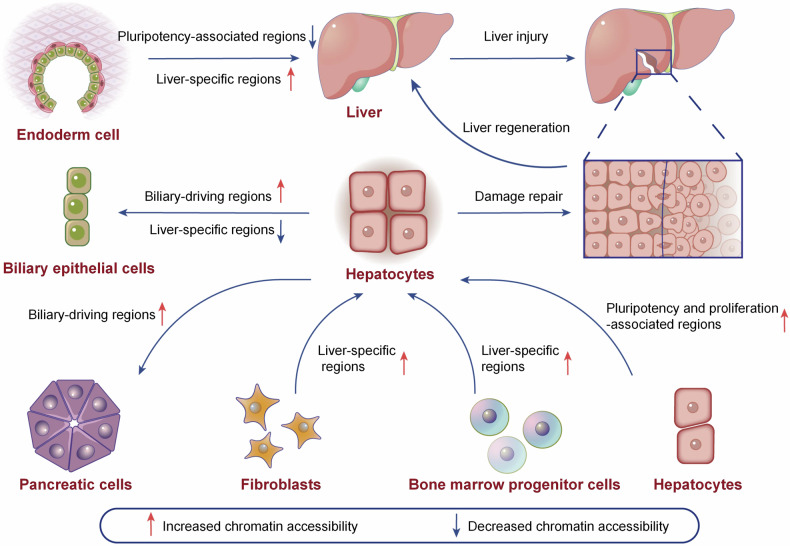
Chromatin accessibility regulates the development, regeneration, and transdifferentiation of liver. During the development of liver, the chromatin accessibility of pluripotent genes and liver-specific genes are reduced and increased, respectively. During the repair of damaged liver, the chromatin accessibility of pluripotency and proliferation-related genes are increased. During the transdifferentiation of liver, the specific gene accessibility of origin tissue is always reduced and that of the aim tissue is correspondingly increased. This picture was drawn by Freescience
Fig. 8
Fig. 8
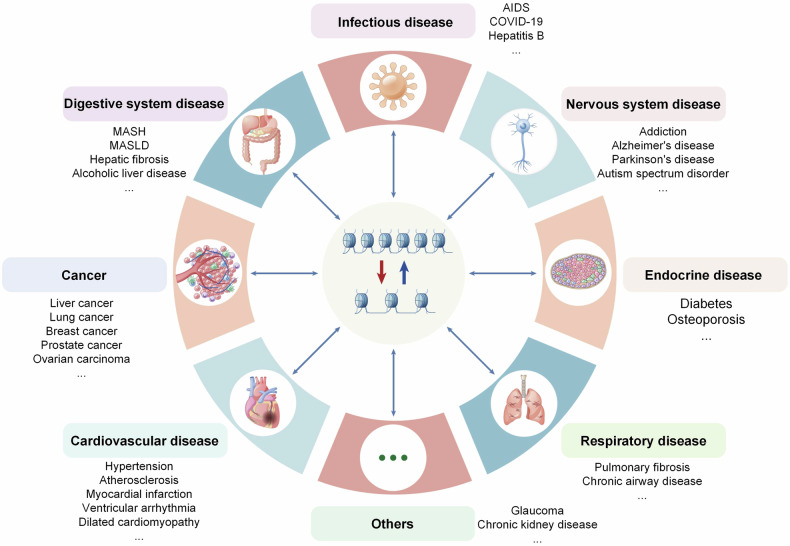
Chromatin accessibility variation is involved in multiple pathological processes. The chromatin accessibility state is dysregulated in multiple diseases. The aberrant chromatin accessibility widely aggravates the initiation and progression of numerous diseases, such as cardiovascular disease, cancer, digestive system disease, nervous system disease, endocrine disease, respiratory disease, and infectious disease. This picture was drawn by Freescience
Fig. 9
Fig. 9
Chromatin accessibility participates in the malignant progression of different cancers. The chromatin accessibility state is dysregulated in multiple cancers which promotes many malignant progression, including tumorigenesis, proliferation, metastasis, chemoresistance, angiogenesis, stemness, immune escape, pro-tumor inflammation, pro-tumor senescence, metabolic reprogramming, heterogeneity, and so on. This picture was drawn by Freescience

References

    1. Kaplan, N. et al. The DNA-encoded nucleosome organization of a eukaryotic genome. Nature458, 362–366 (2009). - DOI - PMC - PubMed
    1. Lee, C. K. et al. Evidence for nucleosome depletion at active regulatory regions genome-wide. Nat. Genet.36, 900–905 (2004). - DOI - PubMed
    1. Thurman, R. E. et al. The accessible chromatin landscape of the human genome. Nature489, 75–82 (2012). - DOI - PMC - PubMed
    1. McBryant, S. J., Adams, V. H. & Hansen, J. C. Chromatin architectural proteins. Chromosome Res.14, 39–51 (2006). - DOI - PubMed
    1. Routh, A., Sandin, S. & Rhodes, D. Nucleosome repeat length and linker histone stoichiometry determine chromatin fiber structure. Proc. Natl. Acad. Sci. USA105, 8872–8877 (2008). - DOI - PMC - PubMed

Publication types

LinkOut - more resources