. 2024 Dec 3;14(1):30134.
doi: 10.1038/s41598-024-81763-7.

RT-RPA as a dual tool for detection and phylogenetic analysis of epidemic arthritogenic alphaviruses

Affiliations

RT-RPA as a dual tool for detection and phylogenetic analysis of epidemic arthritogenic alphaviruses

Sainetra Sridhar et al. Sci Rep. .

Abstract

Chikungunya (CHIKV), o'nyong-nyong (ONNV), and Mayaro (MAYV) viruses are transmitted by mosquitoes and known to cause a debilitating arthritogenic syndrome. These alphaviruses have emerged and re-emerged, leading to outbreaks in tropical and subtropical regions of Asia, South America, and Africa. Despite their prevalence, there persists a critical gap in the availability of sensitive and virus-specific point-of-care (POC) diagnostics. Traditional immunoglobulin-based tests such as enzyme-linked immunosorbent assay (ELISA) often yield cross-reactive results due to the close genetic relationship between these viruses. Molecular diagnostics such as quantitative polymerase chain reaction (qPCR) offer high sensitivity but are limited by the need for specialized laboratory equipment. Recombinase polymerase amplification (RPA), an isothermal amplification method, is a promising alternative to qPCR, providing rapid results with minimal equipment requirements. Here, we report the development and validation of three virus-specific RT-RPA-based rapid tests for CHIKV, ONNV, and MAYV. These tests demonstrated both speed and sensitivity, capable of detecting 10-100 viral copies within 20 min of amplification, without exhibiting cross-reactivity. Furthermore, we evaluated the clinical potential of these tests using serum and tissue samples from CHIKV, ONNV, and MAYV-infected mice, as well as CHIKV-infected human patients. We demonstrate that the RPA amplicons derived from the patient samples can be sequenced, enabling cost-effective molecular epidemiological studies. Our findings highlight the significance of these rapid and specific diagnostics in improving the early detection and management of these arboviral infections, particularly in resource-limited settings.

Keywords: Amplicon sequencing; Chikungunya virus; Mayaro virus; O’nyong Nyong virus; Recombinase polymerase amplification.


Conflict of interest statement

Declarations. Competing interests: BBH is a co-founder of Mir Biosciences, Inc., a biotechnology company focused on T cell-based diagnostics and vaccines for infectious diseases, cancer, and autoimmunity. All other authors declare no conflicts of interest.

Figures

Fig. 1
Fig. 1
Schematic depicting the regions selected for primer design. Multiple sequence alignments (MSAs) were assembled for (A) CHIKV, (B) ONNV and (C) MAYV using the indicated number of sequences following which the consensus sequence was analyzed focusing on the four NSPs, the Capsid, E2 and E1 to identify the most conserved regions for each virus. The heatmaps show the percent non-homology calculated for each region and the top four most homologous sites (with the darkest shading), highlighted in a red border, were selected for primer design. For ONNV, the analysis identified NSP4, highlighted with a discontinuous border, was identified as the fourth target for primer design, however, we chose to prioritize designing primers in E1 instead.
Fig. 2
Fig. 2
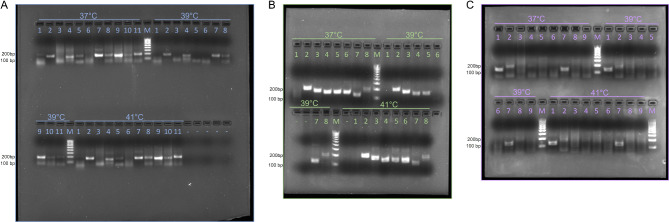
Primer screens conducted by agarose gel electrophoresis of RPA products. All 17 primers for CHIKV, 16 primers for ONNV and 17 primes for MAYV were screened in 20-minute RPA reactions using 105 viral copies with cDNA as input, The reactions were run at three temperatures as indicated. Depicted here is a representative subset of those screened primers, (A) corresponding to CHIKV, (B) to ONNV, and (C) to MAYV.
Fig. 3
Fig. 3
Analytical sensitivities of the designed primers on an agarose gel. Candidate (A) CHIKV, (B) ONNV, and (C) MAYV primer pairs identified in the screen were evaluated on a serial dilution of cDNA inputs ranging from 106 viral copies to 1 viral copy. Cross reactivity of these primers was also tested using 105 copies of cDNA from the other two viruses. The reaction inputs for each well are denoted in the image. The sensitivity was determined to be 102 for CHIKV and ONNV, and between 103 and 102 for MAYV, with not cross-reactivity.
Fig. 4
Fig. 4
Detecting RPA reactions on LFA strips. (A) Schematic representation of the Millenia Biosciences 2T test strips utilized in this study. The strips have two test bands “T1” and “T2,” one coated with streptavidin and the other with an anti-Digitonin antibody. The gold nanoparticles (AuNPs) are conjugated to an anti-FITC antibody. Accordingly, all our reverse primers were either tagged with a 5’Biotin tag (CHIKV) or a 5’ Digitonin tag (ONNV and MAYV), and their probes- hybridization probe for CHIKV and MAYV or nfo-probe for ONNV- were all 5’FAM tagged. Shown in the figure are depictions of the reaction product from the CHIKV assay, that uses a hybridization probe, binding at T1 and the ONNV assay, that uses a nfo-probe, binding at T2. The MAYV RPA product would appear like the CHIKV product since it also uses hybridization probes, however, it would bind at T2, since its reverse primer has a 5’digitonin tag. (B-D) show the analytical sensitivity of the rapid-test versions of the CHIKV (B), ONNV, (C) and MAYV (D) assays. The reactions used a serial dilution of cDNA as their input. Also included are reactions with 105 copies of cDNA from the other two viruses to assess cross-reactivity. RPA reaction products were diluted and applied to the strips and then immersed in the manufacturer-provided assay buffer for up to 30 min or until the strips were dry. The strips were photographed using a smartphone camera. All three assays were able to detect between 100 and 10 copies of viral cDNA, with “eq” indicating an equivocal test result and were not cross-reactive.
Fig. 5
Fig. 5
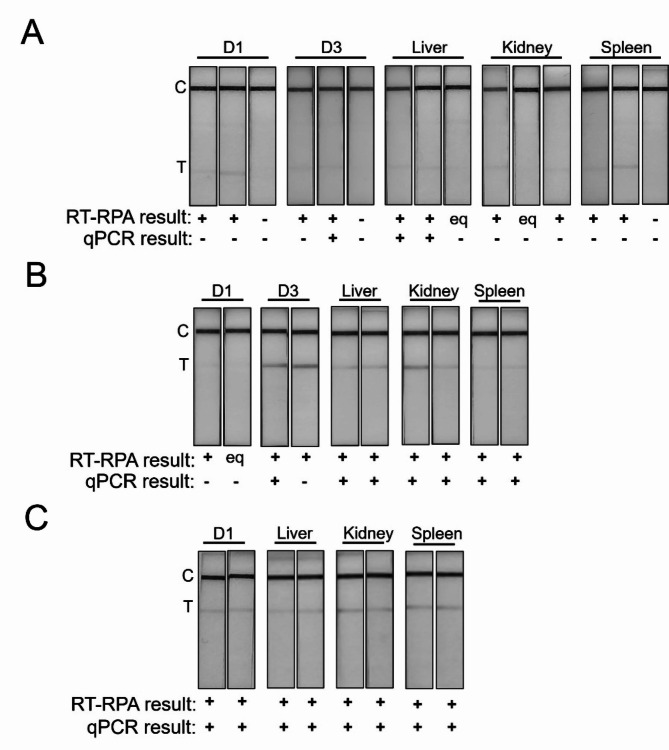
Detecting alphaviruses in serum and tissues from mouse infection models using RT-RPA rapid tests. IFNRα/β/γ -/- mice were infected with 1000 PFU of (A) CHIKV (181/25 strain, n = 3), (B) ONNV (NR-50081 strain, n = 2) and (C) MAYV (NR-51661 strain, n = 2) via subcutaneous footpad injection. Serum was collected 1 day post infection (for all three) and 3-days post infection (for CHIKV and ONNV), and organs were harvested at day 3, when the mice experienced mortality. RNA was extracted, reverse-transcribed and subjected to RPA using labelled primers. The reaction products were applied to the test strips and were photographed using a smartphone camera. The extracted RNA from each sample was also subjected to RT-PCR for comparison. The results of both assays for each sample are indicated with “+” for positive, a “-” for negative, or “eq” for equivocal, as observed.
Fig. 6
Fig. 6
Detecting CHIKV from patient samples using the CHIKV RT-RPA test. (A) 5 CHIKV qPCR-positive patient serum samples from Brazil were evaluated using our designed RT-RPA test, with Zika and dengue qPCR-positive patient sera as negative controls. RNA was extracted and reverse transcribed, and the resulting cDNA was subjected to RPA. The results are as indicated in the figure with either + for a positive result, - for a negative result, or an “eq” for an equivocal result. Additionally, the RT-RPA amplicons from the 5 patient samples were subjected to sanger sequencing and the resulting sequence corresponded with the intended target region in E2. CHIKV sequencing was not performed for the DENV and ZIKV qPCR + samples and were labeled as “N.A.” as in not applicable. (B) Phylogenetic tree constructed from aligning the sequences obtained from sanger sequencing of the 5 patient RPA amplicons (CHIKV_Human_Serum1-5) and RPA product from the same gRNA used in the screens and initial tests (181/25_RPA reaction) with the E2 sequences of various CHIKV strains and isolates. The accession numbers of the strains included in this analysis are as follows: OQ148623.1 (CHIKV_Brazil_Asian, a Brazilian CHIKV isolate with an Asian genotype), L3766.1 (CHIKV_181/25, a live attenuated derivative of an Asian strain of CHIKV, and the source of the gRNA used in the screens and initial tests of our RT-RPA assay), NC_004162.2 (CHIKV_S27_African_prototype, an African strain of CHIKV, and the genome that was used as the basis for primer design in this study), KU940225.1 (CHIKV_Brazil_ECSA, a Brazilian CHIKV isolate with an East-Central-Southern-African genotype). A ClustalW alignment of the sequences was used to construct a maximum-likelihood tree based on the Tamura-Nei model and 500 bootstrapping replications using Mega11.

Update of

References

    1. Pezzi, L. et al. GloPID-R report on Chikungunya, O’nyong-nyong and Mayaro virus, part I: Biological diagnostics. Antiviral Res.16610.1016/j.antiviral.2019.03.009 (2019). - PubMed
    1. Kim, A., Diamond, M. & S. & A molecular understanding of alphavirus entry and antibody protection. Nat. Rev. Microbiol.2110.1038/s41579-022-00825-7 (2022). - PMC - PubMed
    1. Zaid, A. et al. Arthritogenic alphaviruses: epidemiological and clinical perspective on emerging arboviruses. Lancet Infect. Dis.2110.1016/s1473-3099(20)30491-6 (2020). - PubMed
    1. Diagne, C. et al. Mayaro Virus Pathogenesis and Transmission mechanisms. Pathogenetics910.3390/pathogens9090738 (2020). - PMC - PubMed
    1. Rezza, G., Chen, R. & Weaver, S. O’nyong-nyong fever: a neglected mosquito-borne viral disease. Pathogens Global Health. 11110.1080/20477724.2017.1355431 (2017). - PMC - PubMed

MeSH terms

LinkOut - more resources