


Significant increase of firework induced eye injuries in Germany and The Netherlands- are we doing enough to protect minors and bystanders?
- PMID: 39627464
- PMCID: PMC12095323
- DOI: 10.1007/s00417-024-06677-6
Significant increase of firework induced eye injuries in Germany and The Netherlands- are we doing enough to protect minors and bystanders?
Erratum in
-
Correction: Significant increase of firework induced eye injuries in Germany and The Netherlands- are we doing enough to protect minors and bystanders?Graefes Arch Clin Exp Ophthalmol. 2025 Nov;263(11):3283-3285. doi: 10.1007/s00417-025-06970-y. Graefes Arch Clin Exp Ophthalmol. 2025. PMID: 41099827 Free PMC article. No abstract available.
Abstract
Background: After 2 years of pandemic sales ban, on New Year`s Eve 2022/23 consumer firework articles were officially available again in Germany and the Netherlands.
Methods: In the Netherlands we prospectively and anonymously collected data on patients treated for firework induced eye injuries from 2009 on, in Germany since 2016.
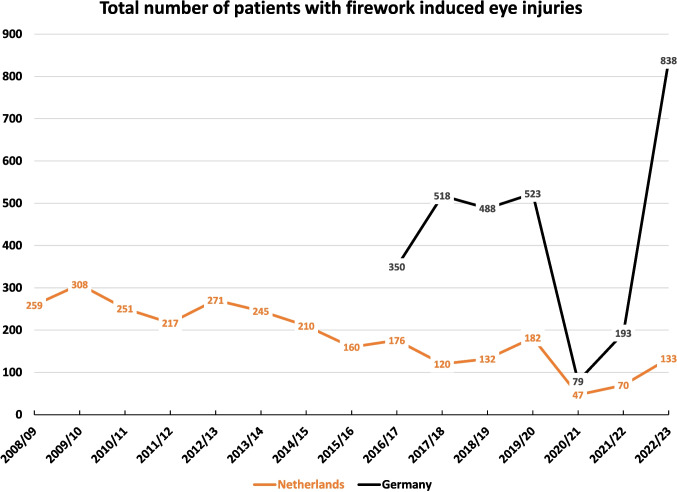
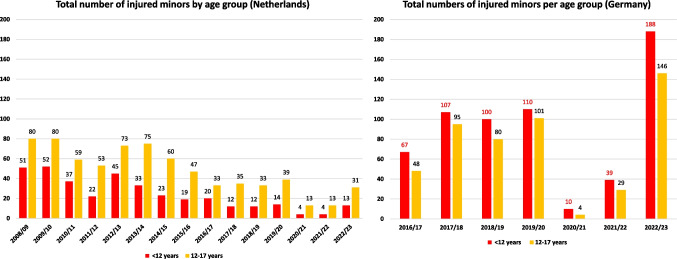
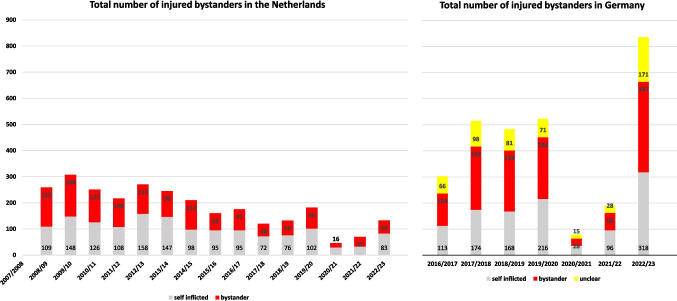
Results: Around New Year ́s Eve 2022/23 the number of patients with firework inflicted eye injuries increased in the Netherlands to 133 and in Germany to 838. In both countries the participation of eye departments was 90%. The incidence of firework induced eye injuries in the Netherlands was 0,8 /100 000 in 2022/23, in Germany 1,0 /100 000 in 2022/23. Comparing age groups of minors with firework induced eye injuries, in the Netherlands, total numbers of children below 12 years was lower than total numbers of adolescents between 12 and 17 years. Yet, in Germany from 2016 on every year, total number of children below 12 years were higher than total number of adolescents. The number of patients who reported on being injured as bystander was between 34% in 2020/21 and 53% in both countries.
Conclusions: While the incidence of firework induced eye injuries in the Netherlands was reduced due to awareness campaigns and regulatory work, the incidence was increasing on the first New Year`s Eve after the pandemic regulations of consumer fireworks in Germany. Especially young children below 12 years need more protection in Germany. In both countries, effective measures of protection need to be implemented for protection of bystanders, whose numbers were low during the first pandemic years.
Key messages: What is known: overrepresentation of affected minors below 18 years and a rate of up to 50% of injured bystanders according to our data collection over 15 years in the Netherlands and 7 years in Germany What is new: In 2022/2023, total numbers of patients with fire work induced eye injuries in the Netherlands and Germany increased significantly after 2 years of pandemic regulations with a sales ban of consumer fire work articles In 2022/23, incidence of firework induced eye injuries is 1/100 000 in Germany, 0,8/100 000 in the Netherlands Among affected minors in Germany school children up to 12 years are at higher risk than adolescents.
Keywords: Bystander; Consumer fireworks; Firework induced eye injuries; Firework inflicted eye injuries; Incidence; Private fireworks; Protection.
© 2024. The Author(s).
Conflict of interest statement
Declarations. Disclosure of potential conflicts of interest: All authors certify that they have no affiliations with or involvement in any organization or entity with any financial interest (such as honoraria; educational grants; participation in speakers’ bureaus; membership, employment, consultancies, stock ownership, or other equity interest; and expert testimony or patent-licensing arrangements), or non-financial interest (such as personal or professional relationships, affiliations, knowledge or beliefs) in the subject matter or materials discussed in this manuscript. Research involving human participants and/or animals: The anonymous, voluntary data collection protocols align with ethical guidelines exempting approval requirements, so we did not seek separate ethics approval for the registry. All registry submissions are de-identified upon submission per established ethics standards, ensuring patient privacy is completely upheld. Informed consent: While individual patient consent was waived, this decision was made after careful consideration. Waiving consent aims to reduce participation bias and ensure robust datasets that support impactful health research and improved patient outcomes. We believe the significant potential for public benefit justifies this protocol. Photographs were included after patients or parents´ consent for publication.
Figures



References
Publication types
MeSH terms
LinkOut - more resources
Full Text Sources
Medical
