


Socioeconomic factors and test preparation strategies are related to success on the USMLE Step 2 clinical knowledge (CK) exam: a single-institution study
- PMID: 39627730
- PMCID: PMC11616350
- DOI: 10.1186/s12909-024-06414-x
Socioeconomic factors and test preparation strategies are related to success on the USMLE Step 2 clinical knowledge (CK) exam: a single-institution study
Abstract
Background: Since the elimination of numerical scoring of the United States Medical Licensing Examination (USMLE) Step 1, the perceived importance of USMLE Step 2 Clinical Knowledge (CK) scores in residency placement has increased. It is known that socioeconomic status (SES) and other demographic factors can be barriers to success in standardized assessment, but few recent studies report the relationship between student demographics, including SES, with Step 2 CK scores in the context of exam practice material access and usage. In this study, we investigated predictors of Step 2 CK success across two years at one institution.
Methods: A survey regarding Step 2 CK exam preparation and demographic factors was administered to two student cohorts at a New York medical school in 2022 and 2023. The cohorts were comprised of all students in a given class year who had taken Step 2 CK. De-identified survey responses were linked to metrics including Step 1, Step 2 CK, shelf exam, and Medical College Admission Test (MCAT) scores.
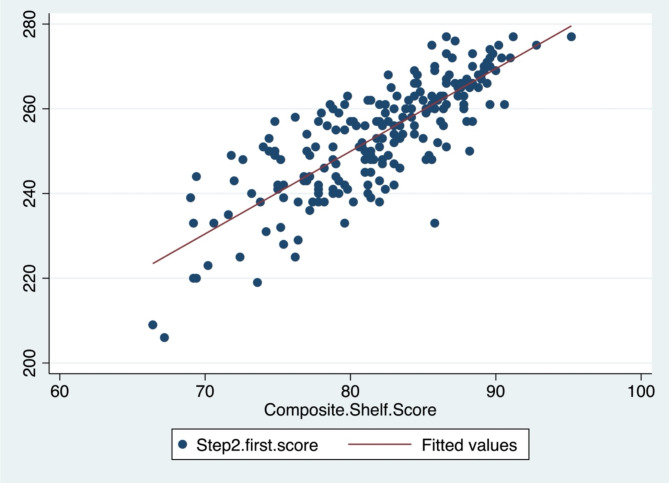
Results: The mean Step 2 CK score among the respondents (n = 213) was 254 ± 13. There was a strong positive correlation between Step 2 CK score and composite shelf scores (rho = 0.80, p < 0.01). Almost all participants used the UWorld question-bank to prepare for the exam (98.1%), and completion of more than 2500 unique questions was associated with better exam performance (256 vs. 252, p = 0.04). On bivariate analysis, students had significantly lower mean Step 2 CK scores if they self-identified as socioeconomically disadvantaged (SED) (250 vs. 256, p < 0.01) and self-reported that financial limitations prevented them from purchasing study resources (249 vs. 257, p < 0.01). In adjusted models, there was no longer a relationship between self-identified SED and Step 2 CK score (beta=-3.50, 95% CI (-8.25, 1.26), p = 0.15).
Conclusions: This study provides insight into the relationship between exam performance, study habits, and demographic factors at a single institution where students, on average, performed above the national mean on Step 2 CK. Results support that Step 2 CK scores are modulated by a high composite shelf score, number of unique UWorld questions completed, dedicated study period length, and socioeconomic inequity.
Trial registration: Study registered with our institutional IRB (IRB number 20177537).
Keywords: Equity; NBME; Performance; Resources; Socioeconomic status; Step 2 CK; Study habits; USMLE.
© 2024. The Author(s).
Conflict of interest statement
Declarations. Ethics approval and consent to participate: The study was approved by Albert Einstein College of Medicine’s Institutional Review Board (IRB# 2017–7537). All participants gave their written informed consent after understanding that submission of the completed survey constituted an agreement to this consent. Consent for publication: Not applicable. Competing interests: A.C.R. serves as a Committee Member of the Nephrology Section MKSAP-22 for the American College of Physicians.
Figures

References
-
- Examination Results and Scoring. https://www.usmle.org/scores-transcripts/examination-results-and-scoring: United States Medical Licensing Examination; Accessed 2024.
MeSH terms
Grants and funding
LinkOut - more resources
Full Text Sources
Research Materials
