


Molecular Mechanisms of Hair Follicle Development
- PMID: 39628556
- PMCID: PMC11614512
- DOI: 10.1155/tswj/5259055
Molecular Mechanisms of Hair Follicle Development
Abstract
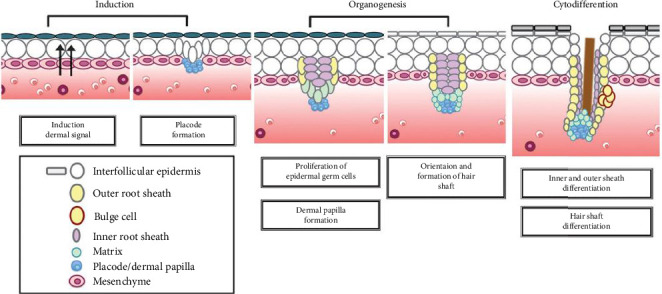
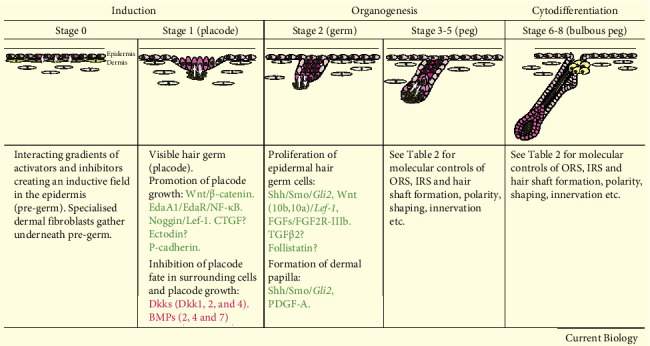
Hair is an intricate biological structure that originates from hair follicles (HFs), which are complex mini-organs embedded in the skin. Each HF undergoes continuous cycles of growth (anagen), regression (catagen), and rest (telogen), driven by intricate signaling pathways and interactions between epithelial and mesodermal cells. The development of HFs requires the interplay of several key signaling pathways, including Wnt, Shh, Notch, and BMP. The Wnt pathway is primarily involved in induction, Shh is essential for early organogenesis and later stages of cytodifferentiation, Notch signaling governs the fate of HF stem cells, and BMP plays a role in cytodifferentiation. Hair health is closely associated with psychological well-being and personal distress. While hair loss (alopecia) does not impact biological health, it significantly affects social well-being. Therefore, a deep understanding of the molecular mechanisms underlying HF development is crucial for developing treatments for hair-related problems and improving hair health. This knowledge has led to significant advancements in therapeutic applications, particularly in treating hair loss disorders, enhancing wound healing, and developing cosmetic treatments. This paper aims to review the molecular mechanisms involved in HF development, with an emphasis on their potential impact on human health and well-being.
Keywords: cytodifferentiation; hair follicle; induction; molecular mechanism; organogenesis.
Copyright © 2024 Mebrie Zemene Kinde et al.
Conflict of interest statement
The authors declare no conflicts of interest.
Figures
References
-
- Randall V. A., Botchkareva N. V. Personal Care and Cosmetic Technology, Cosmetics Applications of Laser and Light-Based Systems . William Andrew Publishing; 2009. Chapter 1—The Biology of Hair Growth; pp. 3–35. - DOI
-
- Hoover E., Alhajj M., Flores J. L., Physiology H. StatPearls . Treasure Island (FL): StatPearls Publishing; 2024. https://www.ncbi.nlm.nih.gov/books/NBK499948/ - PubMed
-
- Dawson J., Murina A. T. Biology of Hair. In: Li B. S., Maibach H. I., editors. Ethnic Skin and Hair and Other Cultural Considerations. Updates in Clinical Dermatology . Cham: Springer; 2021. - DOI
-
- Pelissier-Alicot A. L. In: Perspectives and Challenges of Hair Analysis . Kintz P., Salomone A., Vincenti M., editors. Royal Society of Chemistry; 2023.
Publication types
MeSH terms
Substances
LinkOut - more resources
Full Text Sources
Research Materials
Miscellaneous
