. 2025 Jan;14(3):e2402881.
doi: 10.1002/adhm.202402881. Epub 2024 Dec 4.

Liquid Crystal Elastomer for Compression Therapy

Affiliations

Liquid Crystal Elastomer for Compression Therapy

Gaoweiang Dong et al. Adv Healthc Mater. 2025 Jan.

Abstract

Compression therapy is a widely used treatment for various disorders including venous leg ulcers. Traditional methods such as inelastic bandages and elastic stockings, have limitations in maintaining optimal pressure over time. Dynamic therapy devices offer intermittent pressure cycles but are often bulky or rigid. Here liquid crystal elastomer (LCE) is proposed for both static and dynamic compression therapy. Due to the soft elasticity of polydomain LCE, LCE-based static stocking can maintain consistent pressure over a wide range of leg diameters, permitting the tolerance of stocking application inconsistencies, various limb sizes, and interfacial pressure drop due to leg deswelling. The LCE-based dynamic stocking consists of monodomain LCEs with reversible thermal actuation, heating elements, and electronics. The dynamic stocking generates intermittent pressure from 20 to 60 mmHg with a slight temperature increase above 33 °C and offers pressure profile programmability. Furthermore, an untethered LCE-based dynamic compression device on a human leg is demonstrated. Both LCE-based static and dynamic stockings show minimal stress relaxation and reusability over 1000 cycles, ensuring long-term use in compression therapy applications.

Keywords: compression therapy; dynamic stocking; liquid crystal elastomer; static stocking.


Conflict of interest statement

The authors declare no conflict of interest.

Figures
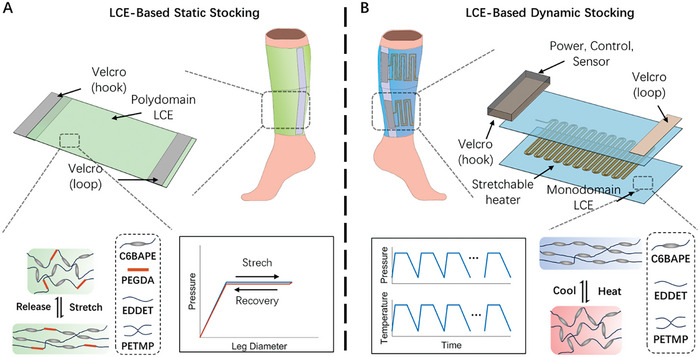
Figure 1
Figure 1
Design concept and working mechanisms of LCE‐based static and dynamic compression stockings. A) An LCE‐based static stocking consists of polydomain LCEs and Velcro strips. The pressure remains nearly constant over a wide range of leg diameters, corresponding to the liquid crystal mesogen rotation in the elastomer, as shown in the molecular schematics. B) An LCE‐based dynamic compression stocking consists of monodomain LCEs, a stretchable heater, a Power, Control, Sensor (PCS) module, and Velcro strips. With periodic voltage input, the LCE‐based dynamic stocking can generate a cyclic, consistent, and controlled pressure profile within the human‐comfort temperature range. The pressure increase is due to the nematic‐isotropic phase transition of the monodomain LCE, as shown in the molecular schematics.
Figure 2
Figure 2
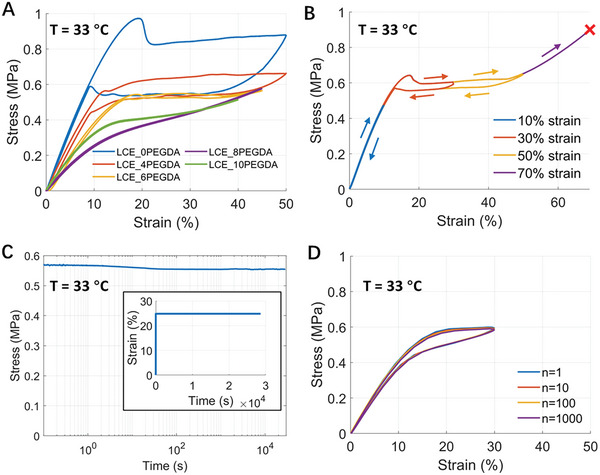
Stress–strain characterization of a polydomain LCE at 33 °C. A) Loading and unloading of a polydomain LCE with various PEGDA content. B) Loading and unloading of LCE_6PEGDA polydomain LCE at various strain values where LCE breaks during the 70% strain loading. C) Stress relaxation of LCE_6PEGDA polydomain LCE under 30% applied strain. D) Durability characterization of LCE_6PEGDA polydomain LCE.
Figure 3
Figure 3
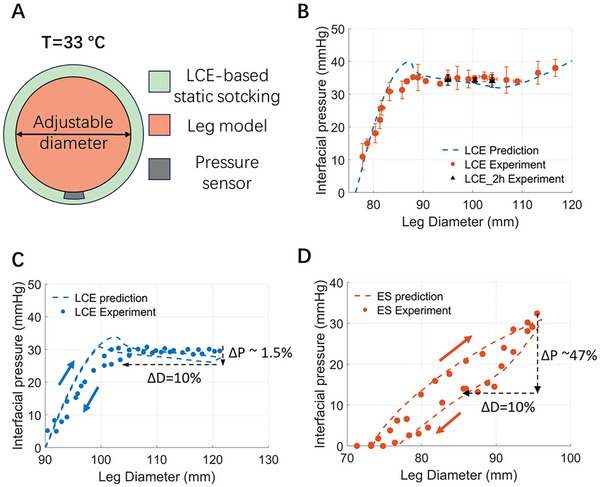
Performance of an LCE‐based static stocking. A) Schematics of the measurement of interfacial pressure generated by the LCE‐based static stocking. B) Prediction and measurement of interfacial pressure over a wide range of leg diameters of LCE‐based static stocking. Prediction and measurement of interfacial pressure drop during the unloading of C) an LCE‐based static stocking and D) a representative commercial elastic stocking.
Figure 4
Figure 4
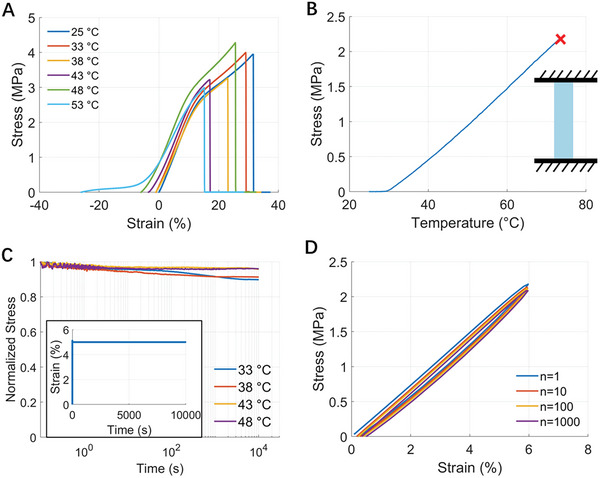
Thermomechanical characterization of a monodomain LCE. A) Stress–strain relationships of monodomain LCEs at various temperatures. The length of a freestanding LCE sample at 25 °C is used as the reference to calculate the strain. B) The thermal actuation stress of a monodomain LCE increases with increasing temperature when the length is fixed at the initial state. C)Stress relaxation of a monodomain LCE with 5% strain under various temperatures. D) Loading and unloading stress–strain curves of a monodomain LCE after different numbers of loading cycles.
Figure 5
Figure 5
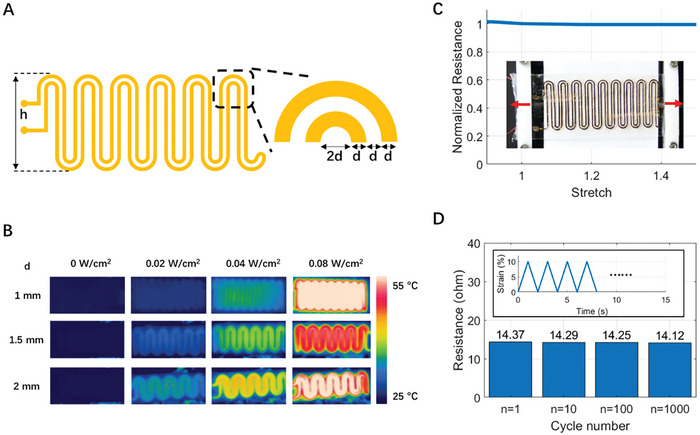
Thermomechanical characterizations of a stretchable heating element. A) Geometry and dimensions of the heating pattern. The number of serpentines is for illustration purposes. B) IR images of the heating pattern with line widths d from 1 mm to 2 mm with different heating power. C) The heating pattern with d  =  1 mm maintains its electrical resistance with a stretch between 0.9 and 1.4. The inserted picture shows the testing setup with a house‐made uniaxial stretcher to precisely control the stretch. D) The change of the electrical resistance of the heater as a function of the cycle number with the pattern width d  =  1 mm.
Figure 6
Figure 6
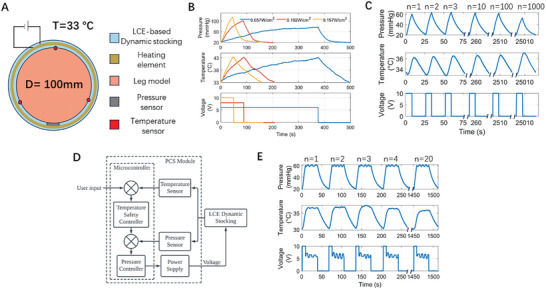
Characterization of the performance of an LCE‐based dynamic stocking. A) Schematics of the experimental setup. B) Characterization of interfacial pressure of LCE‐based dynamic stocking at 43 °C, with various DC power inputs. C) Under cyclic voltage input, the dynamic stocking generates intermittent compression cycles, where the interfacial pressure and temperature are measured as a function of time. The pressure cycles remain consistent for up to 1000 cycles. D) Block diagram of closed loop pressure feedback control for controlling the interfacial pressure profile of the LCE‐based dynamic stocking. E) With pressure feedback control, the interfacial pressure profile of the LCE‐based dynamic stocking can be programmed. The temperature and the applied voltage were measured as a function of time.
Figure 7
Figure 7
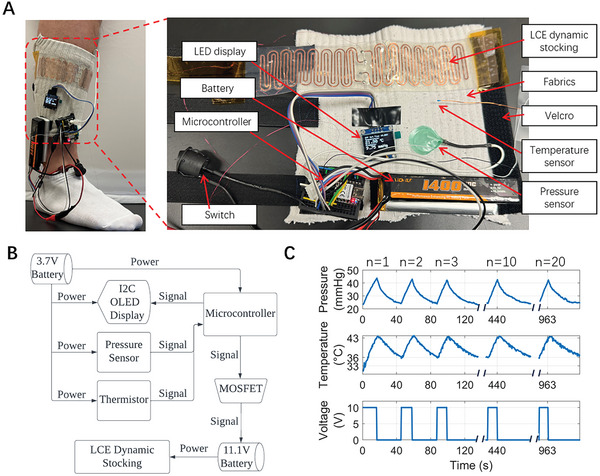
Application of an untethered and wearable LCE‐based dynamic compression device on a human leg. A) Design of the portable LCE compression device and its application on the human leg. The LCE‐based dynamic stocking and the PCS module are attached to a piece of fabric with Velcro straps. B) The working principle and electronic design of the PCS module. C) The performance of the untethered LCE‐based dynamic compression device on a human leg for 20 cycles, exerting interfacial pressure from 23 to 43 mmHg. The maximum working temperature was kept at 43 °C.

Similar articles

Cited by

References

    1. Dissemond J., Assenheimer B., Bültemann A., Gerber V., Gretener S., Kohler‐von Siebenthal E., Koller S., Kröger K., Kurz P., Läuchli S., Münter C., Panfil E.‐M., Probst S., Protz K., Riepe G., Strohal R., Traber J., Partsch H., J. Deutsche Derma. Gesell. 2016, 14, 1072. - PubMed
    1. Berszakiewicz A., Kasperczyk J., Sieroń A., Krasiński Z., Cholewka A., Stanek A., Adv. Dermatol. Allergol. 2021, 38, 389. - PMC - PubMed
    1. Zarchi K., Jemec G. B. E., JAMA Dermatol. 2014, 150, 730. - PubMed
    1. Todd M., Br. J. Nurs. 2011, 20, 681. - PubMed
    1. Webb E., Neeman T., Bowden F. J., Gaida J., Mumford V., Bissett B., N. Engl. J. Med. 2020, 383, 630. - PubMed