Randomized Controlled Trial
. 2024 Dec 5;14(1):30282.
doi: 10.1038/s41598-024-79785-2.

Intensity and volume of physical exercise influence DOMS and skin temperature differently in healthy adults

Affiliations
Randomized Controlled Trial

Intensity and volume of physical exercise influence DOMS and skin temperature differently in healthy adults

Ana Carolina Lamberty de Morais et al. Sci Rep. .

Abstract

It remains unclear whether exercises leading to different outcomes of delayed onset muscle soreness (DOMS) may also elicit different skin temperature responses. The aim of this study was to determine whether different intensities and volumes of a single-joint exercise influence the DOMS and skin temperature measurements differently in healthy adults. Thirty-nine men and women were randomly assigned to three groups performing different exercise of different intensities and volumes (Exhaustion, Fatigue, Submaximal) to induce DOMS in the biceps brachii. DOMS (numeric pain rate scale, NPRS), pressure pain threshold (PPT) and skin temperature (infrared thermography, IRT) were measured on exercise day and 48 h later. The different exercises resulted in lower PPT responses 48 h after exercise and different DOMS reported across the different groups. Skin temperature outcomes did not differ following the different protocols. We found an increased minimum skin temperature 48 h after exercise in groups performing more intense exercises, but such differences were found in both exercised and non-exercised arms. Differently of PPT outcomes, pain reported depended on exercise intensity, and skin temperature 48 h after exercise could not show acute exercise adaptations. Skin temperature responses are contingent upon the characteristics of the participants rather than exercise intensity.

Keywords: Exercise; Fatigue; Muscle damage; Recovery after exercise; Thermography.


Conflict of interest statement

Competing interests: The authors declare no competing interests.

Figures
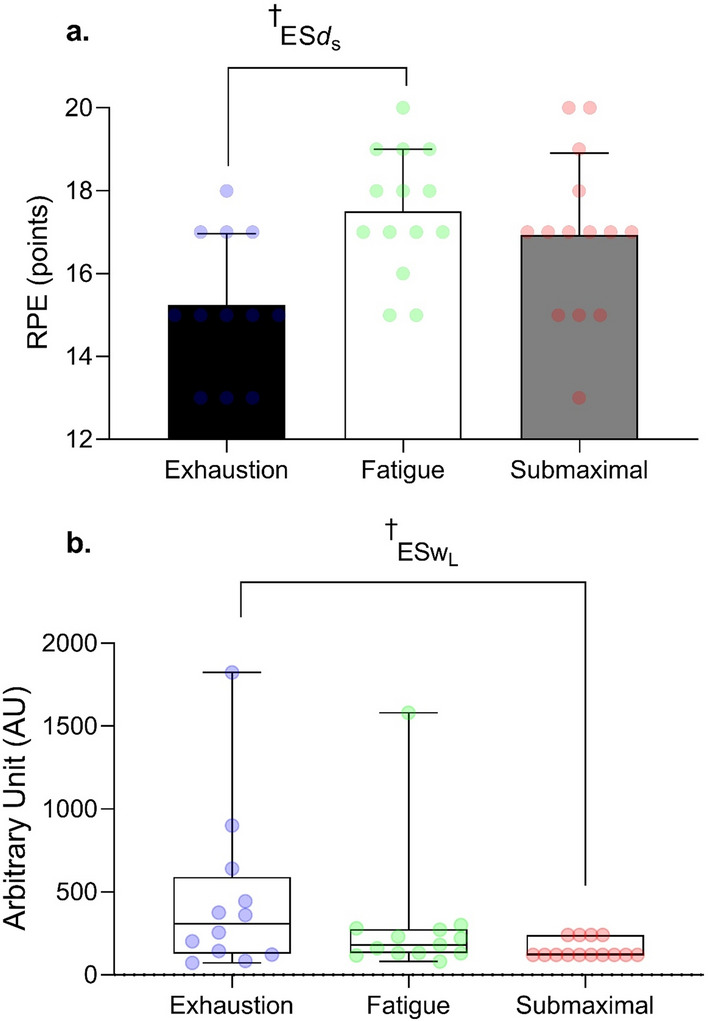
Fig. 1
Fig. 1
Referred exertion and work volume. (a) Mean and standard deviation of rate of perceived exertion (RPE). (b) Median and interquartile range of work volume.Symbols identify differences between groups (p < 0.05), and letters identify the magnitudes of effect sizes (small effect size ESdS or ESWS; moderate effect size ESdM or ESWM; large effect size ESdL or ESWL). Filled circles are the individual values of participants from each group.
Fig. 2
Fig. 2
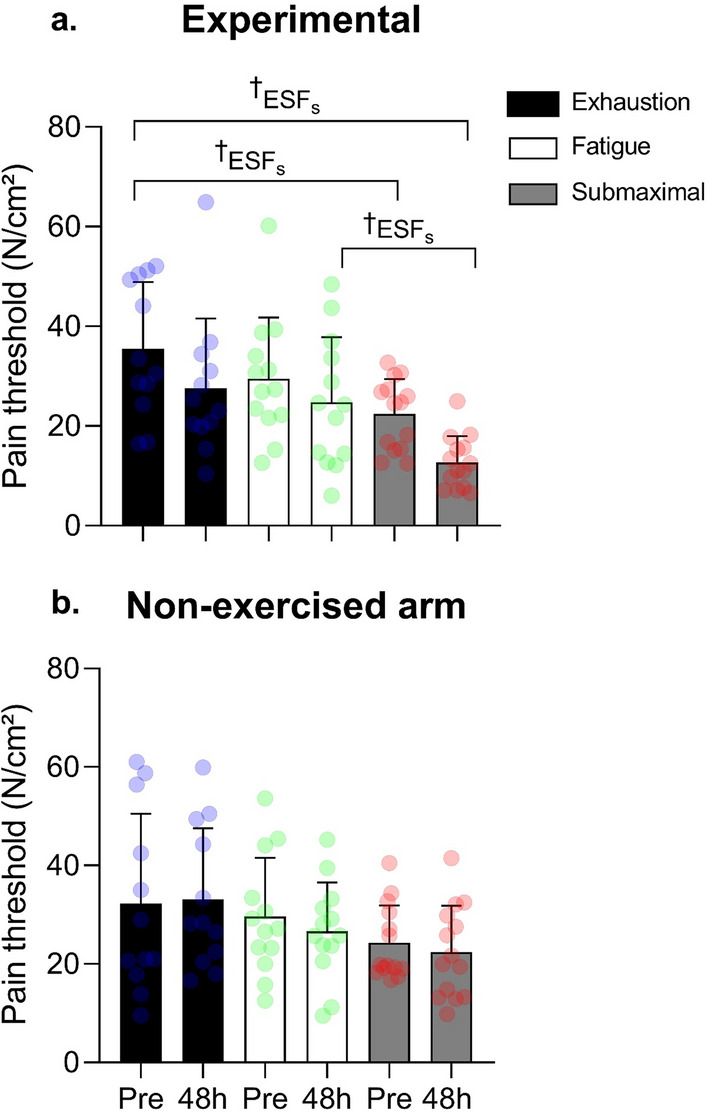
Pain threshold results. (a) Mean and standard deviation of the delta (difference between 48 h after and pre-exercise) variation of pressure pain threshold (PPT) measured in the exercised arm. (b) PPT measures in the non-exercised arm in the three different groups assessed (Exhaustion, Fatigue, Submaximal). Identifies the difference between groups (p < 0.05), and letters identify the magnitudes of effect sizes (small effect size ESFS; moderate effect size ESFM; large effect size ESFL). Filled circles are the individual values of participants from each group.
Fig. 3
Fig. 3
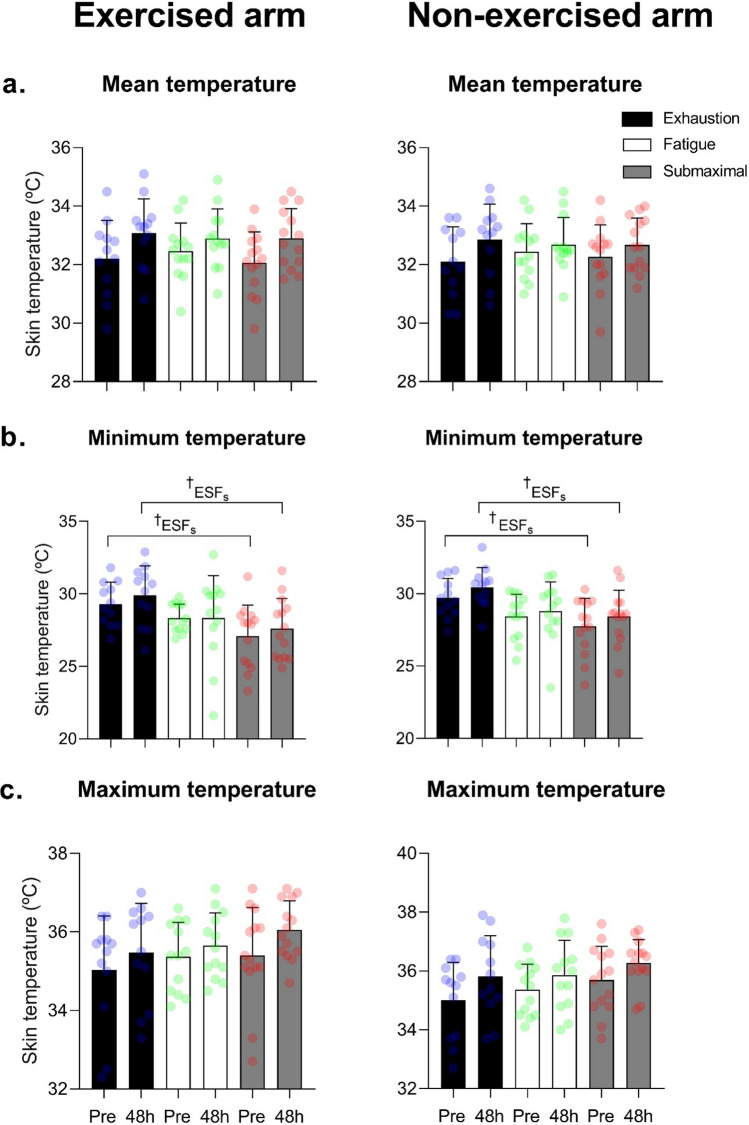
Absolute skin temperature values. Mean and standard deviation of (a) mean, (b) minimum and (c) maximum skin temperature outcomes in the exercised and non-exercised arms for groups Exhaustion, Fatigue, and Submaximal. Identify the difference between groups at a moment (p < 0.05), and letters identify the magnitudes of effect sizes (small effect size ESFS; moderate effect size ESFM; large effect size ESFL). Filled circles are the individual values of participants from each group.
Fig. 4
Fig. 4
Variation in skin temperature. Delta of the skin temperature (ΔT, difference between 48 h post-exercise and pre-exercise) in the exercised arms for groups Exhaustion, Fatigue, and Submaximal and for control arm (Cont) and experimental arm (Expe). Delta was determined for (a) mean, (b) minimum, and (c) maximum temperature. Filled circles are the individual values of participants from each group.
Fig. 5
Fig. 5
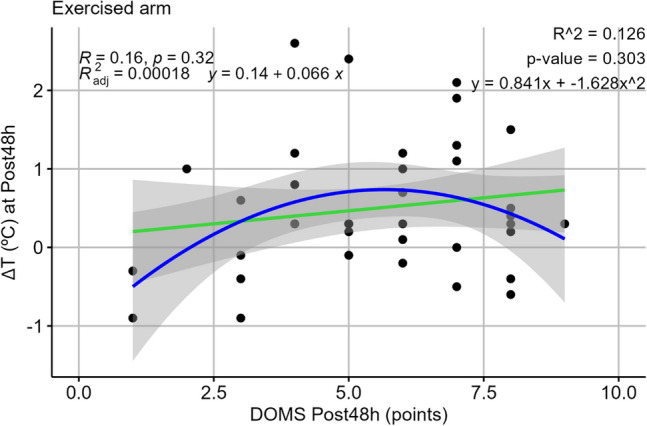
Relationship between skin temperature and DOMS. Relationship between skin temperature variation (ΔT) at 48 h post-exercise and DOMS in the exercise arm Post48h, using linear regression (green line, results showed in the upper left side of the graphic) and quadratic regression (blue line, results showed in the upper right side of the graphic).
Fig. 6
Fig. 6
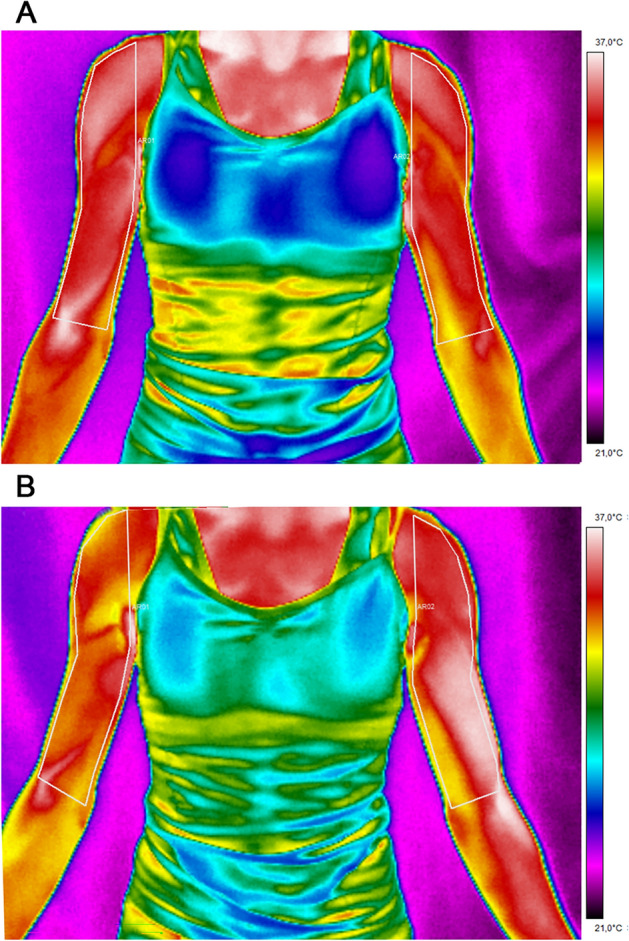
Example of two thermograms. Representation of the two regions of interest (ROIs) considered for the skin temperature data extraction. The image presents the exercised arm (left arm) and non-exercise arm (right arm), and it is representative of all participants. A. Represents pre-exercise, B. represents post-exercise.

References

    1. Aoi, W. et al. Oxidative stress and delayed-onset muscle damage after exercise. Free Radic. Biol. Med.37, 480–487 (2004). - PubMed
    1. Mizumura, K. & Taguchi, T. Delayed onset muscle soreness: Involvement of neurotrophic factors. J. Physiol. Sci.66, 43–52 (2016). - PMC - PubMed
    1. Cheung, K., Hume, P. A. & Maxwell, L. Delayed onset muscle soreness: Treatment strategies and performance factors. Sports Med.33, 145–164 (2003). - PubMed
    1. Fernandes, T. L., Pedrinelli, A. & Hernandez, A. J. Muscle injury: Physiopathology, diagnosis, treatment and clinical presentation. Rev. Bras. Ortop. Engl. Ed.46, 247–255 (2011). - PMC - PubMed
    1. Stewart, I. B. et al. Thermal infrared imaging can differentiate skin temperature changes associated with intense single leg exercise, but not with delayed onset of muscle soreness. J. Sports Sci. Med.19, 469–477 (2020). - PMC - PubMed

Publication types