


High vector competence for chikungunya virus but heavily reduced locomotor activity of Aedes albopictus from Germany at low temperatures
- PMID: 39633401
- PMCID: PMC11619113
- DOI: 10.1186/s13071-024-06594-x
High vector competence for chikungunya virus but heavily reduced locomotor activity of Aedes albopictus from Germany at low temperatures
Abstract
Background: The incidence of human infections caused by arthropod-borne viruses, such as the chikungunya virus (CHIKV), has increased globally due to a number of factors, such as climate change and globalization. The exotic mosquito species Aedes albopictus is a significant vector for CHIKV, raising concerns about its transmission potential in temperate regions, including Central Europe. We have therefore investigated the vector competence of Ae. albopictus for CHIKV at constant and fluctuating temperatures between 15 °C and 24 °C to assess the transmission risk in Europe.
Methods: Aedes albopictus mosquitoes were reared and artificially infected with CHIKV. Infection rates and transmission efficiencies (TEs) were determined after 14 days of incubation at constant and fluctuating (± 5 °C) mean temperatures of 15 °C, 18 °C, 21 °C and 24 °C. In addition, mosquito locomotor activity was measured under the same fluctuating temperature conditions. A risk map for CHIKV transmission in Europe was generated combining temperature data and the current distribution of Ae. albopictus.
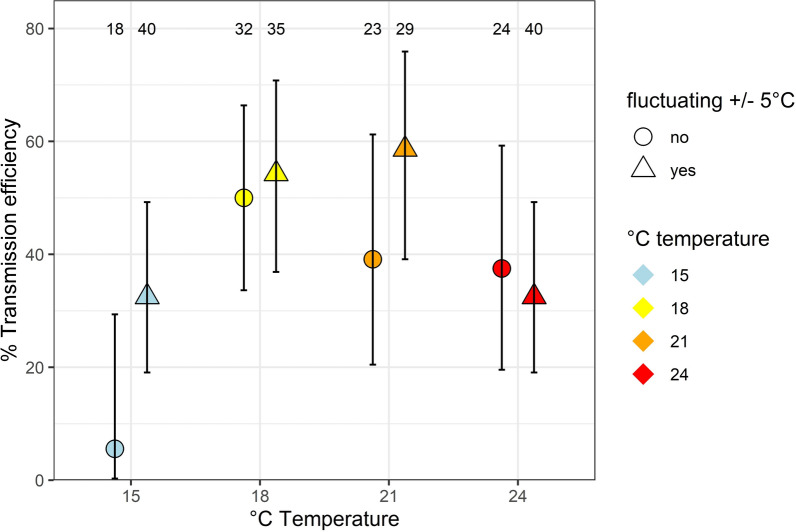
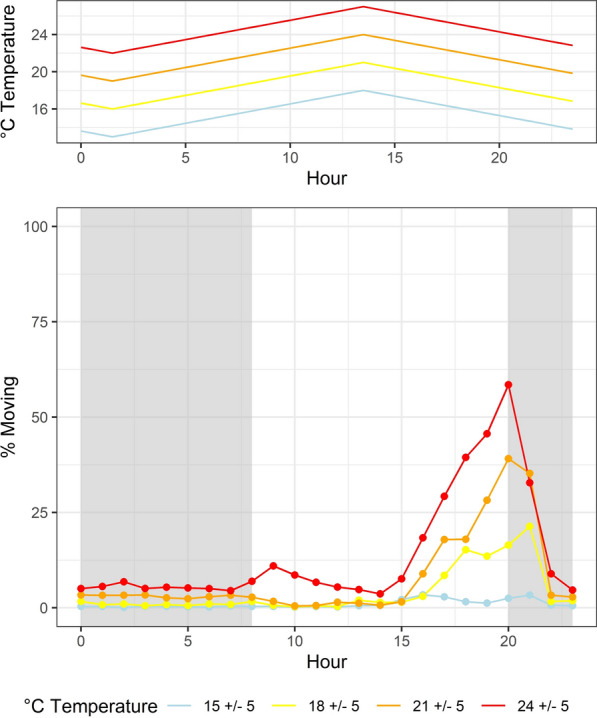
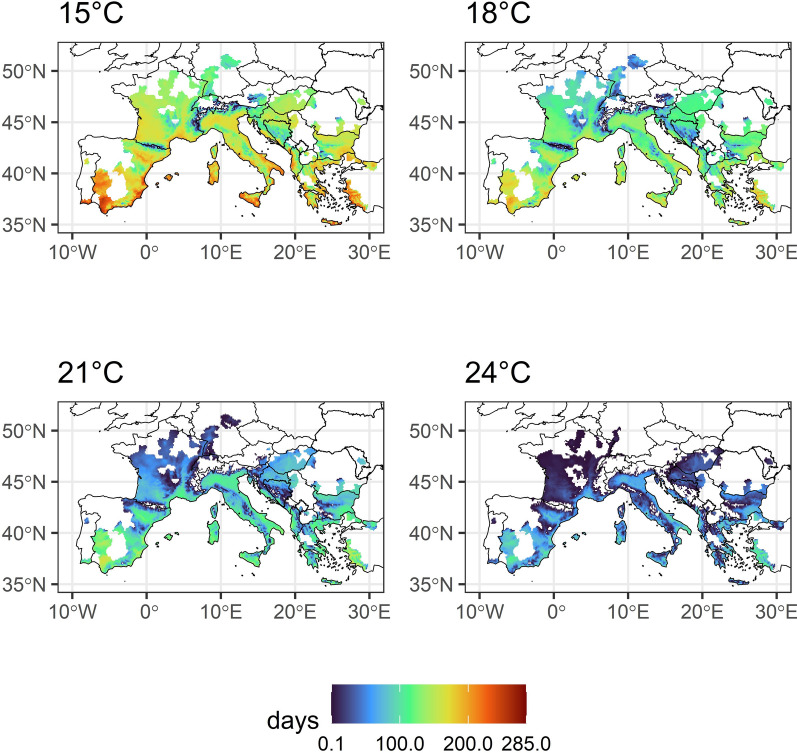
Results: CHIKV transmission was observed at all tested temperatures. The highest TEs were recorded at fluctuating temperatures of 18 °C (54.3%) and 21 °C (58.6%), while the lowest TE was observed at a constant temperature of 15 °C (5.6%). TEs at fluctuating temperatures of 15 °C and 24 °C were the same (32.5%). Mosquito activity showed a nocturnal unimodal activity pattern with a peak during the start of the scotophase (hour 20). The proportion of active mosquitoes per hour increased with temperature and was nearly zero at 15 °C. The risk map indicated that regions in Southern and Central Europe, including recently invaded areas north of the Alps, have temperatures theoretically allowing CHIKV transmission for at least some days per year.
Conclusions: While CHIKV can be transmitted by Ae. albopictus at 15 °C, the activity of this mosquito is strongly decreased at this temperature, likely reducing the transmission risk. These findings emphasize the importance of considering both vector competence and mosquito activity when assessing the risk of arbovirus transmission in temperate regions. Further studies are needed to validate these laboratory findings under field conditions.
Keywords: Aedes albopictus; Chikungunya virus; Locomotor activity; Low temperature; Vector capacity; Vector competence.
© 2024. The Author(s).
Conflict of interest statement
Declarations. Ethics approval and consent to participate: Not applicable. Consent for publication: Not applicable. Competing interests: Norbert Becker is an Associate Editor for Parasites & Vectors and was not involved in the peer review of this paper. The authors declare that they have no other competing interests.
Figures
References
-
- WHO. Geographical expansion of cases of dengue and chikungunya beyond the historical areas of transmission in the Region of the Americas. https://www.who.int/emergencies/disease-outbreak-news/item/2023-DON448. Accessed 7 Jun 2024.
MeSH terms
Supplementary concepts
LinkOut - more resources
Full Text Sources
Medical
